The Tree of Jesse is another Romanesque-Gothic motif worth examining for evidence for the eastern influence that I have suggested was largely brought by Sayabiga settlers -- a segment of which may have become or fused with the people known as
Agotes.
In 1929, Ananda K. Coomaraswamy had suggested that the theme of the reclining, sleeping Visnu giving birth to the creator god Brahma through a lotus sprouting from his navel, a form of Visnu also known as Padmanabha or Anantasayana, was the probable source of the Tree of Jesse motif. I would add that not only was the Padmanabha a source but also the Tree of Life theme from Southeast Asia, and the related motifs found on totem poles and textiles from the same region.
 Visnu reclining and sleeping on a bed of serpents (Anantasesa) in the Milky Ocean gives rise to the creator deity Brahma via a lotus that sprouts from his navel. The relief above is from Ellora Cave 15 and dates to the late 8th century. (Source: elloracaves.org)
 The oldest complete Tree of Jesse depiction from the Chartres Cathedral in France dating to 1145. Based on Isaiah's prophecy: "there shall come forth a rod out of the stem of Jesse, and a branch shall grow out of his roots" (Isaiah 11:1), the window shows Jesse at the bottom with the tree rising out of his "navel." (Source: Sacred Destinations)
 The full Tree of Jesse from Chartres showing the lineage of Jesus from Jesse. (Source: Tree of Jesse, Wikipedia)
 Padmanabha image from Hampi, India. (Source: http://www.travelpod.com/travel-photo/lraleigh/youarehere./1175963580/img_2579.jpg/tpod.html)
The prototype of the Visnu-Padmanabha motif is found in the Atharvaveda, generally dated to at least the 6th century BCE, which mentions a Great Yaksa, or tree spirit, that sleeps on the cosmic ocean. Periodically, a lotus springs from the Yaksa's navel giving birth to the creator Prajapati. When the worship of Visnu began to come to the fore, that deity took the place of the Yaksa in Vaisnava lore.
Visnu-Padmanabha in more or less full form first appears at the 6th century CE Deogarh Temple in central India although in this case the lotus emerges from in back of Visnu from the ocean rather than from his navel. The example above from Ellora is an early example of the motif with the lotus and Brahma arising from Visnu's navel. In many cases, the Tree of Jesse springs from in back of the patriarch rather than from his navel, probably for reasons of artistic preference since the tree trunk must taper to a very small diameter when coming from the navel, and looks like it is coming from the belly when the trunk is depicted in a more realistic proportion.
In some cases, the Tree of Jesse is also shown specifically coming from the navel as in the early13th century Bavarian ivory panel shown below.
 Source: http://en.wikipedia.org/wiki/File:Tree_of_Jesse_Louvre_OA10428.jpg
An example of the Visnu-Padmanabha theme that overlaps with the Romanesque period is the giant bronze statue from Angkor in Cambodia dated to the 11th century. The surviving fragment of this statue is eight feet long and according to some estimates the entire artifact would exceed 20 feet in length making it the largest bronze statue of the ancient or medieval period still extant, if only partially so.
While the motif of humans or deities arising from vegetation that springs from the navel of a sleeping, reclining male progenitor seems certainly to come from an Indic source, the specific "family tree" motif seems to have Southeast Asian connections.
Firstly, the form of the "tree" is not the classic "family tree" of modern genealogies. The tree has a vertical orientation similar to pedigree poles and pedigree lineages displayed in Southeast Asian textiles. In the case of the Tree of Jesse, the older ancestors are at the bottom starting with Jesse and the lineage is shown in order as one goes higher all the way up to Mary, the mother of Jesus, who appears just below her son.
In a similar sense, the totemic pedigree pole generally shows ancestors in order in a vertical fashion. And in Southeast textiles, ancestor figures, either anthropomorphic or symbolic, are often shown connected, interlocked or overlapping in a vertical fashion based on order of descent.
 Maori totem pole, Mt. Victoria, New Zealand (Source: http://picasaweb.google.com/lh/photo/dNAo2GzCDCTMiixEzAVvOA)
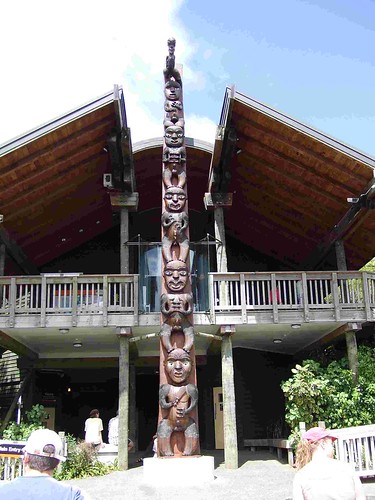 Maori totem pole (Source: http://www.flickr.com/photos/robdickson/370674999/)
 Totem pole from Borneo (Source: http://www.taicollection.com/files/index.htm)
 Ikat hinggi from Sumba, Indonesia. (Source: http://www.trocadero.com/stores/cranegallery/items/946080/item946080.html)
 Mandaya ikat from Mindanao, Philippines with anthropomorphic figures. (Source: http://www.trocadero.com/bundok48/items/930832/en1.html)
 Moai or stone statues from Easter Island are found in ceremonial plots known as ahu, which is also the name of the descent group associated with each group of moai. The statues, the earliest dating back to about 1000-1100 CE, are believed to be those of prominent ancestors and they face towards the lineage's community. The arrangement in neat rows could possibly show order of descent as in the totem pole, although for practical reasons the moai could not be arranged vertically. (Source: http://www.world-mysteries.com/easter_island.htm)
If one looks closely at the Tree of Jesse images above (click on source links for full size options) from Chartres Cathedral, the figures are not clearly seated (although they could be leaning on the tree trunk) and have their arms outstretched holding the branches of the tree. One could interpret this as a variation of the
squatting figure motif mentioned in the post "
More on "Tantric" influence on Romanesque art," with the hands raised up. As mentioned in that article, the squatting figure motif often has
ancestral significations. A similar type of positioning is seen at York Minster dating to 1150, and from Canterbury Cathedral from the late 12th to early 13th century, although in the latter case the figures are seated on throne-like chairs.
Tree of Life motif in Southeast Asian pedigree representations
The burial poles of indigenous peoples of Borneo like the Iban and Kenyah and known by names like
pantar and
sanggaran are decorated with mythical motifs like the hornbill, the serpent or dragon, spears, swords, and jars. In the local belief system, these burial poles are seen as symbols of the Tree of Life.
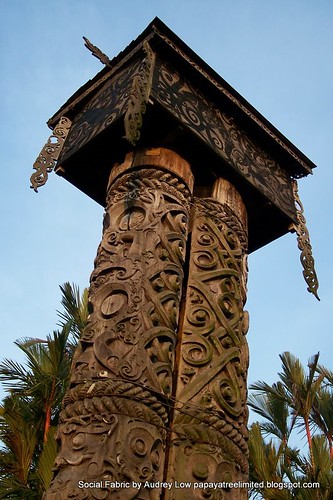 Totem burial pole at the Sarawak Museum. These poles are seen as representing the Tree of Life. (Source: http://www.flickr.com/photos/32734523@N08/3060638554)
The vegetative motifs and the birds and serpents often displayed on Maori totem poles indicate that a similar belief system may have also operated at one time with these memorial carvings.
In a similar system, representations of ancestors and totems on Southeast Asian textiles are often shown together with representations of the Tree of Life.
 A ba baby carrier from Borneo showing a squatting guardian figure clutching a stylized Tree of Life. (Source: http://www.lelong.com.my/Auc/List/2010-04DeStd58768938_AUCTION_-Traditional-BABY-CARRIER-beads-craft-art-antiques-Dayak.htm)
Tree of Life in Southeast Asia and Oceania
A ba baby carrier from Borneo showing a squatting guardian figure clutching a stylized Tree of Life. (Source: http://www.lelong.com.my/Auc/List/2010-04DeStd58768938_AUCTION_-Traditional-BABY-CARRIER-beads-craft-art-antiques-Dayak.htm)
Tree of Life in Southeast Asia and Oceania
Waruno Mahdi and Stephen Oppenheimer have studied the importance of the Tree of Life theme in the regions of Southeast Asia and Oceania. Mahdi compared beliefs in this region to those in South Asia, while Oppenheimer studied the Tree of Life myths worldwide.
According to Mahdi, the Tree of Life in Southeast Asia, Oceania and South Asia was predominantly associated with Ficus species due to the characteristic of having
aerial roots.
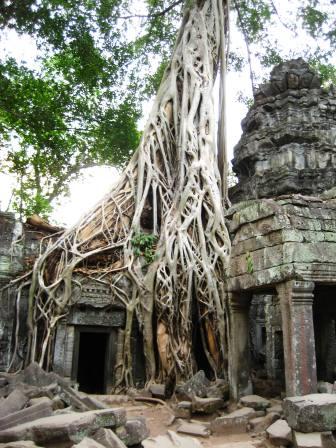 Aerial roots at Ta Promh, Cambodia (Source: http://www.myseveralworlds.com/2007/11/09/the-banyans-of-ta-prohm/)
 Aerial roots (Source: http://outdoors.webshots.com/photo/1131080103044331310ksDLmg)
Aerial roots extending from the branches to the ground were seen as representing the connection between sky and earth, between the upper and lower worlds in many Austronesian cultures and also in other regional mythologies. The important of the aerial roots relates not only to the mythology, ritual and folklore, but also apparently to shamanic practices, for example, the Tree of Life motif appears on textiles used in regional shamanic ritual.
However, it was not simply symbols of the Tree of Life that were used. More commonly actual Banyan or Benjamin type trees were placed on temples or ceremonial platforms, or such structures to include meetings houses were located adjacent to particularly significant trees. Also, ritual ceremony and dance grounds were often marked off by perimeters that corresponded to the shadow cast by a great Ficus with aerial branches. In some cases, the ritual center was carved out of the tree itself.
 The Hindu-Buddhist Kalpataru Tree at the Borobudur stupa in Java. Geese and possibly half-geese kinnaras-kinnaris are shown under the tree. (Source: http://viewmorepics.myspace.com/index.cfm?fuseaction=viewImage&friendID=225953707&albumID=495816&imageID=3808997)
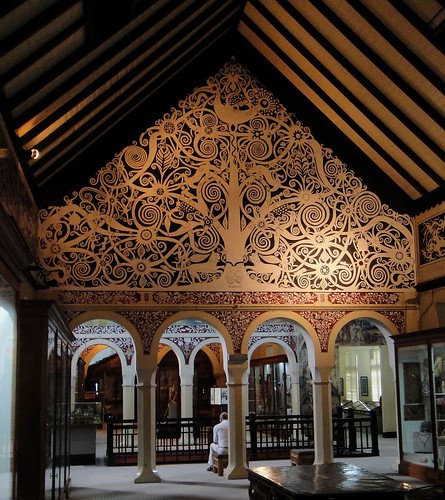 Stylized Orang Ulu Tree of Life from Sarawak with aerial roots spiraling to ground. (Source: http://www.flickr.com/photos/87453322@N00/3877832454/)
 Tree of Life at the Wat Xieng Thong Temple built in 1560, Luang Prabang, Laos. (Source: Luang Prabang)
Some Romanesque trumeaus and the Tree of Life
Tree of Life at the Wat Xieng Thong Temple built in 1560, Luang Prabang, Laos. (Source: Luang Prabang)
Some Romanesque trumeaus and the Tree of Life
Both Mahdi and Oppenheimer note in their studies the close linkage between the Tree of Life and the bird and serpent/dragon motif. The bird and serpent can be seen as types of opposites that represent both conflict and also the creative aspect of union. The Tree of Life itself covers many aspects of duality including the opposition of sky and earth, male and female, and death and resurrection, along with related themes involving warring brothers, jealousy, greed, and fertility.
The trumeau, or tympanum column, below is from Sainte-Marie, Souillac, France dating to 1120-35.
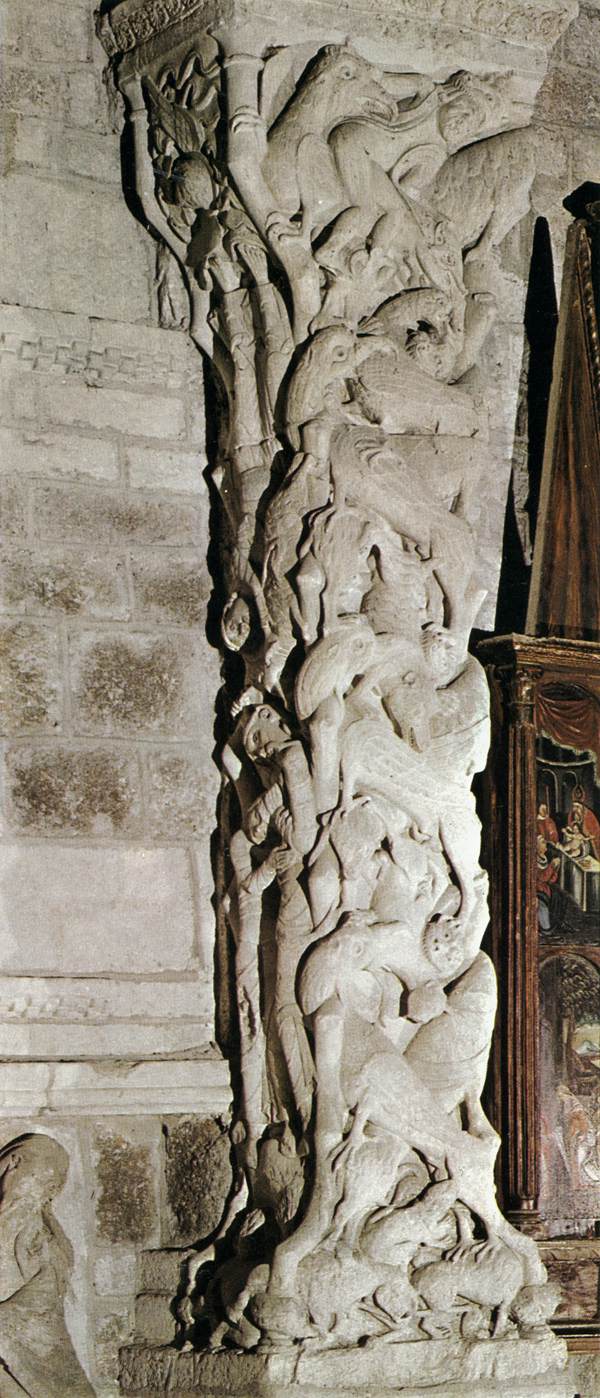 Source: http://www.wga.hu/html/zgothic/1romanes/po-12c11/12f_1100.html
For the full size image of the trumeau,
click here.
You can see that from three corners of the capital there appear to be what could be interpreted as
aerial roots curving down all the way to the base of the trumeau. The claws of the topmost bird figure can be seen clutching one of these roots or branches.
While the scenes involving various creatures gnawing at each other have been interpreted as "hellish," there are obvious Biblical references included on the column such as the Sacrifice of Isaac.
The Sacrifice of Isaac might be appropriate here for it is viewed a symbol of the death and resurrection of Christ, which in turn is a model of the dying and rising tree i.e., the Tree of Life. The gnawing beasts -- griffins, dragons, reptiles, lions -- might represent the conflict associated with the journey from birth to death. Scenes of violence, hunting, biting, etc. are also often also displayed in Southeast Asian depictions of the Tree of Life.
In trumeaus from Moissac that are believed related to the Souillac one, the bodies of human figures (St. Paul and Prophet Jeremiah) are shown elongated with especially the legs looking like the aerial roots or branches as shown in the Souillac trumeau.
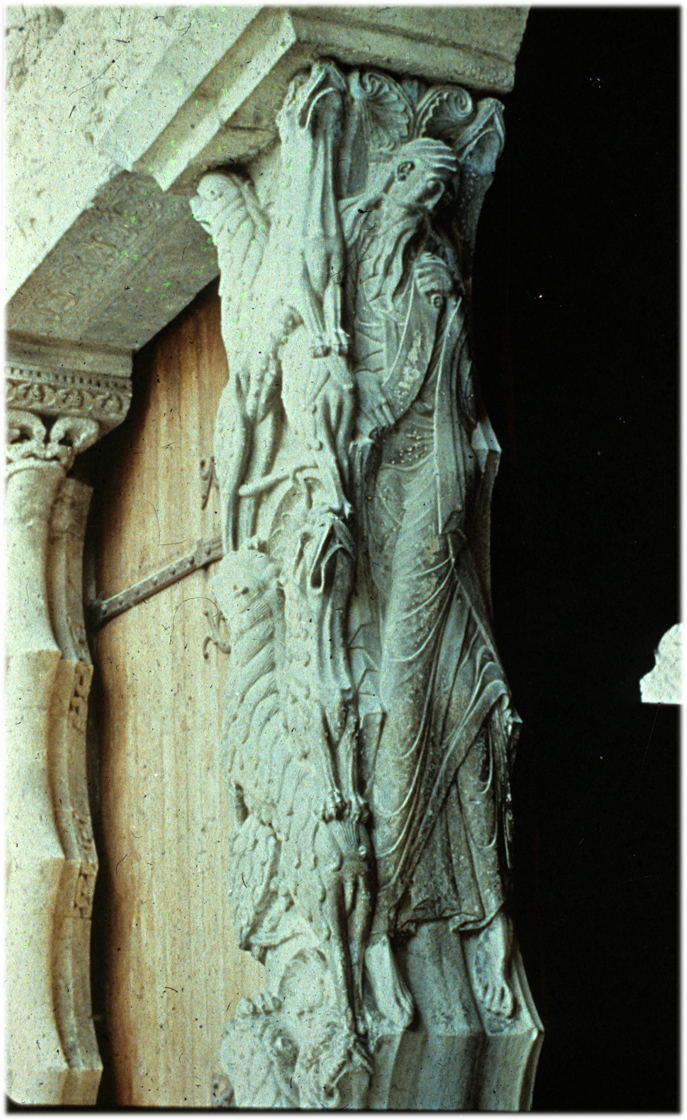 Note the long, root-like legs. Source: http://employees.oneonta.edu/farberas/arth/Images/arth212images/Romanesque/Moissac/trumeau.jpg
 Source: http://employees.oneonta.edu/farberas/arth/Images/ARTH212images/Romanesque/Moissac/trumeau_paul.jpg
One can also view the scrolling branches and the scrolls held by the prophets to side of each ancestor in the Chartres Jesse Tree above as representing aerial roots. The scrolls held by the prophets flanking Jesse seem to fall down from above their heads and reach all the way to the ground.
Tightly-interlocked animals and humans on the Souillac and Moissac trumeaus might also be seen as similar to a mass of intertwined aerial roots. The practice of closely interlocking or compressing animals in totemic designs can be found in both Southeast Asia and the Pacific as seen in some of the examples below.
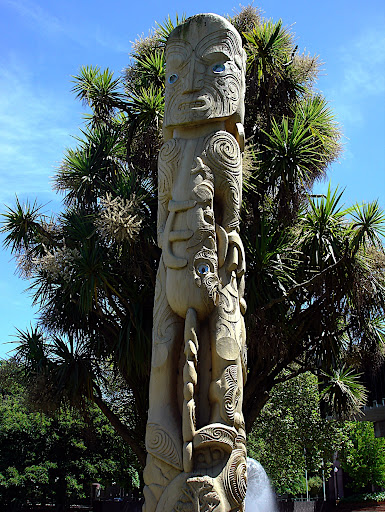 Maori totem pole with highly stylized representations of birds (beaks) and other creatures. (Source: http://picasaweb.google.com/lh/photo/wQbwaprEGJRy7xRciJK0Gw)
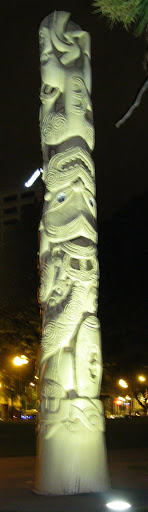 Maori totem pole (Source: http://picasaweb.google.com/lh/photo/xzN3UmPwlz4vCFNG350lAQ)
From Oppenheimer, illustration 32, depicting spirit brothers Lawena and Dawena with one of the cockatoos holding a severed head in its beak, from incised bamboo, Kambot, Papua New Guinea.
From Oppenheimer, illustration 16, Wain and followers showing images tightly compressed in space with many of the creatures biting at the genital areas of others, from incised bamboo, Kambot, Papua New Guinea.
Maori totem pole (Source: http://picasaweb.google.com/lh/photo/xzN3UmPwlz4vCFNG350lAQ)
From Oppenheimer, illustration 32, depicting spirit brothers Lawena and Dawena with one of the cockatoos holding a severed head in its beak, from incised bamboo, Kambot, Papua New Guinea.
From Oppenheimer, illustration 16, Wain and followers showing images tightly compressed in space with many of the creatures biting at the genital areas of others, from incised bamboo, Kambot, Papua New Guinea.
![[14jul'09,totem+poles.jpg]](https://blogger.googleusercontent.com/img/b/R29vZ2xl/AVvXsEipSR4zzo2w0eCwaAxbTd7KK8JaciH_sXb-z5_L0q9G4Hh0eBgu_3PbSwYm77YPRBj6Wy-kcWEO0M7CjzDaHOkVn8uO1fCJ0TThoCXnxxYTBsHxfMF8bigUoNSgb_UdPD65bex9Xw/s640/14jul'09,totem%2Bpoles.jpg) Totem pole from Borneo with stylized hornbill and other creatures. (Source: http://mykambatikworld.blogspot.com/2009/07/blog-post.html)
Totem pole from Borneo with stylized hornbill and other creatures. (Source: http://mykambatikworld.blogspot.com/2009/07/blog-post.html)
 A modern Maori totem pole designed for tourists. Here the stylized animals are transformed in to realistic Western-style representations. (Source: http://www.fly-to-neverland.com/nz/nz7.html)
Sets of motifs
A modern Maori totem pole designed for tourists. Here the stylized animals are transformed in to realistic Western-style representations. (Source: http://www.fly-to-neverland.com/nz/nz7.html)
Sets of motifs
The suggested cognates in motifs between the Visnu-Padmanabha theme from India and the Tree of Jesse are:
- Male ancestor or primordial deity is shown reclining with vegetation rising out of navel.
- The said figure is usually shown as sleeping with eyes closed.
- The head is often resting on or propped up by hand.
- The said figure is usually reclining on right side with head on right hand.
- The vegetation can sprout either out of the navel or from the rear of the said figure, in the case of the Tree of Jesse sometimes from his side.
- Humans or deities are sitting, standing or squatting on the vegetation rising out of the navel.
 Tree of Jesse (Capuchin's Bible, c. 1180) showing the patriarch reclining on his right side with eyes closed and head resting on right hand, compare with images of Visnu above. (Source: http://en.wikipedia.org/wiki/File:JesseTree.JPG)
 Tree of Jesse (Scherenberg Psalter, c.1260), with head propped on right hand and eyes closed. (Source: http://en.wikipedia.org/wiki/File:Cod_St_Peter_perg_139_Scherenberg-Psalter_7v_.jpg)
The Southeast Asian Tree of Life motifs found in common with the Tree of Jesse motif are:
- Vertical arrangement of ancestors in order of descent.
- Ancestors are placed in or around tree.
- Ancestors may be framed in branches/aerial roots of tree, and may be grasping these branches/aerial roots.
- Ancestors may be shown in variation of squatting figure motif -- front-facing with arms outstretched to the side and hands raised.
- The ancestor figures are often connected -- by the trunk of the tree, a root/vine, a line, etc.
- The Souillac and Moissac trumeaus appear to have representations or stylized representations of aerial roots and the depiction of animals on the columns is similar to that seen on totem poles and other indigenous art in Southeast Asia and the Pacific.
Dating of the motifs in Southeast Asia and the Pacific can be difficult. For example, squatting figures may be found arranged in either vertical or horizontal lines, and may be connected together, but we cannot say for sure that this represents an ancestral lineage.
Also, in modern times, something as simple as a triangle can represent the Tree of Life to one set of textile weavers, the Cosmic Mountain to another, and both motifs to yet another group of weavers. However, we do not know for sure that such simple symbols had the same meaning long ago.
However, the combination of South Asian and Southeast Asian motifs fits in nicely with the idea of Sayabiga transmission during the Romanesque period. The kingdom of Zabag (Sabag) was highly influenced by
Tantric Buddhism and other cultural streams from India, and of course, they would have been very familiar with Southeast Asian symbolism.
Regards,
Paul Kekai Manansala
Sacramento
References
Coomaraswamy, Ananda K. "The Tree of Jesse and Indian Parallels or Sources,"
The Art Bulletin, Vol. 11, No. 2 (Jun., 1929), pp. 216-220.
Mahdi, Waruno. "Linguisitc and philogical data towards a chronology of Austronesian activity in India and Sri Lanka," IN:
Roger Blench, Matthew Spriggs.
Archaeology and Language IV: Language Change and Cultural Transformation, Routledge (UK), 1999.
Stephen Oppenheimer.
Eden in the East: The Drowned Continent of Southeast Asia,
Phoenix, 1999.