Showing posts with label lapita culture. Show all posts

Friday, August 06, 2010

Lapita, Taotie and other Face/Head Motifs (Part 3 of 3)

Another strong evidence of the relationship between the Indian and European face motifs is the existence in Romanesque art of a feline face disgorging (or gorging) strings of beads from the corners of its mouth.  Similar motifs are found in India and Tibet with the apparent earliest example located at the Ajanta Caves dating to the 5th century.


Feline masks with strings of beads streaming from the corners of their mouth at Iffley Church in Oxford, England, 12th-13th century. (Source:  http://www.bejo.co.uk/greenmantrail/html/missing.html)


A Gupta era Kirtimukha with festoons of pearls disgorged from the corners of the mouth. Notice the double spiral "horns." (Source: Huntington Archive)


Traditional Tibetan bell (Source: Encyclopedia of Tibetan Symbols and Motifs) and


A more elongated type of head disgorging various items from the upper part of the mouth with no lower jaw visible, Lincoln Cathedral, Norman period. Click on image for larger view. (Source: Wikipedia http://en.wikipedia.org/wiki/File:Lincoln_cathedral_03_West_portal.jpg)


More on the meaning of the face motifs

Face motifs continue to be used to this day in the Austronesian-speaking regions in tattoos, textiles and other art forms.  In the Marquesas, the mata hoata "face" and ipu "eye" motifs can be used to denote the etua, the deities and deified ancestors to include the pantheistic Fractal Being.

The Kala form of the face motif in Southeast Asia gives this design a connection with the deity of cosmic time.  In the Philippines, the pantheistic volcano gods are seen in some cultures as lords of, or personifications of time.  In medieval Tibet, the Kalacakra Deity was both lord of time and also a form of the pantheistic Adibuddha or "First Buddha."

In the Philippines, one of the closest matches to the face motifs under discussion are the decorations found on  boat prows, blade hilts, musical instruments, and other items known variously by names such as Bakunawa, Buaya, and Naga.   The Bakunawa motif is connected with a deity among certain peoples of Panay who in the past chose auspicious times for events based on the direction that the Bakunawa was said to be facing.  Almanacs were made that gave the direction of the Bakunawa's face for any time of the year, and these calendars also served a geomantic purpose in orienting the direction of the entrance of a home under construction.

The Bakunawa was thus related to aspects of astronomical time, although I have not seen information connecting this deity with any constellations or stars.  Viewed as a great winged dragon-like creature with a red tongue, the Bakunawa was also said to swallow the Moon during eclipses.  In this sense, the serpent may have been related to the Indian deity Rahu, who was also envisioned as a disembodied head that devoured the Sun or Moon during an eclipse.
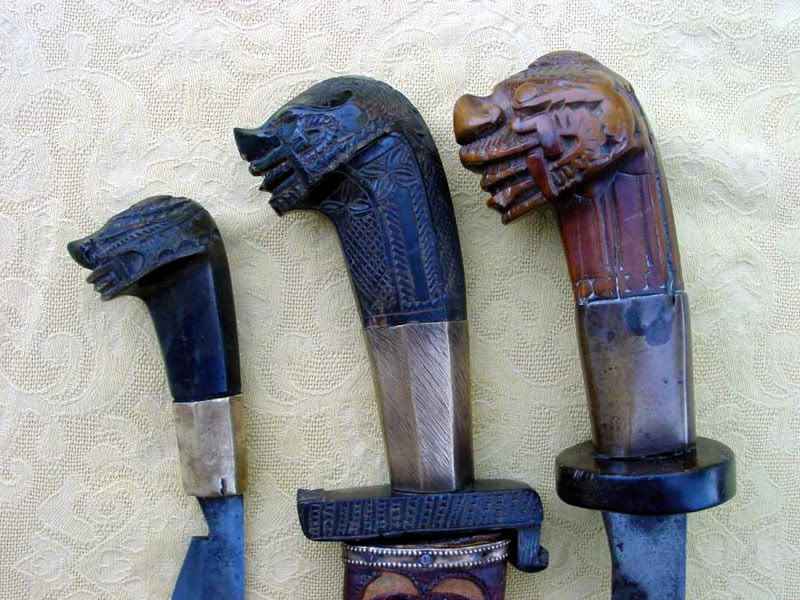

http://img.photobucket.com/albums/v51/zelbone/Philippine%20Edged%20Weapons%20Forum/3Visayanhilts.jpg

Bakunawa blade hilts (Source: http://img.photobucket.com/albums/v51/zelbone/Philippine%20Edged%20Weapons%20Forum/3Visayanhilts.jpg)


http://woodside.blogs.com/.a/6a00d8341f9d6353ef0133f20750be970b-800wi
The hilt on this blade from Panay is more like the buaya or makara motif (crocodile-like). (Source: http://www.filhistory.com/2010/07/sundang-itak-bolo-pinuti-talibong-tenegre-pinote-philippiine-weapon-filipino-sword-sandata-1-1.html)


The idea of the Bakunawa devouring the Sun or Moon may connect with the earlier red-slipped, Lapita and Taotie face motifs.  In the tumpal face design, the "eyes" can also represent the Sun as discussed above but additionally they can represent the Moon also.  In an earlier post, I suggested that the crescent shape, and also the half circle shape found in some red-slipped and other early tumpal patterns could represent the "Crescent Sun."   The latter astronomical term refers to a Sun nearly fully eclipsed but with the non-eclipsed part forming a crescent shape.

In addition, the name "Taotie" is generally translated as "Glutton," while the Chinese term for "solar eclipse" 日食 means literally "to eat the Sun."  However, while some experts believe the Taotie may be linked with the eclipse, I have not seen any explicit literary or artistic reference making this connection.  K. C. Chang does provide literary evidence that the motif was linked with the concept of "devouring humans" though.

The concept of devourer is also found in the legends surrounding Kala, who as the personification of time consumes humans and also the entire world in his ceaseless march.   The depiction of Kala above gates in Indonesian temples gives the impression that the deity is devouring the pilgrims as they move from one part of the temple to another.

In Papua New Guinea and Melanesia, one commonly finds instances of masks representing "Ghosts" that devour and regurgitate initiates in sacred rituals.  A similar idea may have been present in the pre-colonial Philippines and nearby parts of Indonesia in relation to concepts of immortality.  Here we find the idea that the entrails represented human mortality and that removal of these entrails cause the subject to become immortal.

In relation to this we have the legends of what are now considered demons -- the Aswang and Manananggal -- that are able to detach their heads from their bodies when they go to search for "prey."  In most cases, they do not devour their victims whole but simply suck out their viscera.  While this myth today is used in horror stories, in ancient times it may have referred to rituals believed to confer immortality or long life.

Interestingly the Aswang and Mananaggal when detaching their heads were said to take their own viscera along with them trailing from their necks.   According to early Spanish records, the icon of the god Malyari of Pinatubo and Zambales, was said to consist only of a head and straw arms.  Possibly the straw arms were actually viscera as in the case of the legends of the body-less "demons," and these hanging entrails could be related to the depiction of foliage streaming out of the mouth of Kirtimukha and Kala images.  The protruding tongue motif widely found in Polynesia, Melanesia and Papua New Guinea, and less commonly in Southeast Asia, may also be related to the imagery of streaming intestines-vegetation.


The Green Man and the Green King

In Europe, the foliage spewer motif is often related to the medieval tales of the Green Knight as found in Grail and other literature of the same period.  However, an even better explanation might be found in the concept of the Green King found in Eastern Christian apocalyptic literature.

Most important of these is the Apocalypse of Bahira, a 9th century work in Syriac and Arabic that tells of a Green King from the East to come in the last days:

...a king dressed in green clothes will come from the East and through him there will be great peace and quiet in the world. Churches will be built and monasteries will be restored. And he is the last one whom the world expects to come at the end of the kingdoms of the Sons of Ishmael.

Barbara Roggema thinks the idea of the Green King is related to the Islamic al-Khidr, the Green One, who represents fertility and immortality.  However, she notes that al-Khidr was not destined to kingship and she interprets the concept as an early prototype of the king who would become known as Prester John.  She gives as evidence a passage from the Liber Otensor written by the 14th century Franciscan Jean de Rocquetaillade who equated the Green King of the Apocalypse with the King of the Tartars, who at the time was widely identified as Prester John.

According to Ibn al-Tiqtaqa, the Green King wore green clothing because that was the color of garments worn in Paradise -- another link with the Prester John kingship. In addition to having Paradise within or near his kingdom, Prester John's land was filled with many fruits and fountains that bestowed long life, and he ruled with a fabulous emerald scepter.


For another possible connection involving the Green King and al-Khidr, see my article on Qingtong, the Blue-Green Lad, (and here also) who was an early Daoist messianic figure expected to arise from a region to the southeast of China; as well as my article on Mount Qaf


Regards,
Paul Kekai Manansala
Sacramento

References

Ambrosio, Dante L. "Bakunawa and Laho," Philippine Daily Inquirer, 02/08/2009, http://opinion.inquirer.net/inquireropinion/talkofthetown/view/20090208-188046/Bakunawa_and_Laho.

Chang, Kwang-chih. Art, myth, and ritual: the path to political authority in ancient China. Cambridge, Mass. u.a: Harvard Univ. Press, 1983, 72-3.

Healy, Tim. "The Missing Link?" The Green Man Trail, 2007, http://www.bejo.co.uk/greenmantrail/html/missing.html.

Roggema, Barbara. The legend of Sergius Baḥīrā: eastern Christian apologetics and apocalyptic in response to Islam. Leiden: Brill, 2009.

Riesenfeld, Alphonse. The Megalithic Culture of Melanesia, Brill, 1950.

Scott, William Henry. Barangay: Sixteenth-Century Philippine Culture and Society. Quezon City, Manila, Philippines: Ateneo de Manila University Press, 1997, 252.

Thursday, August 05, 2010

Lapita, Taotie and other Face/Head Motifs (Part 2)

If the "simplified" Lapita face motifs can be traced back to similar designs in red-slipped and other early wares from Southeast Asia, then the simple design probably predated the realistic version.  However, since the face motif appears to be derived from a mask, in which the mouth area is often left open for vocal reasons, then there may have been a realistic earlier mask version that did not survive.  Since masks tend to be made of perishable materials, they would not endure in tropical environments like clay pottery.


 "Simplified" face motifs suggested by Chiu, and the tumpal motif design in the bottom right corner that was discussed in the last post.


Red-slipped and Neolithic pottery fragments with designs similar to the "simplified" Lapita motifs. From top to bottom, left to right, Gua Sirih, Sarawak; the next two from Saipan, Marianas; the next two from Kamassi, Sulawesi, Indonesia; Minanga Sipakko, Sulawesi; Batungan, Masbate, Philippines; next two from Saipan. 


According to Madeleine Colani, a design consisting of a hachured triangle with a small circle on top found in jewelry of Laos and Vietnam was said by locals to represent the Sun. As mentioned before, the tumpal or triangle design in Insular Southeast Asia is often said to represent hills or mountains. The idea of the circle, double circle, or circle dot motif as a symbol of the Sun is found widely in many cultures including some in the Austronesian region. For example, Florentin-Étienne Jaussen, mentions that the circle dot symbol in Easter Island, or at least parts of that island, represented the Sun.

Earlier in this blog, I suggested that the triangle with a circle at its apex was a symbol for an erupting volcano, and specifically the sacred volcanoes on Luzon that erupted in the Neolithic period.

When we look at the Lapita face motif consisting of two of these triangle-circle combinations linked together,  the circles would represent both the Sun and also the eyes of the face motif.  The space between the two triangles, or mountains, would form the nose, beak, snout, tongue, or combination of these features on the face motif.

The connection between eye and Sun is supported by the widespread use of related words or phrases found in the Austronesian region.  For example, the word for Sun in Malay is mata hari or mata wari meaning literally "eye of the day."   In the Pacific, some examples include mata ni siga of Fiji and San Cristoval meaning "shining eye,"  and Western Eromangan nipmi-nen "eye of the day."

Use of mountains and Sun to create a face design may relate again to pantheistic beliefs discussed earlier -- the idea that the universe exists in the form of a universal deity's "body." That this deity is sometimes represented in human form and sometimes in animal or composite form, often in the same culture, could also suggest that the people believed that these forms were interchangeable, i.e., part of the same being.


Face motifs before the appearance of the Kirtimukha image

After the period of Lapita and Taotie face motifs, the most important evidence for a continuation of this tradition in the realistic versions comes from the Pejeng and moko type bronze drums, and the Roti axes,  found in Indonesia and Malaysia.  Face motifs, which stylistic similarities, also appear on megaliths and certain other artifacts that are mostly related to megalithic sites in the same region.

The famed "Moon of Pejeng" or "Moon of Bali" drum is the most noteworthy of these artifacts.  However, the face motif here is similar to the full Lapita face designs rather than those that lacked a lower jaw.

Face motif from the Moon of Pejeng bronze drum in Bali. The mask-like motif has double circle eyes, and the whole jaw is represented. (Source: Wikipedia)


While difficult to date, the Moon of Pejeng and the other early bronze drums in Insular Southeast Asia are thought to be at least 2000 years old.  Some of the Roti axes, which have a similar face motif, may be older than the bronze drums.

One interesting thing about the moko drums found in Alor and similar drums found elsewhere in the region is the form of a triangle used in the area where the mouth should be located, or else the whole head has a triangular or heart-like shape.  As noted in the Lapita designs, the "nose" is often triangular, and is sometimes formed by two linked triangles.  In other examples, the whole head is triangular in shape.

In describing early mokos found at various museums around the world, August Johann Berne Kempers states:  "There is also the indication of a mouth, triangular or oval — or rather something in-between suggestive of a nose and a mouth simultaneously."  Kempers also notes that on one of the mokos the mouth has been "swallowed up by the lines and triangles (tumpal),"  while another face lacks a mouth entirely.

 A triangular form placed in the lower part of the face together with the absence of a mouth are certainly suggestive of a relationship with both the more realistic and "simplified" Lapita forms.  We find a similar type of design in the mask-like tattoos of Borneo's Dayaks.

mask, shield, weapon, sword, headdress, sword, art, tribal art, ethnographic art, figures, mask, bowl, sculpture, drum, container, helmet, charm, drum, knife, basket, basketry, jewelry, ornament, weapon, amulet, shaman, ceremony, ceremonial, ritual, tattoo, skull, art, tribal, tribe, culture, cultural, artifact, wood, stone, metal, bronze, brass, ethnographic, ancestor, Indonesian jewelry, paintings,  woodcarvings, baskets, Indonesian masks, Balinese music, dolls, Indonesian jewelry, Indonesian statues, arts, painting, primitive art, traditional art, wayang, kalimantan, borneo, dayak
Dayak tattoo pattern with inverted double spiral forming eyes, and triangular lower face. (Source: http://www.indonesiatraveling.com/Indonesia%20traveling%20over%20Land/Pages_arts/kalimantan/sculptures_ii.htm)


The often obscure triangular shape found on moko drums and Dayak tattoos may have been related to an image that developed into the lotus bud that drops from the mouth of many Kirtimukha motifs in India.  Mercia MacDermott, in her book Explore Green Men, suggests that the fir cones, leaves, and grape bunches dropping straight down from face images in Romanesque Europe are derived directly from the lotus bud of the Kirtimukha.


A 12th century carving at Abbey of St George, Saint-Martin-de-Boscherville showing a pine cone hanging from the upper jaw of a human-like face. MacDermott suggests that this was derived from the lotus bud that hangs from the mouth of Kirtimukha images. (Source: http://www.beyond-the-pale.org.uk/column.htm)


Click here for continuation.


Regards,
Paul Kekai Manansala
Sacramento

References

Kempers, A. J. Bernet. The Kettledrums of Southeast Asia: A Bronze Age World and Its Aftermath, Rotterdam and Brookfield: A.A. Balkema, 1988, 371-3.

Macdermott, Mercia. Explore Green Men. Loughborough: Heart of Albion Press, 2003.

Miksic, John N. Earthenware in Southeast Asia: Proceedings of the Singapore Symposium on Premodern Southeast Asian Earthenwares. Singapore: Singapore University Press, 2003.

Solheim, Wilhelm G., David Bulbeck, and Ambika Flavel. Archaeology and Culture in Southeast Asia: Unraveling the Nusantao. Diliman, Quezon City: University of the Philippines Press, 2006, 112.

Wolff, Werner. Island of Death: A New Key to Easter Island's Culture Through an Ethno-Psychological Study. New York: J.J. Augustin, 1948, 65.

Zahorka, Herwig. "The mystery of the twin masks on megaliths at Long Pulung in East Kalimantan: prehistoric wax modeling molds for casting bronze moko drums? An interpretative attempt" The Free Library 01 January 2004. 06 August 2010 <http://www.thefreelibrary.com/The mystery of the twin masks on megaliths at Long Pulung in East...-a0134382058>.

Monday, August 02, 2010

Lapita, Taotie and other Face/Head Motifs

The possibility of a relationship between the Taotie face motif that dates back to the Shang Dynasty in China, and the previously discussed Kirtimukha images of India and the Kala images of Southeast Asia, has been explored in previous literature. Joseph Campbell in The Mythic Image (pp. 118-130) believes these motifs along with the Mesoamerican jaguar mask and the Greek Medusa all owe their similarities to diffusion.

Stella Kramrisch and Raymond Burnier also apparently see a direct relationship between the Kirtimukha/Kala images and the Taotie, and also the "Green Man" motif from medieval Europe (foilage spewers-column swallowers). 

The earliest of these images is the Taotie, however, it has a possible contemporary match in the Lapita face motif, which to my knowledge has not been explored.  The Taotie and Lapita images date from about the same period -- from the middle of the second millennium BCE to the beginning of the first millenium BCE -- the dates for the Erligang Culture in Henan and the Lapita Culture in eastern Melanesia and Western Polynesia.   The face motifs appear to date to the earliest phases of both Lapita and Erligang cultures.


Examples of Lapita faces taken from Chiu 2007 and Spriggs 1993


Examples of Taotie face motif from Erligang Culture in Henan, China from Allan 1991.


While there are significant stylistic differences between these contemporary motifs, there are also some important similarities:

  • In both cases, the face normally consists of defined eyes and nose, whether realistic or stylized, but the mouth, or at least the lower jaw, is missing or not clearly defined.
  • Opposing spirals are an important element in both types of face motifs. With the Lapita face, the spirals often define or border the eyes, but in some cases they appear as "horns" to the side of a set of eyes.
  • Leaf-like eyes with pointed edges or tips are found in both regions.
  • A "face within a face" motif is found often involving the "horns" of the image in some Lapita images, and this also appears to be clearly defined in some Taotie motifs from the Shang-Zhou period.
  • The presence of flanking decorative elements that occasionally take on a clearly independent identity, and which may be related to later images in Oceania, Asia and Europe.
  • The presence of scrolling patterns, spirals, and leaf-like or flower-like designs can be seen as suggestive of foliage in both cases.


Three sets of Lapita face motifs showing two pairs of eyes sharing the same "nose."  The outermost pair of eyes is found in the "horns" of the smaller eye set. From Spriggs 1993.


Below are leaf and other foliage-like eye motifs from Lapita artifacts.


Origin of the motifs


Both Spriggs and Chiu refer to the large number of "simplified" face motifs on Lapita artifacts suggesting that these motifs are latter developments of the earlier more realistic face designs.

However, at least one these simplified versions may have a very ancient origin.  The dentate or linked triangular pattern with circles at the top of the triangle is very similar to designs found on red-slipped wares in the Philippines that may date back to before 5000 BCE. Such patterns are found widely in Southeast Asia by the Late Neolithic period.

Here is an example of the motif found in Lapita culture:


The triangular design in latter times is known at tumpal and is often said to represent hills or mountains.  However, this would not preclude its use in face designs.  The use of vegetative motifs in other Lapita forms as well as in the Taotie face motifs could suggest these faces or mask have a pantheistic or fractal identity, which is something we shall examine in future posts.

Click here for continuation.


Regards,
Paul Kekai Manansala
Sacramento

References

Allan, Sarah. The Shape of the Turtle: Myth, Art, and Cosmos in Early China. SUNY series in Chinese philosophy and culture. Albany, NY: State University of New York Press, 1991.

Campbell, Joseph, and M. J. Abadie. The Mythic Image. Princeton/Bollingen paperbacks. Princeton, N.J.: Princeton University Press, 1981, 118-128.

Chiu, Scarlett, Detailed analysis of Lapita Face Motifs: Case Studies from Reef/Santa Cruz Lapita Sites
and New Caledonia Lapita Site 13A,
http://epress.anu.edu.au/terra_australis/ta26/pdf/ch15.pdf, 2007.

Kramrisch, Stella. The Hindu Temple 2. Delhi: Motilal Banarsidass Publ, 1996, 322-25.

Miksic, John N. Earthenware in Southeast Asia: Proceedings of the Singapore Symposium on Premodern Southeast Asian Earthenwares. Singapore: Singapore University Press, 2003.

Spriggs, M. "How Much of the Lapita Design System Represents the Human Face?" In P. Dark and R. Rose (eds), Artistic Heritage in a Changing Pacific,   Bathurst: Crawford House Press, 1993, 7-14.

Sunday, November 09, 2008

Researchers to trace sea voyages of Lapita voyagers and domesticated animals

The press release below from Durham University announces a proposed recreation of Lapita voyages into the Pacific by Keith Dobney and Greger Larson.

The two researchers will sail in double canoes along the proposed routes of Austronesian speakers into the remote Pacific. They will test domesticated animals along the way hoping to learn more about their diffusion into this region. Dobney and Larson are already well-known within the field for their research on the migration of humans and domestic animals in ancient times. Their most recent research concentrates on chickens and pigs, two animals that were carried into the Pacific by the Lapita colonizers.

Regards,
Paul Kekai Manansala
Sacramento
---

Public release date: 6-Nov-2008


Contact: Dr. Keith Dobney
k.m.dobney@durham.ac.uk
44-191-334-1119
Durham University

6,000km trip to reveal clues to ancient migration

Epic voyage to discover the origins and migration routes of the ancestors of ancient Polynesians and their animals

Two Durham University scientists are to play a key part in a 6000km trip following the migration route of ancient Pacific cultures.

Drs Keith Dobney and Greger Larson, both from the Department of Archaeology, will be joining the voyage, which will be the first ever expedition to sail in two traditional Polynesian boats - ethnic double canoes - which attempts to re-trace the genuine migration route of the ancient Austronesians.

The main aim of the voyage is to find out where the ancestors of Polynesian culture originated but the Durham University researchers will also be examining the local wildlife.

Dr Larson will be joining the expedition as it sets off from the Southern Philippines in late October, and Dr Dobney will join it in February with another researcher linked with the University, Prof Atholl Anderson, when it leaves the southern Solomon islands en-route into the Pacific.

They will be furthering their own research work along their way, taking hundreds of samples from animals such as dogs, cats, chickens and pigs to use in their ongoing investigations into the origin of these important farmyard animals which the ancient Polynesians carried with them into the remote Pacific.

Work by Drs Larson and Dobney - which probes the genetic make-up of domestic and commensal species linked with human migration - has gained international media attention. Recent findings have focused on the origins and dispersal of domestic chickens and pigs.

The trip, called "Lapita-Voyage", will be crewed by two Polynesians, two scientists, a cameraman and the initiators James Wharram, Hanneke Boon (catamaran-designers) and Klaus Hympendahl (author and organiser of the project).

At the end of the voyage the two double canoes will be presented to the inhabitants of the small Polynesian islands of Tikopia and Anuta, acknowledging the debt owed by Western yachtsmen to the Polynesian inspiration for their 'modern catamarans'.

###