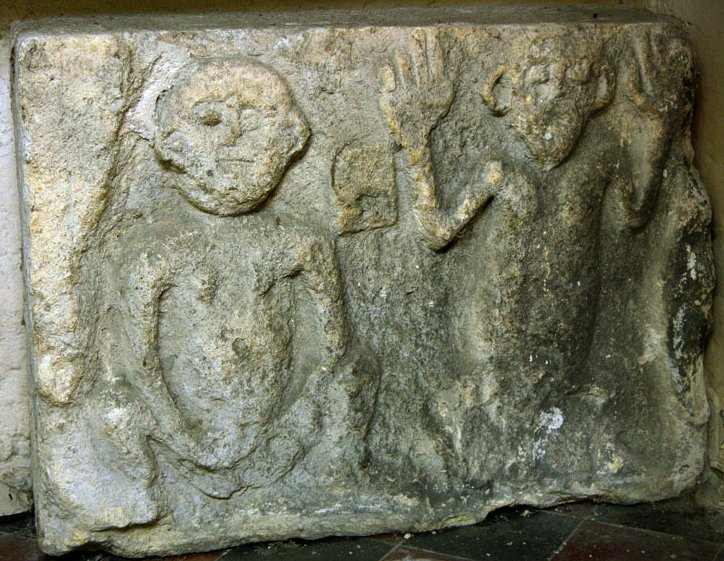
Showing posts sorted by date for query "green man". Sort by relevance Show all posts

Monday, December 20, 2010

Father Christmas and the Green Man

With the holiday season upon us, it's a great time to investigate the possible connections of Father Christmas with the Green Man.

The idea of the link between Father Christmas, linked with the Yuletide or Winter Solstice, and the Green Man of art and architecture has been explored since at least the time of Lady Raglan in 1939.  Father Christmas is traditionally depicted with crowns or other ornaments of holly, ivy and mistletoe and often dressed in green robes.


Green Man 

Source: http://web.archive.org/web/20040310163133/http://www.lincsheritage.org/lincs/misc/green-man.html


The Green Knight of medieval literature -- often equated with the artistic Green Man -- had a Winter Solstice connection. He scheduled his rematch with Sir Gawain on the shortest day of the year.  Interestingly, in the first contest between the two, the Green Knight's head was cut off by Gawain but with surprising results.  The headless body of the Green Knight retrieved the head, which offered the winter challenge to Gawain before body and head went on their way together.

The head cult perspective offers an obvious link with the foliate head of the Green Man depicted in art.

File:Scrooges third visitor-John Leech,1843.jpg
Victorian drawing of Father Christmas from a copy of Charles Dickens: A Christmas Carol with green robe and foliate crown.


Source: http://en.wikipedia.org/wiki/File:Scrooges_third_visitor-John_Leech,1843.jpg


If we go back to the Tantric connections suggested for the Green Man here, we can find in the Kabbalah the idea of a father figure known as Abba, which means "father" in Hebrew.  This Abba is related to the male principle of creation.  He is paired with Imma, meaning "mother" in Hebrew, the female principle.

While Judaism disdained anthropomorphic icons, Abba and Imma were described in the texts as mated in divine union resulting in the generation of progeny or creation.  Abba can be equated with Adam Kadmon, the primordial man.  The divine union of Abba and Imma is similar in many respects to that of the Tibetan concept of Yabyum.  Yab also means "father" in Tibetan, while Yum means "mother."  The Yabyum depiction of deities in Tibetan art shows a male and female deity in sexual union. The literary references to Abba and Imma are also quite sexually explicit in their description of the cosmic union.

Despite the taboo against iconography, Abba was still meditated upon in the sense of his Partzufim or "face."  The Kabbalistic practitioner concentrated on the divine face of Abba and other forms of the creative male principle, particularly focusing on the massive beard. According to some interpretations, by concentrating on the face of Abba and traveling along the hairs of his beard, one achieves unity with the Divine Image.  The similarity with Tantric visualization of the deity is striking.

Also, the aspect of meditating on the face brings us back to the head cult, i.e., in the Green Knight example, and to the "face motif" discussed here earlier in connection with the Green Man.

 http://img2.allposters.com/images/BRGPOD/202525.jpg

Non-religious depiction of the head of Adam Kadmon, who himself is seen as a form of the Tree of Life.


Source: http://img2.allposters.com/images/BRGPOD/202525.jpg


Although I have not found a direct solstice link with Abba and Imma, the erotic union of the two, or rather the union of their "faces,"  is considered  to have generated the ten Sephirot of the Sefer Yetzirah "tree."


Abba, along with other forms of the male principle, are also directly seen as types of the Sun, while Imma and the female principle including the Shekinah were seen as types of the Moon.  The Partzufim or faces motif blends quite well with this linkage to the celestial luminaries.


Like Abba, Father Christmas has a full beard while the Green Man has vegetation spewing from his mouth.  In all these cases, the representation may be that of the generative powers of the Sun.

Regards,
Paul Kekai Manansala
Sacramento

Sunday, September 12, 2010

More on migration of Tantric concepts

In 1977, the anthroposophist Pio Filippani-Ronconi suggested that elements of Ismaili Shi'ism appeared to have originated from the Vajrayana Tantric Buddhist doctrine in Tibet.  Specifically he compared the Vajrayana system of the five Dhyani Buddhas, also called Jinas and Tathagatas, to the Holy Family of Islamic mysticism -- the Five of the Mantle.  Indeed, one could favorably compare many elements, particularly in the areas of cosmology and numerology, within the Tibetan and Islamic mystical traditions, and furthermore extend these westward to the Kabbalistic traditions.

The five Dhyani Buddhas are transcendental enlightened beings (Buddhas) as compared to their earthly, human counterparts known as Manusa Buddhas.  Each of the Dhyani Buddhas is linked with a specific cosmic time cycle, and also with a "family" of beings and attributes.  The five-fold division of the cosmos in line with the Dhyani Buddhas recalls the Wuxing classification in China, but we will not pursue that lead in this article.

Dhyani Buddhas are particularly associated with the five primary colors -- white, blue, red, gold/yellow, and green.  

In Islamic mystic tradition, the Five of the Mantle (or Cloak) -- Muhammad; his daughter Fatima, her husband 'Ali; and the couple's sons al-Hasan and al-Husayn -- become primordial, transcendental beings in Twelver Shi'ism.  They are said to have existed before Creation and are linked with successive cosmic cycles in a manner remarkably similar to that of the Dhyani Buddhas.  Additionally, the five are associated with the "Five Lights" or "Five Colors" a reference to the human incarnations of these transcendental beings.

In Tibetan Buddhism, the five Dhyani Buddhas are combined with a sixth being -- the Adibuddha -- representing the pantheistic totality of the group.  Similarly in Islamic mystical tradition, the angel Gabriel becomes the "sixth of you five," which Henry Corbin describes as the "uni-totality" of the pentad.  In both the Tibetan and Islamic systems, this sixth member is associated with the element of the mind, as Vajrasattva (manas "mind") in the case of the Adibuddha, and as the Ruh Natiqa or "Thinking Spirit" in the Ismaili tradition.


Body of Light

The association of the Dhyani Buddhas and the Five of the Mantle with the five colors links conceptually with the belief found in both schools that spiritual adepts can attain a "body of light."

In the Dzogchen and Bonpo traditions of Tibet, this is known as the Rainbow Body or the Rainbow Light Body.   Upon the attainment of the highest yogic plane before death, the yogi dissolves into the "Five Pure Lights," i.e., the five primary colors of the rainbow achieving union with the Dharmakaya, the pantheistic godstuff.

The Sufi "body of light" or "resurrection body" is attained by the adept who completes a sacred itinerary that is generally thought of as imaginal in nature.  Actually the final part of the journey is that in which the devotee travels to union with the Divine in this subtle body of light.


The Inner and Outer Journey

Both the Tibetan and Islamic mystical traditions include concepts of a pilgrimage that the adept undertakes to attain spiritual transformation.

In the Tibetan case, there are clearly both real world along with imaginal sides to this tradition. The pilgrimage sites are real places that have been traditionally used as such including Kamarupa in Assam, the Gondavari River in South India, and the Himalayan range in Nepal and Tibet.  The only really exotic destination is Suvarnadvipa, which also happens to be a key location in this blog's research.

The Tibetan pilgrimage sites are divided into five major groups -- the pitthas, ksetras, chandohas, melapakas and smasanas -- and these are further subdivided by adding the prefix upa- to each major group.  Thus there are five groups of pilgrimage sites, ten in all including subgroups, that are said to correspond also to ten parts of the human body:

Suvarnadvipa is included in the group known as the upamelapakas, which are associated with the feet and the calves.  According to Jamgon Kongtrul, the inner journey of transformation begins interestingly enough from the head and then moves downward toward the feet.  Suvarnadvipa is found at the eighth stage of awakening and is associated with the sacred ground known as the "Higher Gathering Place."  The sacred grounds of the ninth and tenth stages are known respectively as "Cemetery" and "Higher Cemetery" suggesting that the adept is already passed on beyond this life.

The Sufi and Shi'a sacred journey is represented by the journey of the birds to the East toward Mt. Qaf, the eighth mountain in a system that consists of either nine or ten stages.  The birds never proceed beyond Qaf, which is known as the Footstool of God, for the next stages take the adept to the very Throne of God.

For the Sufi mystics also, the inner itinerary begins from the top, starting in the eyes according to al-Kubra then moving down into the face, the chest, and then the rest of the body.  Like Suvarnadvipa, the eighth stage of the Tantric pilgrimage, Mt. Qaf, the eighth sphere, was located in the furthest East.  Abassid tradition places it "behind," i.e. on the other side of the China Sea.


Kabbalah echoes

The Zohar, the central text of Kabbalah that dates back to 13th century Spain, also emphasizes a journey, mainly spiritual in nature, that the practitioner undertakes to reach Gan Eden -- the Garden of Eden, also known as Pardes.  There are actually two Garden of Edens -- a heavenly one that one attains to after death, and an earthly garden where the Shekinah is exiled.

The Shekinah is the female aspect of the Divine that remained in the Terrestrial Paradise after the banishment of humanity.  The Kabbalah adepts seek to rejoin the Shekinah via a sacred pilgrimage to the primordial garden through mystical paths known as Sephirot.  The Sephirot were likened to the organs of the human body, specifically that of Adam Kadmon, the Primordial Man.

File:Tree of life hebrew.svg
The Sephirot shown in a traditional diagram. (Source:  http://en.wikipedia.org/wiki/File:Tree_of_life_hebrew.svg)


From Wikipedia:  "Metaphorical representation of the Five Worlds, with the 10 Sephirot radiating in each, as successively smaller Iggulim-concentric circles."


At the top of the body is the first Sephira, Keter, the crown of the head, while the tenth and last Sephira corresponding to Gan Eden is Malkuth, which also represents the feet of Adam Kadmon.  The Hebrew term malkuth is related to the malakut of Islamic mysticism with both words referring to the "realm of kings," an area on the border of the earthly and heavenly regions.


Although the sacred journey of Kabbalah was an inner one, the belief in a real world Gan Eden did exist.  According to medieval documents like the Hebrew letters of Prester John, the location of Gan Eden was 'India ha-gedolah or "Further India," the same area where one finds the Sambatyon River and the Lost Ten Tribes of Israel.

Evidence exists that at least some medieval Kabbalists undertook real journeys to these far-off locations.  For example, Abraham Abulafia attempted to find the Sambatyon River with the idea that he could help the world along toward the end times, but also to help undo the "knots" that hindered his own spiritual development. 


Echoes in the East

Suvarnadvipa (Island of Gold) in the Tibetan version of the spiritual itinerary would equate with the locations of Qaf and Gan Eden in the respective Islamic and Kabbalah traditions. As I have argued often here, the Ming Dynasty kingdom known as Lusung (Luzon) was the political and cultural heir to Suvarnadvipa and located in the same geographical political center.

Here we can still find the concept of cyclic and generational time represented in the image of a human body divided into five parts.  The body thus divided could represent five generations of a clan, and also the cycles of regeneration and reincarnation that existed in the previous belief systems.

I have also suggested previously that the sacred lands of Lusung were apparently divided in a quadripartite fashion based on the imagery of the human body.  Thus, we have place names like Olongapo or Ulo ng Apo "Head of the Lord." 

Another example of the human form representing the cosmos or at least the Earth can be seen in the Tausug house architecture that interlinks Earth, tree, house and human body.


http://i18.photobucket.com/albums/b121/kharl_prado/tausug.jpg

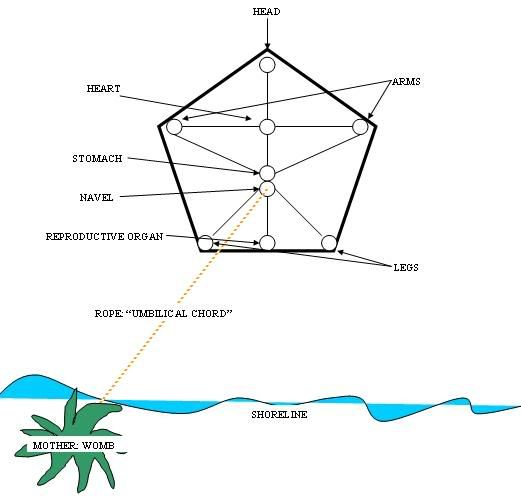
A diagram of a traditional pentagonal Tausug house made with nine posts that create an outline of a human body in the well-known squatting figure motif.  The tree acts as the umbilical cord of the Mother Earth extended by a rope tied to a central post.  After nine months, the period of human gestation, the rope is cut.  (Sources  http://media.photobucket.com/image/tausug%20nine%20square%20house%20numbers/kharl_prado/tausug.jpg)


The house with it's symbolic human figure represents the "child" of the Earth and thus is a copy of the world in microcosm. While the oldest form of the Austronesian house had four corner posts, a central post is often added symbolically to represent the center of the world.  Thus, the five posts create an imagery of the cosmos. In the Austronesian scheme of the base, trunk and tip, the base of the house is the bottom and thus one travels back to the "source" by going from top to bottom.  

In another sense, the mythical family of Pinatubo and Arayat can be compared to the Holy Family of the Mantle in Islamic tradition.  In the local folk legends, this family is often represented with five members, for example, Sinukuan and his spouse and their three daughters. However, an extensive review of the traditions would allow us to logically reconstruct the family as consisting of the two deities of Pinatubo and Arayat, standing for the Moon and Sun respectively;  a single child for each of these deities, more connected with the Earth, who are involved in a battle-courtship; and the offspring of the latter who again has an astronomical relationship representing Venus, the Morning Star.

Islamic mystical tradition normally equates Muhammad with the Sun; 'Ali with the Moon; Fatima with Venus; while the al-Hasan and al-Husayn are sometimes equated with the pole stars.  The emphasis on the luminaries and Venus to the exclusion of the other planets is quite telling. The astronomical links here are clearly associated with the association of these "families" with cyclic time.

We also hear of widespread beliefs surrounding the rainbow in the Philippine region .  In some cases, the rainbow was equated with the Supreme Deity, while elsewhere it is seen as the abode of God or the gods.  Sometimes it is viewed as a bridge or boat by which one reaches the Divine after death.  There was a belief that people who died a noble death by the sword, or who were devoured by crocodiles, or struck by lightning, became anitos (deified spirits) and were united with the pantheistic Deity in the rainbow, or through the vehicle of the rainbow.

In Pampanga, the pantheistic nature of the rainbow can be seen in its name pinanari "loincloth of the King" with the "king" here probably referring to the creative force Mangetchay.

Concepts of transformation are also included in the practice of obtaining a mutya, although in this case the transformation involves those still living on earth.  Mutya refers to a pearl or gem that shines and radiates light.  Grace Odal-Devora states: "...the inherent powers and virtues of the various mutya objects can be the basis for conceptualizing on the nature of the self – that starts from discovering the innate powers and inherent virtues within and using them to transform oneself and one’s society – like the transformation of the pearl from slime, mud, sand or dirt into a gem of light, beauty, healing and purity."


Regards,
Paul Kekai Manansala
Sacramento

References

Cooper, David A. The Ecstatic Kabbalah. Boulder, Colo: Sounds True, 2005.

Corbin, Henry. Cyclical time and Ismaili Gnosis, http://www.amiscorbin.com/textes/anglais/Corbin%20Cyclical%20Time.pdf.


Idel, Moshe. Studies in Ecstatic Kabbalah. SUNY series in Judaica. Albany: State University of New York Press, 1988.

Karma-gliṅ-pa, and W. Y. Evans-Wentz. The Tibetan Book of the Dead: Or, The After-Death Experiences on the Bardo Plane, According to Lāma Kazi Dawa-Samdup's English Rendering. Oxford: Oxford University Press, 2000.

Katz, Nathan. Indo-Judaic Studies in the Twenty-First Century: A View from the Margin. New York: Palgrave Mac Millan, 2007, 64-5.

Merkur, Daniel. Gnosis: an esoteric tradition of mystical visions and unions. SUNY series in Western esoteric traditions. Albany, NY: State Univ. of New York Press, 1993, 217-245.

Odal-Devora, Grace. 2006. Some problems in determining the origin of the Philippine word "mutya" or "mutia."  Paper presented at Tenth International Conference on Austronesian Linguistics. 1720 January 2006. Puerto Princesa City, Palawan, Philippines. http://www.sil.org/asia/philippines/ical/papers.html.

Reyes y Florentino, Isabelo de los.  Notes in order to familiarize myself with Philippine theodicy : the religion of the Katipunan which is the religion of the ancient Filipinos, National Historical Institute, 1980, 4, 6.

Sakili, Abraham P. Space and Identity: Expressions in the Culture, Arts and Society of the Muslims in the Philippines. Diliman, Quezon City: Asian Center, University of the Philippines, 2003.

Silliman, Robert Benton. Religious Beliefs and Life at the Beginning of the Spanish Regime in the Philippines: Readings. Dumaguete City, Philippines: Reproduced by College of Theology, Silliman University, 1964.

Wallace, Vesna A. The Inner Kālacakratantra A Buddhist Tantric View of the Individual. New York: Oxford University Press, 2001.

Zangpo, Ngawang, and Blo-gros-mtha'-yas . Sacred Ground: Jamgon Kongtrul on "Pilgrimage and Sacred Geography". Ithaca, N.Y.: Snow Lion Publ, 2001.


Friday, August 06, 2010

Lapita, Taotie and other Face/Head Motifs (Part 3 of 3)

Another strong evidence of the relationship between the Indian and European face motifs is the existence in Romanesque art of a feline face disgorging (or gorging) strings of beads from the corners of its mouth.  Similar motifs are found in India and Tibet with the apparent earliest example located at the Ajanta Caves dating to the 5th century.


Feline masks with strings of beads streaming from the corners of their mouth at Iffley Church in Oxford, England, 12th-13th century. (Source:  http://www.bejo.co.uk/greenmantrail/html/missing.html)


A Gupta era Kirtimukha with festoons of pearls disgorged from the corners of the mouth. Notice the double spiral "horns." (Source: Huntington Archive)


Traditional Tibetan bell (Source: Encyclopedia of Tibetan Symbols and Motifs) and


A more elongated type of head disgorging various items from the upper part of the mouth with no lower jaw visible, Lincoln Cathedral, Norman period. Click on image for larger view. (Source: Wikipedia http://en.wikipedia.org/wiki/File:Lincoln_cathedral_03_West_portal.jpg)


More on the meaning of the face motifs

Face motifs continue to be used to this day in the Austronesian-speaking regions in tattoos, textiles and other art forms.  In the Marquesas, the mata hoata "face" and ipu "eye" motifs can be used to denote the etua, the deities and deified ancestors to include the pantheistic Fractal Being.

The Kala form of the face motif in Southeast Asia gives this design a connection with the deity of cosmic time.  In the Philippines, the pantheistic volcano gods are seen in some cultures as lords of, or personifications of time.  In medieval Tibet, the Kalacakra Deity was both lord of time and also a form of the pantheistic Adibuddha or "First Buddha."

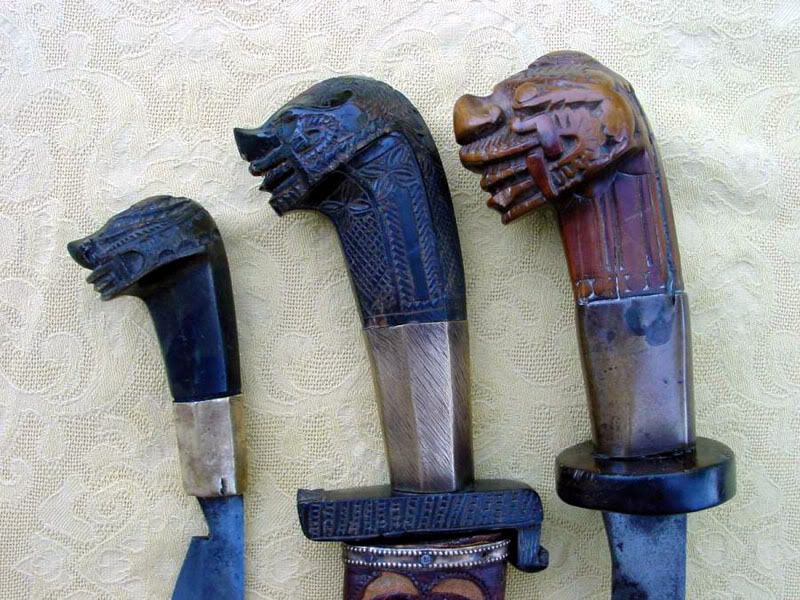
In the Philippines, one of the closest matches to the face motifs under discussion are the decorations found on  boat prows, blade hilts, musical instruments, and other items known variously by names such as Bakunawa, Buaya, and Naga.   The Bakunawa motif is connected with a deity among certain peoples of Panay who in the past chose auspicious times for events based on the direction that the Bakunawa was said to be facing.  Almanacs were made that gave the direction of the Bakunawa's face for any time of the year, and these calendars also served a geomantic purpose in orienting the direction of the entrance of a home under construction.

The Bakunawa was thus related to aspects of astronomical time, although I have not seen information connecting this deity with any constellations or stars.  Viewed as a great winged dragon-like creature with a red tongue, the Bakunawa was also said to swallow the Moon during eclipses.  In this sense, the serpent may have been related to the Indian deity Rahu, who was also envisioned as a disembodied head that devoured the Sun or Moon during an eclipse.


http://img.photobucket.com/albums/v51/zelbone/Philippine%20Edged%20Weapons%20Forum/3Visayanhilts.jpg

Bakunawa blade hilts (Source: http://img.photobucket.com/albums/v51/zelbone/Philippine%20Edged%20Weapons%20Forum/3Visayanhilts.jpg)


http://woodside.blogs.com/.a/6a00d8341f9d6353ef0133f20750be970b-800wi
The hilt on this blade from Panay is more like the buaya or makara motif (crocodile-like). (Source: http://www.filhistory.com/2010/07/sundang-itak-bolo-pinuti-talibong-tenegre-pinote-philippiine-weapon-filipino-sword-sandata-1-1.html)


The idea of the Bakunawa devouring the Sun or Moon may connect with the earlier red-slipped, Lapita and Taotie face motifs.  In the tumpal face design, the "eyes" can also represent the Sun as discussed above but additionally they can represent the Moon also.  In an earlier post, I suggested that the crescent shape, and also the half circle shape found in some red-slipped and other early tumpal patterns could represent the "Crescent Sun."   The latter astronomical term refers to a Sun nearly fully eclipsed but with the non-eclipsed part forming a crescent shape.

In addition, the name "Taotie" is generally translated as "Glutton," while the Chinese term for "solar eclipse" 日食 means literally "to eat the Sun."  However, while some experts believe the Taotie may be linked with the eclipse, I have not seen any explicit literary or artistic reference making this connection.  K. C. Chang does provide literary evidence that the motif was linked with the concept of "devouring humans" though.

The concept of devourer is also found in the legends surrounding Kala, who as the personification of time consumes humans and also the entire world in his ceaseless march.   The depiction of Kala above gates in Indonesian temples gives the impression that the deity is devouring the pilgrims as they move from one part of the temple to another.

In Papua New Guinea and Melanesia, one commonly finds instances of masks representing "Ghosts" that devour and regurgitate initiates in sacred rituals.  A similar idea may have been present in the pre-colonial Philippines and nearby parts of Indonesia in relation to concepts of immortality.  Here we find the idea that the entrails represented human mortality and that removal of these entrails cause the subject to become immortal.

In relation to this we have the legends of what are now considered demons -- the Aswang and Manananggal -- that are able to detach their heads from their bodies when they go to search for "prey."  In most cases, they do not devour their victims whole but simply suck out their viscera.  While this myth today is used in horror stories, in ancient times it may have referred to rituals believed to confer immortality or long life.

Interestingly the Aswang and Mananaggal when detaching their heads were said to take their own viscera along with them trailing from their necks.   According to early Spanish records, the icon of the god Malyari of Pinatubo and Zambales, was said to consist only of a head and straw arms.  Possibly the straw arms were actually viscera as in the case of the legends of the body-less "demons," and these hanging entrails could be related to the depiction of foliage streaming out of the mouth of Kirtimukha and Kala images.  The protruding tongue motif widely found in Polynesia, Melanesia and Papua New Guinea, and less commonly in Southeast Asia, may also be related to the imagery of streaming intestines-vegetation.


The Green Man and the Green King

In Europe, the foliage spewer motif is often related to the medieval tales of the Green Knight as found in Grail and other literature of the same period.  However, an even better explanation might be found in the concept of the Green King found in Eastern Christian apocalyptic literature.

Most important of these is the Apocalypse of Bahira, a 9th century work in Syriac and Arabic that tells of a Green King from the East to come in the last days:

...a king dressed in green clothes will come from the East and through him there will be great peace and quiet in the world. Churches will be built and monasteries will be restored. And he is the last one whom the world expects to come at the end of the kingdoms of the Sons of Ishmael.

Barbara Roggema thinks the idea of the Green King is related to the Islamic al-Khidr, the Green One, who represents fertility and immortality.  However, she notes that al-Khidr was not destined to kingship and she interprets the concept as an early prototype of the king who would become known as Prester John.  She gives as evidence a passage from the Liber Otensor written by the 14th century Franciscan Jean de Rocquetaillade who equated the Green King of the Apocalypse with the King of the Tartars, who at the time was widely identified as Prester John.

According to Ibn al-Tiqtaqa, the Green King wore green clothing because that was the color of garments worn in Paradise -- another link with the Prester John kingship. In addition to having Paradise within or near his kingdom, Prester John's land was filled with many fruits and fountains that bestowed long life, and he ruled with a fabulous emerald scepter.


For another possible connection involving the Green King and al-Khidr, see my article on Qingtong, the Blue-Green Lad, (and here also) who was an early Daoist messianic figure expected to arise from a region to the southeast of China; as well as my article on Mount Qaf. 


Regards,
Paul Kekai Manansala
Sacramento

References

Ambrosio, Dante L. "Bakunawa and Laho," Philippine Daily Inquirer, 02/08/2009, http://opinion.inquirer.net/inquireropinion/talkofthetown/view/20090208-188046/Bakunawa_and_Laho.

Chang, Kwang-chih. Art, myth, and ritual: the path to political authority in ancient China. Cambridge, Mass. u.a: Harvard Univ. Press, 1983, 72-3.

Healy, Tim. "The Missing Link?" The Green Man Trail, 2007, http://www.bejo.co.uk/greenmantrail/html/missing.html.

Roggema, Barbara. The legend of Sergius Baḥīrā: eastern Christian apologetics and apocalyptic in response to Islam. Leiden: Brill, 2009.

Riesenfeld, Alphonse. The Megalithic Culture of Melanesia, Brill, 1950.

Scott, William Henry. Barangay: Sixteenth-Century Philippine Culture and Society. Quezon City, Manila, Philippines: Ateneo de Manila University Press, 1997, 252.

Monday, August 02, 2010

Lapita, Taotie and other Face/Head Motifs

The possibility of a relationship between the Taotie face motif that dates back to the Shang Dynasty in China, and the previously discussed Kirtimukha images of India and the Kala images of Southeast Asia, has been explored in previous literature. Joseph Campbell in The Mythic Image (pp. 118-130) believes these motifs along with the Mesoamerican jaguar mask and the Greek Medusa all owe their similarities to diffusion.

Stella Kramrisch and Raymond Burnier also apparently see a direct relationship between the Kirtimukha/Kala images and the Taotie, and also the "Green Man" motif from medieval Europe (foilage spewers-column swallowers). 

The earliest of these images is the Taotie, however, it has a possible contemporary match in the Lapita face motif, which to my knowledge has not been explored.  The Taotie and Lapita images date from about the same period -- from the middle of the second millennium BCE to the beginning of the first millenium BCE -- the dates for the Erligang Culture in Henan and the Lapita Culture in eastern Melanesia and Western Polynesia.   The face motifs appear to date to the earliest phases of both Lapita and Erligang cultures.


Examples of Lapita faces taken from Chiu 2007 and Spriggs 1993


Examples of Taotie face motif from Erligang Culture in Henan, China from Allan 1991.


While there are significant stylistic differences between these contemporary motifs, there are also some important similarities:

  • In both cases, the face normally consists of defined eyes and nose, whether realistic or stylized, but the mouth, or at least the lower jaw, is missing or not clearly defined.
  • Opposing spirals are an important element in both types of face motifs. With the Lapita face, the spirals often define or border the eyes, but in some cases they appear as "horns" to the side of a set of eyes.
  • Leaf-like eyes with pointed edges or tips are found in both regions.
  • A "face within a face" motif is found often involving the "horns" of the image in some Lapita images, and this also appears to be clearly defined in some Taotie motifs from the Shang-Zhou period.
  • The presence of flanking decorative elements that occasionally take on a clearly independent identity, and which may be related to later images in Oceania, Asia and Europe.
  • The presence of scrolling patterns, spirals, and leaf-like or flower-like designs can be seen as suggestive of foliage in both cases.


Three sets of Lapita face motifs showing two pairs of eyes sharing the same "nose."  The outermost pair of eyes is found in the "horns" of the smaller eye set. From Spriggs 1993.


Below are leaf and other foliage-like eye motifs from Lapita artifacts.


Origin of the motifs


Both Spriggs and Chiu refer to the large number of "simplified" face motifs on Lapita artifacts suggesting that these motifs are latter developments of the earlier more realistic face designs.

However, at least one these simplified versions may have a very ancient origin.  The dentate or linked triangular pattern with circles at the top of the triangle is very similar to designs found on red-slipped wares in the Philippines that may date back to before 5000 BCE. Such patterns are found widely in Southeast Asia by the Late Neolithic period.

Here is an example of the motif found in Lapita culture:


The triangular design in latter times is known at tumpal and is often said to represent hills or mountains.  However, this would not preclude its use in face designs.  The use of vegetative motifs in other Lapita forms as well as in the Taotie face motifs could suggest these faces or mask have a pantheistic or fractal identity, which is something we shall examine in future posts.

Click here for continuation.


Regards,
Paul Kekai Manansala
Sacramento

References

Allan, Sarah. The Shape of the Turtle: Myth, Art, and Cosmos in Early China. SUNY series in Chinese philosophy and culture. Albany, NY: State University of New York Press, 1991.

Campbell, Joseph, and M. J. Abadie. The Mythic Image. Princeton/Bollingen paperbacks. Princeton, N.J.: Princeton University Press, 1981, 118-128.

Chiu, Scarlett, Detailed analysis of Lapita Face Motifs: Case Studies from Reef/Santa Cruz Lapita Sites
and New Caledonia Lapita Site 13A,
http://epress.anu.edu.au/terra_australis/ta26/pdf/ch15.pdf, 2007.

Kramrisch, Stella. The Hindu Temple 2. Delhi: Motilal Banarsidass Publ, 1996, 322-25.

Miksic, John N. Earthenware in Southeast Asia: Proceedings of the Singapore Symposium on Premodern Southeast Asian Earthenwares. Singapore: Singapore University Press, 2003.

Spriggs, M. "How Much of the Lapita Design System Represents the Human Face?" In P. Dark and R. Rose (eds), Artistic Heritage in a Changing Pacific,   Bathurst: Crawford House Press, 1993, 7-14.

Sunday, May 02, 2010

Mandalas, Wheel Windows and Rose Windows

Following up on my posts on the evidence of "Tantric" eastern influences in Romanesque Europe, one very interesting element that pops up in Romanesque churches is the wheel window.

The wheel window generally adorns the west fronts of these churches staring in about the 12th century.  The subsequent rose window is widely believed to have been derived from the wheel window.  Most scholars see the wheel window as a development of the earlier Roman oculi, a circular opening in structures for ventilation and lighting.

However, most do admit that the designs of the wheel and rose window may indicate foreign influences. For example, some have suggested that the designs may have come from the six-petaled rosettes of the Khirbat al-Mafjar in Jordan.

A stronger argument exists, I think, linking the wheel window with the dharma cakra (wheel of law), and the initial rose window designs with the mandala.  These cultural elements could have been brought over, again, by the Sayabiga and related peoples.

Firstly, many of the earliest wheel windows have eight "spokes" as in these examples from 12th century Norman England:


Patrixbourne


Barfreston 


Castle Hedingham


(Source for photos:  Mary Berg at the Kent Archaeology Page)


The dharma cakra appears very early in Indian art, for example, in the Asokan architecture, but the spoke number can vary.  By the late ancient period though, the eight-spoked dharma chakra becomes well-established and it is the classical type used in Tibetan Buddhism.  At churches with eight-spoked wheel windows, we often see that many motifs also occur in groups of eight.

Another noteworthy similarity found in many early wheel windows is the use of the column motif for the "spokes."  In the Barfreston and Patrixbourne examples above, these column-spokes form a likeness of a trefoil arch between each spoke.

A traditional widespread form of the dharma chakra displays trefoil-like "knobs" that appear to protrude from each "spoke" through the "rim" of the dharma wheel as in the examples below:

File:Flag of Sikkim.svg
 A dharmacakra on the flag of Sikkim.  Note the trefoil-like knob at each quadrant. (Source: Wikipedia)

File:Wheel of Dharma. Craftsman in Xining by reurinkjan.jpg
A dharma cakra manufactured in Xining, China with large trefoil designs, one for each spoke. (Source: Wikipedia)


Another similarity is that the "rim" in both the dharma chakra and the window wheel is wide and often very ornately decorated, for example, with vegetative motifs.

A very striking comparison can be made between the wheel window of Barfrestron and the dharma cakras found on the Sun Temple of Konark, eastern India, which dates to the 13th century.  In both cases, the rims are decorated with the respective bestiaries of each culture.


Bestiary on rim of Barfreston wheel window includes griffins, winged lions, harpies, crabs and other creatures both real and fabulous. (Source: http://www.green-man-of-cercles.org/articles/bestiary_arches.pdf)


Rim of dharma wheel at Sun Temple of Konarak has elephants, swans, deer, deities, mythical creatures and sensuous couples displayed in a circular vine motif.


Rose windows

The early rose windows were obviously similar to the wheel windows that came before.  For example, the following window from the cathedral at Chartres dating to the late 12th century is sometimes called a rose window and sometimes a wheel window.


http://www.sacred-destinations.com/france/chartres-cathedral-photos/slides/ext-rose-window-cc-ed-swierk.jpg
Wheel window at Chartres Cathedral (Source:  http://www.sacred-destinations.com/france/chartres-cathedral-photos/)


Here there are twelve column-like spokes in the central figure creating arch-like "petals."  The design is very much like the mandalas of Tibet.

While Tibetan tradition states that mandalas were originally taught by the Buddha, the first mandalas to appear on murals date from about the 10th century.  By the 11th century, highly-sophisticated textile mandalas were made.  While the word "mandala" can refer to any circular type of design, but in Tibetan art it generally referred to a representation of the cosmos that was concentric in nature.

The concentric design of mandalas often resulted in fractal patterns. For example, many Buddhist mandalas  display the fractal plane known as the Sierpinski Carpet.  Even a simple design of concentric circles is fractal in a way -- the outer circle surrounds a circle that in turn surrounds a circle surrounding a circle.

More complex fractal patterns can include, for example, a circle of Buddhas encircled by smaller circles of Buddhas.

File:Mandala of the Six Chakravartins.JPG

The Mandala of the Six Cakravartins dates at least to the 11th-12th century Vajravali text, although it is based on an earlier prototype.  The mandala above was created in the 19th century.  In this mandala, a Cakravartin, or World Emperor, is enclosed in a circle surrounded by eight deities in lotus petal-like containers. The lotus is encircled and placed in a square with cruciform "gates."  Five other Cakravartins in similar presentation surround the central figure. (Source:  http://en.wikipedia.org/wiki/File:Mandala_of_the_Six_Chakravartins.JPG)


Vajravarahi Abhibhava Mandala
A 14th century Vajravarahi Awakening Mandala shows a central eight-petaled lotus or rosette with deity figures surrounded by smaller six-petaled lotuses. (Source: http://www.asianart.com/mandalas/page14.html)


In the wheel window of Chartres Cathedral the central lotus or rose-like figure has twelve "petals" and has a rosette-like figure at its center with twelve apses.  The rose is surrounded by smaller circles with eight apses.

These figures with the apses may possibly be related to the description giving in Titurel during the 13th century of the Grail Temple:


Grail Temple plan after Ringbom (A. A. Barb, 1956: 34) following descriptions in Titurel. 


In the following sand painting of a Mandala Palace, the outermost lotus figure has 22 petals, which can be compared to the 22 apses of Titurel's Grail Temple.  The number 22 in Tibetan Buddhism can represent the 22 deities of the Kalacakra Deity's Palace, the 22 Bodhisattvas, etc.


http://buddhistsymbols.info/wp-content/uploads/2008/07/mandala.jpg
Source: http://buddhistsymbols.info/wp-content/uploads/2008/07/mandala.jpg


Architectural changes during the Romanesque period

Changes in design and orientation are also supportive of the idea of eastern influences in line with those already described in this and previous posts.

For example, we see the rise of cruciform churches during this period.  The new architecture is generally seen as a fusion of the Visigothic cruciform church and Mozarabic design elements.  However, one interesting feature is the idea of the church representing Paradise -- something that is carried on into the Gothic period.

The churches now have gates or portals that can be viewed as entrances into a representation of either the divine or the terrestrial paradise.  One interpretation of the trees, vegetation and rivers represented in Romanesque and Gothic churches is that they are intended to represent the Garden of Eden. The palm tree, in particular, is represented as the Tree of Paradise.  In a similar sense, the terraced pyramid temple of Southeast Asia, which also had a cruciform building plan, represented the cosmic mountain, the axis mundi.

Additionally, during this period the churches began to be pointed in an eastward direction.  The high altar was placed at the "top" of the cross in the easternmost part of the church.  However, the churches were not oriented directly at the rising Sun during the equinoxes.  They usually diverged from a few degrees to 15 or more degrees from true East.  Previously Christian churches had no particular orientation and could be facing in any direction.

Now the great majority of temples in South and Southeast Asia traditionally had the same orientation -- toward the East but rarely toward true East.

Various explanations have been given for the orientation of Romanesque churches including the idea that they faced the Sun on first day of building or on the patron saint's day.  Some have also suggested that compasses were used for orientation and that they were thrown off by magnetic declination.

One possibility that could be tested is whether the churches or a subset of them were oriented toward a fixed geographical location like the mosque was oriented toward Mecca.  Giving the paradisaical themes of Romanesque churches, they may, for example, have been pointed toward the perceived location of the Garden of Eden in the East.  If this were the case, then we should see that the churches tend to face more southward as the church's location is more eastward in longitude and northward in latitude.

Regards,
Paul Kekai Manansala
Sacramento

References

Abrahamsen, Niels. Orientation of Romanesque Churches and Magnetic Declination in the 12th Century in Denmark. GeoSkrifter, 23. Aarhus: Geologisk Institut Aarhus Universitet, 1985.

Brunius, Teddy. "Old nordic churches and the points of compass" Konsthistorisk Tidskrift/Journal of Art History 66.4 (1997). 03 May. 2010.

Cowen, Painton.  The Rose Window, London and New York, 2005

Grabar, Oleg. Constructing the Study of Islamic Art 2 Islamic Visual Culture, 1100 - 1800. Aldershot [u.a.]: Ashgate Variorum, 2006, 387.

Graham, Robert Maxtone. The Sculptures at the Church of St Nicholas, Barfreston, http://www.green-man-of-cercles.org/articles/bestiary_arches.pdf, 2008.

Hoare, Peter G., Caroline S Sweet, "The orientation of early medieval churches in England," Journal of Historical Geography, Volume 26, Issue 2, April 2000. 

Hughes, Robert. Heaven and Hell in Western Art. London: Weidenfeld and Nicolson, 1968.


Kubach, Hans Erich. Romanesque Architecture. History of world architecture. New York: Abrams, 1975.

Tuesday, April 27, 2010

More on "Tantric" influence on Romanesque art

Warning: While I post a risque photo or image now and then, this article plus the links will have more than a few "carnal" images.


The term "tantric" is often associated with erotic iconography and sacred sexual practices, although the latter idea is greatly exaggerated in most cases.

However, one can say that there was a definite surge in erotic art and a more open attitude toward sex during the Tantric period.  Not that India was any stranger to such ideas since the Kamasutra was written in this region, but it has been suggested that more conservative attitudes had prevailed especially after the Muslim invasions.

Tantric texts give evidence of more open attitudes toward sacred sexuality flowing into India from the East -- from Suvarnadvipa, Mahacina and Cina, i.e., from Insular and Mainland Southeast Asia and South China.

Earlier I suggested that Tantric influences had been brought by the Sayabiga and Zutt into Islam via "dervish" groups, and that these influences also reached into Europe and were found in the Grail literature.  During the height of the Tantric period, at the same general period when erotic temples like Khajuraho and Konark were being built in India, there arose a tradition of erotic sculpture in Romanesque art as well.


Source: http://goeurope.about.com/cs/sex/a/sexual_carvings.htm 

From the Romanesque section (~12th century) of the Santa María Church-Fortress in Ujué, Spain. Compare above to this graphic sculpture from the 15th century Candi Sukuh Temple in Java.


Erotic elements in Romanesque art appear concentrated most heavily in northern Spain and southwestern France -- locations closely associated with the Agote peoples discussed in the previous blog posting.   The style also became popular in Italy, England and Ireland.   Note that these sexual carvings were displayed both in the interior and on the exterior of churches.  Nothing comparable was found before, and starting in the Renaissance, the church began to suppress such artistic expression.  Types of sexual and amorous literature that arose at about the same time was publicly burnt in some places.  The evidence suggests then that the erotic displays in Romanesque churches were an intrusive development.

Anthony Weir and James Jerman in Images of Lust: sexual carvings on medieval churches suggest that the practice actually was diffused along the routes that led to Santiago de Compostela in Spain, where the great medieval pilgrimage took place to the supposed burial place of the Apostle St. James. 

Motifs we have studied, like the Avaritia and la femme aux serpents, are to be found along, or in the close vicinity of, the four main pilgrimage roads of France, but only the westernmost, from Compostela, along the northern provinces of Spain, into Aquitaine, Poitou, the Vendee, Brittany and Normandy (with a tributary northeast of Paris to Liesse), thence to the British Isles, has sexual exhibitionists in significant numbers.

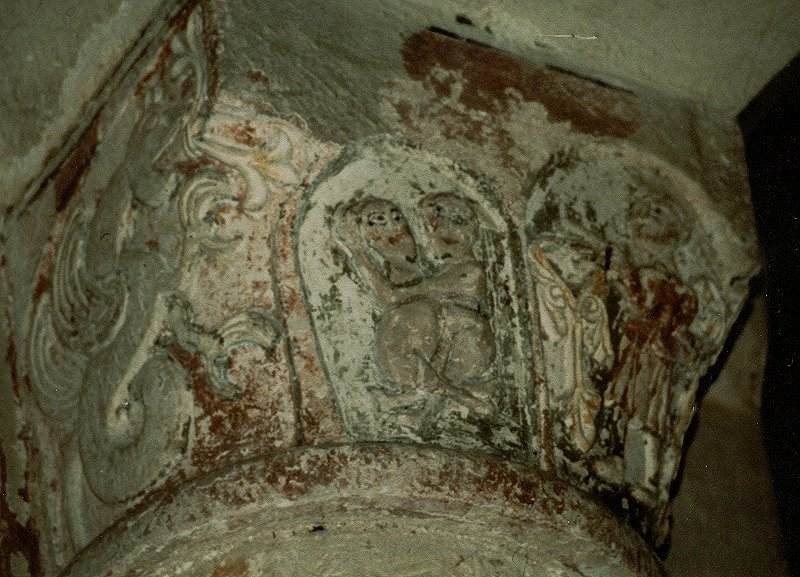
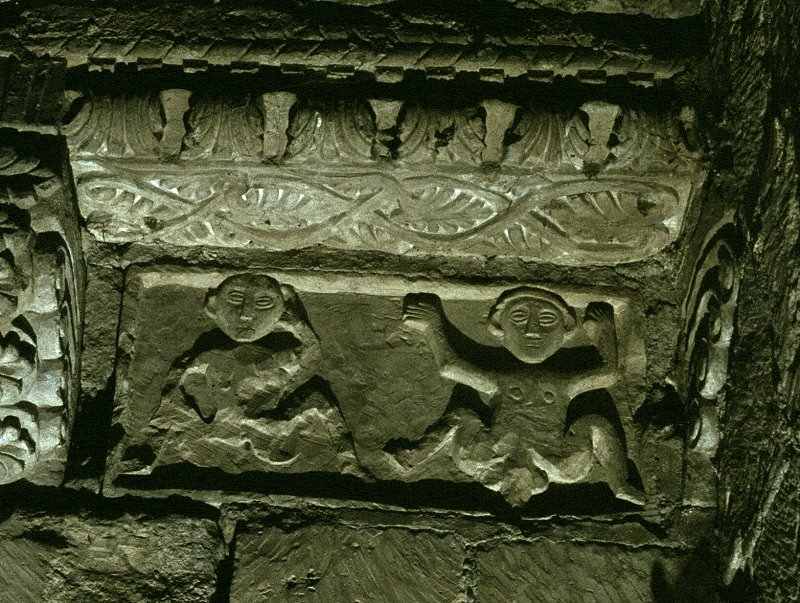
The exhibitionist sculpture included scenes of copulating couples, a depiction in Indian art known as mithuna. In the tantric art of Tibetan Buddhism, deities are often shown in a divine and sexual embrace known as yab-yum.  In many cases, the couples in Romanesque churches are in non-missionary, Kamasutra-like positions as in the relief from Carennac, France below.


For some more clear examples of Romanesque mithuna, see this Beyond the Pale webpage or browse through the whole site.


Squatting figure motif

One important type of sexual exhibitionist motif displayed in Romanesque art is that of the squatting figure.  Here is an example from Poitiers in France, and further below from Moulton in Suffolk, England:


For more examples of this motif along with one for comparison from Candi Sukuh in Java, see the Poitiers page at the Beyond the Pale site.

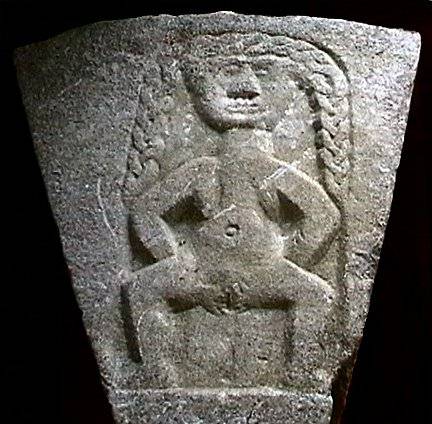
Another type of squatting figure commonly found at Romanesque sites is that known as Sheela na gig and features a female figure boldly displaying her her vulva.


photo by 
Gay Cannon
Sheela na gig from Rahara, Ireland (Source: beyond-the-pale.org.uk)


The squatting figure motif is a well-known and widespread element in the art of Southeast Asia and the Pacific.  Robyn J. Maxwell, in her work on Southeast Asian textiles, states:

The oldest realistic representation of the human body on textiles presents a full frontal view, standing or squatting.  Strength is conveyed in the stance, usually with feet apart and arms raised, although the bold 'hands-on-hips' pose is also an ancient representation.

The motif can be classified into three basic types:

  • A high squat or standing figure with hands raised, usually above the head.  Variations include hands on or near the hips or the elbows extended outward with hands dropping down.  This figure gives an imposing look that may be protective against evil (apotropaic).
  • A very low squat with groin at about the same level as hips. In many cases, this is a birthing posture.  Tiwari notes that this is the traditional posture for parturition from South Asia to the Pacific where the squatting figure motif is still widely used to this day.  The low, splayed squat is also found in male depictions, so it does not always represent child birth.  Arms may be raised or positioned near the hips or groin.  Here is an article on the Lajja Gauri statue that was popular in India during a period that overlapped with the Romanesque.
  • A position of sitting on one's haunches as is common in many parts of Southeast Asia and the Pacific, or simply sitting with one's legs bent in front of the body as when squatting.  This is often called the hocker motif.  The elbows or hands are usually resting on the knees.  When depicted with genitals, this figure often represents an ancestor. Check out this article on the hocker motif in Micronesia.

Not only is the squatting figure widely used in this region today, but it is also very old.  Examples have been found among the Angono Petroglyphs in the Philippines and in the Harappan Culture of South Asia.  Both Ban Chiang artifacts from Thailand and Dongsonian pieces display the squatting figure motif.


petroglyphs by laz'andre.
Squatting figure motif from the Angono Petroglyphs in the Philippines dated by cultural association to 2000 - 4000 BCE.  The open end at the legs probably indicates a female figure. (Source: http://www.flickr.com/photos/40493841@N00/154225235/)


Meaning of motifs


Weir and Jerman suggested that the sexual exhibitionist art was meant as a lesson against sexual immorality.  They note the presence of other motifs symbolizing greed and that in some cases these motifs include depictions of punishment or hellish surroundings.

Other alternative explanations that have been offered including suggestions that the motifs were fertility symbols; apotropaic, or protective against evil; or that they were meant for humor and to break down social inhibitions.

The squatting figure motif in the region of South Asia, Southeast Asia and the Pacific has attested functions for warding off evil; promoting fertility; sorcery; good luck; success during hunting, fishing, maritime travel and similar expeditions; and ancestor worship.   A Harappan depiction shows a "goddess" in wide splayed squat sprouting a plant from her womb, and it has been suggested that this is the origin of the Lajja Gauri statues, which have a lotus instead in place of the head. T'boli textiles, according to Maxwell, may show the squatting figures giving birth to smaller figures of the same form again indicating a fertility or creation theme.


Romanesque changes in attitudes toward women

One thing to note during this period is the appearance in literature of new attitudes that uplifted the status of women.  For example, the theme of "courtly love" appears to arise out of Mozarabic poetic romances in Moorish Spain and the works of Ibn Hazm (11th century) and Ibn Arabi (1165-1240). 

The impulses come from the direction of Spain and it is hard to disconnect these changes from the sudden appearance of the very strange trend in sexual church art.  The timing overlaps with the rise of Tantrism in South and Southeast Asia where we see similar types of art, but maybe with different interpretation.

Check out this page for a good representation of sexual exhibitionist art from the Romanesque period.  And here for more on Tantric influences in the Grail Legends.

Regards,
Paul Kekai Manansala
Sacramento

References

Lommel, Andreas. Prehistoric and Primitive Man. London: Paul Hamlyn, 1966. 103.

Macdermott, Mercia. Explore Green Men. Loughborough: Heart of Albion Press, 2003.

Maxwell, Robyn. Textiles of Southeast Asia: Tradition, Trade and Transformation. Singapore: Periplus, 2003, 82, 83, 128.

O'Donoghue, Bernard. The Courtly Love Tradition. Manchester: Manchester University Press, 1982, 75-5.

Tiwari, Jagdish Narain. Goddess Cults in Ancient India: With Special Reference to the First Seven Centuries A.D. Delhi: Sundeep Prakashan, 1985, 210, 217.

Weir, Anthony, and James Jerman. Images of Lust: Sexual Carvings on Medieval Churches. London: Routledge, 1999, 144.

Friday, May 08, 2009

Apocalypse, Swan Knight and the Crusades

Turning a bit to more esoteric matters, the legend of the Swan Knight, it has been mentioned, was included in the genealogy of the famous leader of the First Crusade, Godfrey of Bouillon.

William of Tyre around the year 1170 was the first to mention this connection:

We pass over, intentionally, the fable of the Swan, although many people regard it as a fact, that from it he (Godfrey de Bouillon) had his origin, because this story seems destitute of truth.

From this quote we can surmise that the story of Godfrey's descent from the Swan Knight was already current and that there were "many people" who took it quite seriously; although William of Tyre was not one of them. The latter, who was archbishop of Tyre, was raised in Jerusalem when that city was co-ruled by Melisende, the daughter of Godfrey de Bouillon's cousin Baldwin II.

The legendary crusader histories, known as the Crusade Cycle, beginning shortly after William of Tyre wrote the statement above, appear to have been composed by those believers in the Swan Knight story.

Whether fictional or, at least party, based in truth, the Swan Knight origin of Godfrey de Bouillon can be shown to have links with the millenial thought that pervaded Europe in the period leading up to the First Crusade.


Apocalypse and the Crusades


There is some evidence that many people in Europe expected the apocalypse around the year 1000. The texts of Adso, Abbo and Glaber seem to indicate an increasing concern in this area in the lead up to the new millenium. Some believed the invasion of the Magyars heralded the beginning of the end-times.

When the year 1000 came and past, these millenarian feelings did not subside. These apprehensions were based as much on extra-biblical prophecies like the Sibylline oracles and Pseudo-Methodius, and their reworkings, as on the canonical works like Daniel or Revelations.

Pope Gregory VII in 1074 might be considered the first to, unsuccessfully, call for a crusade when he mentioned his plans to himself lead an expedition of 50,000 in liberating the Holy Sepulchre. It appears from Gregory VII's statements that he was casting himself as the Last Emperor mentioned in the Tiburtine Sibyl.

In 1086, Benzo, bishop of Alba, called on the emperor Henry IV to conquer Rome, Constantinople and Jerusalem, again mentioning the prophetic liberation of the Holy Sepulchre and reworking passages from the Cuman Sibyl into his message. In describing the Second Crusade, Otto of Freising quoted Sibylline works that mention the "pilgrim God" (peregrini Dei), and he describes the invading crusaders as "pilgrims" to the Holy Land.

H. Hagenmeyer's analysis of the Gesta Francorum, the anonymous chronicle of the First Crusade written by a member of Bohemund I of Antioch's expedition, gives an idea of the importance of the sibyls to crusader thought. Hagenmeyer found that the only written works referred to in the Gesta are the Bible and the "Sibylline prophecies."

Sibylline literature is known for its references to a savior "king from the east," a concept that I believe is important in both Godfrey's Swan Knight link and in the claims made in the letters of Prester John in the following century. Pseudo-Methodius, whose prophecies were also popular during this time, has his own version of the king from the east in Jonitus, the extra-biblical fourth son of Noah who settles in the "region of the Sun" (hiliu chora) to the East where we find the lands of Eden and Nod.

Pseudo-Methodius predicts one or two conquering Christian emperors in the last days. One will come from "the seed of Chuseth, the daughter of Phol, king of Ethiopia" arising as 'King of the Romans.' There is also a conquering king who descends, at least in collateral line, from Jonitus in the East. The prophecies do not clearly separate these two and that may be why latter writers wrote of two prominent Christian kings in the end-times. For example, Jacques de Vitry in the early part of the 13th century, wrote of a King of the West, who he equates with Frederick Barbarossa, and a King of the East, or Prester John, whom de Vitry identifies with the news trickling in of Genghis Khan's conquests.

We know from three prominent Benedictine historians of the period -- Guibert of Nogent, Baldric of Bourgueil and Robert the Monk -- that the crusades were viewed , in certain circles at least, as fulfillment of biblical prophecy. Another indication of the millenarian environment is the case of Count Emicho of Flonheim and leader of the "German Crusade" who claimed he was himself the Last Emperor who would lead his armies to the final battle.

The King of the East concept appears to be directly linked with Godfrey de Bouillon's descent from the Swan Knight in the Crusade Cycle and other medieval literature.


House of Bouillon and the Swan Knight

The three earliest versions of the story linking Godfrey de Bouillon with the Swan Knight are Dolopathos, Elioxe and Beatrix, generally dated between the last quarter of the 12th century and first half of the 13th century.

  • Dolopathos -- A king meets a fairy woman who claims to be queen of the forest. The two marry and produce seven children with golden chains around their neck. The sons become swans until all except one are changed back to humans. The brother that remains a swan pulls a knight, the Swan Knight, in a boat using his gold chain.

  • Elioxe -- King Lothair from 'beyond Hungary,' meets the fairy Elioxe who comes from inside a mountain. They have seven swan children including one who is said will become a "king of the orient," (un roi d'Orient). Again one brother remains a swan and pulls the boat of his Swan Knight brother.

  • King Oriant of Lillefort (Illefort) the "strong island," marries Beatrix and the rest of the story follows the same pattern with swan children, and the Swan Knight drawn in his boat by his swan brother. "Oriant" or "Oryant" is an archaic form of French "Orient," and this name has been linked by some with "un roi d'Orient" of Elioxe.

  • These early stories mention either a 'king of the east' or indicate a fairy kingdom, which might also be an indication of an eastern location. Elioxe places the scene vaguely "beyond Hungary." The late 13th century Lohengrin places the Swan Knight in India along with the Holy Grail.

    From the 15th to 17th centuries, a series of works claiming earlier sources have the Swan Knight born in the terrestrial paradise, and founding the House of Cleves rather than that of Bouillon. In 1478 Gert van der Schuren, secretary of the first Duke of Cleves, says that the Swan Knight "comes from the earthly paradise, which some call the Grail." He claimed to have learned this from a lost 13th century work of Helinandus. Dutch historian John Veldenaer in 1480 also citing earlier sources says: "Some chronicles say that the Knight of the Swan came out of the ' Gral,' as the paradise on earth was earlier called."

    In 1609, the tutor of the Duke of Cleves named
    Stephanus Vinandus Pighius claimed that: "Some ancient chronicles assert that this Helius came from a certain splendid earthly paradise called Grail and that he came in a boat."

    The words gral, grail, graele, etc. in these accounts is thought to be the same "graal" first mentioned by Chretien i.e, the Holy Grail; and thus refers to the Grail Realm. In Parzival, Wolfram von Eschenbach writes:


    Upon a silken cushion green
    She bore the wish of paradise,
    Root and branch before their eyes.
    A thing it was they called the grail.
    Earthly wishes' fullest tale...

    The grail's a prize from Eden's shore,
    Earthly pleasures' fullest store,
    In much 'tis heaven's counterpart

    The Swan Knight associated with the House of Cleves was not apparently the same one found in the legend of Godfrey de Bouillon as Pighius says that the knight arrives at Nimegen in 732. According to the legend, the Swan Knight is called forth on his mission by a bell located in the earthly paradise or in some mountain on his unknown home. Therefore, he is sent periodically over the ages to perform his calling, which seems linked with protecting the rights of women. In three cases, he defends the duchesses of Brabant and Cleves; and the countess of Bouillon -- all in the Low Countries that are today known as Benelux -- from marauding dukes intent on forcibly taking their inheritance.

    Pighius, Hermann Stangefol (1656) and other later writers tended to dismiss the wondrous tales of an earthly paradise and gave other explanations, for example, that the Swan Knight came from a monastery called Paradise in Thurgau.

    However, in the earlier accounts the concept of the terrestrial paradise places it squarely at the furthest East in the Indies. Even Parzival's Wasteland, the realm of the Grail, while appearing to refer to Jerusalem in part, also by analogy, points to the eastern paradise and it was there that Lohengrin, his Swan Knight, was born.


    The Ebstorf Map (1234) of Gervase of Tilbury is a traditional "flat earth" type of map showing the world in the form of the Corpus Domini. Notice the head of Christ at the top of the map, which signifies the East, near Paradise; with the feet at the bottom, or West; and the hands in the directions North and South, or right and left respectively. Click on image for full scalable version.


    Close-up showing Christ's head signifying the East, to the left of which is the Terrestrial Paradise in an inset with Adam, Eve, the Tree of Knowledge and the Serpent. Notice the word "India" below this depiction of the Garden of Eden near the right-hand corner.


    Gervais crammed all the legendary places of the East and the Indies found in the Alexandrine and other romances in his mappa mundi. Click on image for full version detailing certain locations and peoples including Chryse, the Cynocephali, the Kingdom of Women and the Tomb of St. Thomas.


    Now the Crusade Cycle generally has the Swan Knight coming in his boat to Nijmegen (Nymegen) or Mainz, drawn by a swan, to rescue the lady of Bouillon from the Duke of Saxony. Their daughter becomes the mother, so they say, of Godfrey of Bouillon.

    We find the story of a child, Sceaf, coming on a rudderless boat to Scandea (Scandinavia) in Beowulf and the Anglo-Saxon Chronicle both of the 8th century. Here it appears to be borrowed partly from Pseudo-Methodius as Sceaf is called, like Jonitus, the fourth son of Noah in the Anglo-Saxon genealogies and regnal lists. The European writers further made Sceaf the ark-born son of Noah from which idea apparently was derived the Swan Knight's boat.

    Jonitus was closely associated in medieval Europe with Paradise, living himself in Nod to the east of Eden; and credited with having brought the seeds, fruit or branches of the Tree of Paradise from which was planted the tree used to make the cross of Christ.

    Again, it was one of the lineage of Jonitus who would come in the end-times to conquer the Saracens and Jerusalem heralding the Second Coming. In Gerbert de Montreuil's continuation of Chretien's Conte du Graal written around 1226-30, Perceval is told in a vision that he will have a son from whose seed will descend the Swan Knight, who will in turn liberate Jerusalem and the Holy Sepulchre. Here again we find the Tiburtine Sibyl's prophecy of the Last Emperor who regains the tomb of Christ.

    Whether fiction or (partly) truth, giving Godfrey the leader of the First Crusade a descent from the Swan Knight was to link him, at least through analogy, with Sibylline prophecies of the "king from the East," and with those of Pseudo-Methodius by suggesting lineage from Jonitus.

    Swan Knight tales are centered in the multi-lingual areas of French Walloon, Flemish and Dutch speakers -- now known as Benelux -- and a bit southward into the German-speaking area of Mainz. Across northern France was the locus of fairy-related tales in Brittany and Anjou, also multi-lingual. This whole region between and including Brittany and the Netherlands contributed most of the participants in the First Crusade.

    Interesting from an esoteric standpoint were the stories of the marriages of the Swan Knight and the Melusine, the female fairy type, with "humans." In the case of the Melusine, her husband was instructed never to look at her while she bathed. Inevitably the curious husband would succumb to curiosity discovering his wife's serpent form. The Swan Knight had the condition that his wife should never ask his true name or origin. Again, the wife would eventually break the agreement upon which the Swan Knight would take his leave on a swan-pulled boat headed for regions unknown.

    In each case, there was a need to keep the real identity, the fairy identity, secret. Interesting also is the swan or bird identity of the male fairy, while the female fairy is serpentine -- a pattern that we have discussed here before.


    The case of Prester John

    In the century that followed the First Crusade, we find also that Prester John apparently makes claims in his famed letters based on the same concept of the millenarian "king from the east."

    There have been attempts to analyze the internal evidence provided by the Prester John letters, one of the best undertaken by Vsevolod Slessarev.

    Slessarev surmised, primarily due to the negative comments made against the Byzantine emperor, that the author of the letter to Manuel must have been a forgery by a Western Christian author. However, as noted by Sabine Baring-Gould, the slights against Rome appear even more intense in the same letter. Indeed, the eastern king says that one of his descendents would conquer Rome and all the Western Christian kingdoms!

    In the letter addressed to the "Emperor of Rome" (Frederick Barbarossa) and the "King of France," Prester John only mentions his promise to retake the Holy Sepulchre and "all the Promised Land."

    Nowhere does Prester John claim to be a member of, or the desire to be a member of, the Byzantine or Roman churches. Indeed, the importance given to St. Thomas and the titles of church officials attached to his kingdom give, as Baring-Gould notes, a solid indication of Nestorian bias. And in the message given by Hugh of Gabala earlier in the century, Prester John is expressely described as a Nestorian king.

    The insults to Byzantine and Western Christian kingdoms make it unlikely also that the letters were sent by anyone living in those kingdoms. Yet, the knowledge of the political intrigues of Jerusalem, including those involving the Templars, hint that the letters were at least informed by someone living close to but not in the crusader kingdoms.

    One manuscript of the letter to Emperor Manuel contains a note indicating it was translated from Greek into Latin by Archbishop Christian of Mainz. Versions of this letter do contain Greco-Latin forms such as "Romeon" instead of "Romanorum." Another manuscript claims to be translated into Latin from Arabic. Quite probably, the letters mentioned by Albericus in the Chronicon were in different languages -- the one to Emperor Manuel in Greek and that to Emperor Frederick in Latin -- for example.

    There would have been little difficulty in obtaining translators for these letters. Many learned Arabs were very familiar with Greek, having helped preserved the ancient Greek corpus, and some were also versed in Latin. Aspects of the Alexandrine romantic literature, which pervade the Prester John letters, would have been widely familiar to scholars in the Muslim world.

    As to the claim of forgery, we can note again as earlier in this blog that both letters mentioned here give indications of a previous meeting of envoys, who may also have aided in the composition of the letters between the monarchs.

    In the letter to Manuel, we read:

    Receive the dignity of our hierarch in our name and use it for they own sake, because we gladly use your vase of oil, in order that we mutually strengthen and corroborate our virtue.

    Also according to Albericus:

    Our Majesty has been informed that you hold our Excellency in love, and that the report of our greatness has reached you. Moreover we have heard through our treasurer that you have been pleased to send to us some objects of art and interest, that our Exaltedness might be gratified thereby.

    Being human, I receive it in good part, and we have ordered our treasurer to send you some of our articles in return.

    And in the letter to Frederick and Louie VII, Prester John states:

    We beg you to keep in mind the holy pilgrimage, and may it take place soon, and may you be brave and of great courage, and pray, do not forget to put to death those treacherous Templars and pagans and, please, send us an answer with the envoy who brought the presents.

    These statements indicate that envoys had been working behind the scenes and also suggest a previous exchange of gifts. Similar contact between envoys in found in Pope Alexander III's letter to Prester John. Obviously had such contact not taken place, the letters would be immediately revealed as fraudulent. Thus, a consistent tradition would indicate that such diplomatic contacts had taken place during the events recorded by Albericus starting in 1165. There must have been reasonable cause for the Pope, emperors and other kings to whom the letters were sent to have believed in their validity and in the integrity of the envoys. In addition, they must have had some reason to believe in the possibility of the self-described "Prester John" to fulfill some of the promises he offered in the correspondence.

    However, the reason for mentioning these letters here is that both give indications that Prester John was appealing to the same millenarian yearnings that helped fuel the crusades, and which were likely linked with the Swan Knight legend.

    In the letter to Frederick Barbarossa and Louis VII, Prester John promises to liberate the Holy Sepulchre and capture the entire Christian Holy Land -- a link with Sibylline prophecy. Furthermore he states that his own success was prophesied to his father:

    Know that I had been blessed before I was born, for God sent an angel to my father who told him to build a palace full of God's grace and a chamber of paradise for the child to come, who was to be the greatest king on earth and to live for a long time.

    The letter to Manuel also gives apocalyptic utterances:

    These accursed fifteen nations will burst forth from the four quarters of the earth at the end of the world, in the times of Antichrist, and overrun all the abodes of the Saints as well as the great city Rome, which, by the way, we are prepared to give to our son who will be born, along with all Italy, Germany, the two Gauls, Britain and Scotland. We shall also give him Spain and all the land as far as the icy sea. The nations to which I have alluded, according to the words of the prophet, shall not stand in the judgment, on account of their offensive practices, but will be consumed to ashes by a fire which will fall on them from heaven.

    Prester John was in effect claiming to be the promised "king from the east" of the pre-crusade prophecies.

    As an aside it is worth mentioning that Prester John apparently had also requested Alexander III for permission to build a church in Rome and an altar in Jerusalem. Previously we have noted that the king of Zabag had engaged, as part of his policy of attraction, in building projects in India and China. Edrisi, writing around 1154, states that the king of Zabag was still actively trading along the African coast at that time. However, we hear nothing of the envoy sent by Alexander III to Prester John. Maybe this is not too surprising as Chinese annals record that the last envoys sent from this kingdom came in the year 1178, only a year after Alexander III's envoy was dispatched. The eastern king was named in transliterated Chinese characters Si-li-ma-ha-la-sha.

    After the 1178 embassy, no more is heard of the kingdom during the remainder of the Sung dynasty or in the Yuan dynasty that followed.


    Swan Knight as sleeping hero

    In most versions of the Swan Knight tale, the hero comes sleeping on a boat from his mysterious homeland.

    In the Wartburgkrieg written in the first half of the 13th century, we read:

    How Arthur lives within the mount and many heroes bold,
    Hundreds she to me did name;
    With him from Britain's isle they came,
    Nor may their names to any churl be told.

    And Arthur too has sent forth knights
    To Christendom since he departed mortal sight.
    Hear how these a tocsin calls

    Many thousand miles away,
    Wherefrom a noble count hath lost his life in fray;
    Hear how pride hath made him false,

    Hear too the tale about this bell: all of Arthur's singers
    Must leave their art and cease to sing,
    For in their ears the bell doth ring,
    Whence in the court no trace of pleasure lingers.

    The Sibyl's child, Felicia,
    With Arthur there both she and Juno are,
    That from Saint Brandan's lips I know full well. Nor yet does Klinsor this explain,
    Who is the knight whom Arthur has sent out again,
    And neither does he say who 'tis who rings the bell. . . .

    Canst thou to us in song explain
    How Loherangrin by Arthur was sent forth again?"

    Here King Arthur lives within a far-off hollow mountain together with Loherangrin, the Swan Knight, and other notables -- the Roman goddess Juno; Felicia, daughter of the Sibyl; and St. Brandon, who sailed east from Ireland to the "Island of Paradise" also called the "Promised Land of the Saints" never to be heard from again. This is the mountain of the "sleeping heroes" that appears so often in later medieval works.

    Arthur probably first appears in a subterranean realm in Etienne's Draco Normannicus (1167-9) were he is described as 'King of the Underworld' in the far-off Antipodes. This is Avalon, or as called in Tristan, 'Avelun, the fairy land.'

    Gervais of Tilbury and Caesarius of Heisterbach, both writing in the same period as the Wartburgkrieg also mention the underground realm of Arthur. However, rather than place the Arthurian underworld in the Garden of Eden, they rather place it in or on Mt. Aetna in Silicy, the entrance to Hell in some medieval traditions. Caesarius writes:
    At the time when Emperor Henry had subjugated Sicily there was in the bishopric of Palermo a certain deacon who was, I think, a German. When one day he lost his best palfrey he sent his servant to look for it in various places. The servant met an old man who said to him: ' Where are you going and what are you looking for?' When the servant replied that he was hunting for his master's horse the old man rejoined that he knew where it was. ' And where?' asked the servant. ' In Mount Gyber [Aetna],' was the reply: ' there my lord King Arthur has it, and this mountain spits forth fire like Vesuvius.' To the astonished servant he said further, ' Tell your master that he come here in forty days to the court of King Arthur. If you neglect to tell him you will be heavily punished.' The servant went back and tremblingly told his master what he had heard. When the deacon heard he had been invited to the court of Arthur he laughed, but on the day set he was stricken and died. These things Godescalcus, canon of Bonn, told us, and said that they happened in recent times.

    In this description, the domain of Arthur is described in volcanic terms as it "spits forth fire like Vesuvius."


    Joe and the Volcano

    The idea that the grail paradise of the Swan Knight was volcanic may also be seen in a latter tradition that equates this mountain home with the Venusberg of Tannhauser fame.

    The Saxon Chronicle of Caspar Abel discovered in 1732 but dated to the 15th century says of Lohengrin "that he came from that mountain where Venus is in the grail." This hollow mountain of Venus is likened to hell and the fires of Vesuvius in the Tannhauser literature.

    We can venture to the land of Prester John during medieval times for signs of active volcanoes near the area where most medieval geographers placed the Terrestrial Paradise.

    In the mid-ninth century, we read in the Akbar al-Sin wa'l Hind: "...near Zabaj is a mountain called the Mountain of Fire, which it is not possible to approach. Smoke escapes from it by day and a flame by night, and from its foot comes forth a spring of cold fresh water and a spring of hot water."

    Al-Mas'udi, writing about a century later, says:

    There is no volcano on earth which makes a greater noise, nor any the smoke of which is more black, or the flames more copious, than that which is in the kingdom of the Maharaj [Zabag].

    He further describes this volcano:

    From these mountains issues fire, by day and night. By day it has a dark appearance, and at night it shines red. It rises to such a height, that it reaches the regions of the heaven (i.e. it ascends above the atmosphere). The explosion is accompanied with a noise like the loudest thunder. Sometimes a strange sound proceeds from these volcanos, which is indicative that their king will die; and, if the sound is lower, it foretells the death of one of their chiefs. They know the meaning of these sounds, by long habit and experience. This is one of the great chimneys (craters) of the earth. At no great distance is another island, from which, constantly, the sound of drums, lutes, fifes, and other musical instruments, and the noise of dancing, and various amusements, are heard. Sailors, who have passed this place, believe that the Dajjal (Antichrist) occupies this island.

    Prester John's letters mention a river of stones and sea of sand that can also be interpreted as representing volcanic activity:

    "Three days' journey from this sea are mountains from which rolls down a stony, waterless river, which opens into the sandy sea. As soon as the stream reaches the sea, its stones vanish in it, and are never seen again....In our territory is a certain waterless sea consisting of tumbling billows of sand never at rest. None have crossed this sea -- it lacks water all together, yet fish of various kinds are cast up upon the beach, very tasty, and the like are nowhere else to be seen."

    The river of stones is part of a quite unusual reference to the Sambatyon River that sequestered the Lost Ten Tribes of Israel. The references to the Sambatyon in Jewish literature appear to describe volcanic events. We also find in Prester John's letter to Emperor Manuel, mention of the salamander and the fire-proof cloth that it was supposed to spin:

    In one of our lands, hight Zone, are worms called in our tongue Salamanders. These worms can only live in fire, and they build cocoons like silkworms, which are unwound by the ladies of our palace, and spun into cloth and dresses, which are worn by our Exaltedness. These dresses in order to be cleaned and washed are cast into flames.

    Similar tales are told in Chinese works at least by 520 CE in the Liang Si Gong Zhi where we hear of the "Island of Fire" and "Burning Mountain" located near Fusang, the Cynocephali and the Kingdom of Women. These latter kingdoms are linked to very much the same region that is later known as Sanfotsi and Toupo i.e, the lands of Zabag and Wakwak, although the Liang Si Gong Zhi gives exaggerated distances between these lands.

    Upon the summit of the mountain Yen- kuen [Burning Mountain] there live fire rats (ho-shu), the hair of which serves also for the fabrication of an incombustible stuff, which is cleansed by fire instead of by water.

    Berthold Laufer thought the material described was not asbestos, as sometimes suggested, but instead a type of barkcloth made of "a certain wood, which, laid in the fire, burns, sparkles, and flames, yet consumes not, and yet a man may rub it to powder betwixt his fingers."

    He quotes the Liang annals contemporary with the previous source: "On Volcano Island there are trees which grow in the fire. The people in the vicinity of the island peel off the bark, and spin and weave it into cloth hardly a few feet in length. This they work into kerchiefs, which do not differ in appearance from textiles made of palm and hemp fibres...".

    Curiously, Sung Dynasty writings do not mention the volcanic eruptions given for the 100-year period between the 9th and 10th centuries found in Muslim works. Ma Tuan-lin does mention volcanic islands in the region concerned, but he appears to be copying much earlier works.

    If we take that this volcano mentioned is Pinatubo, the documented eruptions are either too early or too late to match the related time period. However, J.C. Gaillard has noted that wood samples dating from 1670-1802 bp related to the filling of the paleo-shoreline of the Pampanga Bay may indicate an undocumented eruption phase. A vast area of the Pampanga Bay was filled with sediment, and Gaillard rightly notes that this likely did not happen after the last pre-Pinatubo eruption known as the Buag phase (800-500 bp), since Spanish chronicles make no mention of the phenomenon.

    The wood sample dated at 1670 bp (WW-4685) would put the event very close to the eruptive activity indicated in the Liang Dynasty records. And there is evidence that the sedimentation mostly ended by 1000 bp when sea levels reached their present state. We could then postulate that instead of one massive explosive eruption, there was a long eruptive phase likely consisting of periodic eruptions that gradually filled in the Pampanga Bay between 1800 bp and 1000 bp.

    Such eruptive activity and filling in of the Pampanga Bay could account for the river of stones and the sea of sand mentioned in Prester John's letter that would have been written about a century after the shoreline stabilized. However, either some minor activity may have continued or else the long history of volcanic eruption had worked its way into local tradition.

    Additionally we find that both Prester John's letter and the Chinese notices of Sanfotsi (Zabag) contain references to subterranean regions.

    From Prester John:

    Near the wilderness trickles between barren mountains a subterranean rill, which can only by chance be reached, for only occasionally the earth gapes, and he who would descend must do it with precipitation, ere the earth closes again.


    And from Zhao Rugua's description of Sanfotsi:

    There is an old tradition that the ground in this country once suddenly gaped open and out of the cavern came many myriads of cattle, which rushed off in herds into the mountains, though the people all tried to get them for food. Afterwards the crevice got stopped up with bamboo and trees and disappeared.

    We can see then a good match between the volcanic, underworld paradise of the Swan Knight and Arthur, and the historical eastern kingdoms of Zabag-Sanfotsi; and I would also suggest the kingdom of Prester John.

    Here we have the same region where Iranian legend places Kangdez the hollow mountain fortress of sleeping heroes waiting for the apocalypse, and the Sea of Milk where Visnu's sleeping avatars await the end of the old era before awakening.

    Regards,
    Paul Kekai Manansala
    Sacramento

    References

    Baring-Gould, S. Curious Myths of the Middle Ages. London: Rivingtons, 1867.

    Collins, John Joseph. The Apocalyptic Imagination: An Introduction to Jewish Apocalyptic Literature. The biblical resource series. Grand Rapids, Mich: William B. Eerdmans, 1998.

    Frassetto, Michael. The Year 1000: Religious and Social Response to the Turning of the First Millennium. New York: Palgrave/Macmillan, 2002.

    Gaillard, J.C. "Mt Pinatubo and the Kapampangan region before 1991," IN: K-list: Kapampangan List, 2005, http://groups.yahoo.com/group/k-list/message/11263.

    Gaillard, J.C., F.G. Delfin, Jr., E.Z. Dizon, J.A. Larkin, V.J. Paz, E.G. Ramos, C.T. Remotigue, K.S. Rodolfo, F.P. Siringan, J.L.A. Soria, J.V. Umbal. "Anthropogenic dimension of the eruption of Mount Pinatubo, Philippines, between 800 and 500 years BP," L’anthropologie. 102(2), 2005: 249-266.

    Laufer, Berthold. "Asbestos and Salamander: An Essay in Chinese and Hellenistic Folklore," T'oung-pao XVI, 1915, 299-373.

    Myers, Geoffrey M., Emanuel J. Mickel, and Jan Nelson. La Naissance Du Chevalier Au Cygne. The Old French Crusade cycle, v. 1. University: University of Alabama Press, 1977.

    Schein, Sylvia. Gateway to the Heavenly City: Crusader Jerusalem and the Catholic West (1099-1187). Church, faith, and culture in the medieval West. Aldershot, Hants, England: Ashgate, 2005.

    Schwartz, Hillel. Century's End: A Cultural History of the Fin De Siècle--from the 990s Through the 1990s. New York: Doubleday, 1990.

    Slessarev, Vsevolod. Prester John; The Letter and the Legend. Minneapolis: University of Minnesota Press, 1959.
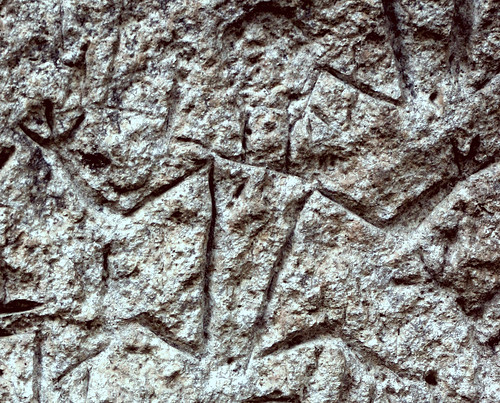
    Soria, J., Siringan, F., Parreno, P. "Compaction rates and paleo-sea levels along the delta complex north of Manila Bay, Luzon Island, Philippines," Science Diliman, North America, 17, jun. 2007. Available at: http://journals.upd.edu.ph/index.php/sciencediliman/article/view/63/14. Date accessed: 09 May. 2009.