Showing posts sorted by relevance for query kundalini. Sort by date Show all posts

Saturday, October 29, 2005

Glossary: The Inner Volcano

In yoga and tantra tradition, the kundalini represents a form of energy often likened to a fiery serpent that resides in the sacrum region of the body. The kundalini is mentioned as early as the Upanishadic period in ancient India. The goal of the practitioner is to arouse or awaken the kundalini sparking what is often described as a volcano-like eruption of fiery bodily energy.

The kundalini fire is said to quickly rise up the spinal cord flooding all the intermediate channels before reaching the Sahasranacakra, an energy center at the crown of the head.

Chinese Taoists describe a spiritual alchemy in which the human breath and reproductive seed form the base elements for internal transmutation of an energy likened to liquid or molten gold. The molten, purified gold also moves upward through the body toward the crown of the head.

As with the Indian kundalini, the furnace for the Taoist alchemical process is located in the region around the groin and base of the spine, the "lower" parts of the body. Yogic tradition describes the first cakra, one of seven spiraling energy centers in the body, as the root or earth cakra. It is located right at the base of the spine.

The kundalini has been described as residing in the earth chakra with the brilliance of "ten million suns." The idea of the Sun within the Earth is one we have discussed here before with reference to volcanic imagery. The kundalini has also been linked with the Vedic Agni, the divine personification of fire, who is often described in the early hymns as "deeply hidden," or as a "thief lurking in a dark cave" or as "seated in a secret place."

Vedic hymns also say that Agni lives in the midst of the sea or within the waters. This may be a reference to the submarine fire of Indian belief, later called the Vadavamukha, and visualized as an undersea volcano shaped like a mare's head. The Vadavamukha was located in the far south, at times placed right at the South Pole, and was said to consume the waters of the ocean.

In Rgveda 2.35.3, we read that the rivers collect water for the propitiation of the ocean-fire.

According to Hindu eschatology, at the twilight of the ages, the Vadavamukha explodes or erupts in a cataclysm that destroys the world.

A good paper studying the relationship of Agni with the kundalini can be found at the following URL:

http://www.al-qiyamah.org/pdf_files/god_agni_as_kundalini_(yrec.org).pdf


In the Yogakundalini Upanishad and Hathayogapradipika, the method of arousing the kundali is referred to as manthana or "churning." In a similar sense the Vedic hymns use the phrase "churning up" in reference to kindling a fire.

You may recall the churning of the Milky Ocean motif in which giant Mt. Mandara sitting on the back of a great turtle is used to churn the sea. The great heat created by the churning action eventually sets the top of the mountain ablaze. From the resulting storm, rivers of ash created from the incinerated forest and mountaintop flow down into the sea. This milky-looking ash flow is described as "amrita" or "elixir."

In a similar sense, the Taoists also used the term "elixir of immortality" to describe the "molten gold" of internal alchemy. The meditation cycle consists of inhaling and mixing the breath with the vital (sexual) seed. The heat created removes the "dross" from the reaction which is expelled from the body during exhalation. The energy elixir created flows up through the body's central channel and out of the crown of the head. In the same, way the kundalini fire erupts out of the Sahasranacakra.


In Southeast Asia and into the farthest reaches of the Pacific, there exists numerous beliefs in the existence of three selfs or bodies -- the lower body, the middle body and the upper body. The upper body is often said to be detached from the physical body and to exist in heaven.

All three bodies are connected via a "cord," the spinal cord with reference to the physical self, and an invisible cord for the heavenly body that extends toward heaven through the anterior fontanelle. The latter is basically the equivalent of the Crown Cakra.

Again, this reminds us of the holy mountain as the axis that links the three worlds -- lower, middle and upper. This mountain most often has a hole or opening, usually placed at the top in the same sense as a volcano.

Regards,
Paul Kekai Manansala
Sacramento

Thursday, October 02, 2008

Symbiosis

Indian yogis claim that a latent force, spirit, being, etc. known as the Kundalini dwells within humans in a type of sleeping state.

Through yogic meditative practices, the Kundalini can be aroused causing the practitioner to enter a state of entasy or meditative absorption and unity with the divine. The Kundalini is often portrayed as a serpent or serpent-like creature that dwells in the sacral region until awakened in a fiery conflagration when it ascends upward toward the head.

In Christianity, the Holy Spirit is thought of as a spirit that descends from Heaven and dwells within believers causing a state of ecstasy. The Holy Spirit is also a type of spirit guide that leads people to speak in tongues, prophesy, etc. This spirit is portrayed generally as bird, specifically a dove. In the New Testament, when Jesus is baptized at the Jordan, he is also anointed by the Holy Spirit from above in the form of a dove.

In Christian art and literature, the Holy Spirit is usually depicted as a dove hovering above, flying toward or around, or actually standing on a person's head. The New Testament also depicts the Holy Spirit as flames on the heads of the disciples.


The symbolism of bird and serpent would of course be familiar to those who have followed this blog, which is partly named after these creatures. The cosmic tree has been discussed here that is commonly depicted with a serpent at its roots and a bird resting in the topmost branches. Interestingly, in the yoga of Kundalini, the spinal column is also viewed as a type of cosmic tree in microcosm.

When aroused, the Kundalini serpent ascends the spine toward the top of the head. Like the Holy Spirit, the Kundalini is seen also as a form of the Divine, in this case of the female principle or Goddess known as Sakti. About its fiery awakening, it ascends to unite with male divine principle located at the top of the head bringing the subject into a state of divine union or entasy.

The Holy Spirit, instead descends from Heaven in dove form, as a part of the Trinity it is also one with Divine and communes with the subject by entering or resting upon the head causing here a state of ecstasy and union.


The Kundalini took the form of a coiled serpent.


Devaraja

In medieval Southeast Asia, the Devaraja royal cult made the king into a form of the Divinity. Not so much as an avatar though, but as a host for the Deity.

For example, an avatar is usually seen as god that incarnates at birth as a human. But in the Devaraja system, it is only the installed King who is identified with the god. Thus, the Crown Prince is not also seen in the same divine light as the King.

In the scholarly literature, the spirit of the Deity is known as the "royal ego." In Java and Cambodia, the royal ego was permanently located in a linga, a phallic symbol, placed atop the king's royal ziggurat.

When the king was installed, the royal ego, or part of it, descends upon the king giving him divine status. When the king dies, the royal ego returns to the linga. When the crown prince succeeds his father in ritual ceremonies, the royal ego then descends once more from the linga to commune with the new kingly host.

Again, readers of this blog will recognize the pyramidical temple of the king as a form of the holy mountain or volcano. The linga itself can be seen as the cosmic tree that usually is depicted as resting atop the sacred mount, a form of the fiery pillar associated with a volcanic eruption. It doesn't take much to see the royal ego as a bird perched in the branches of the cosmic tree that descends to anoint the new king. In the same sense, the linga has serpent or dragon connotations in this belief system.

In relation to this, we can note also the widespread concept in Insular Southeast Asia of the bird-double or bird-spirit. This is apparently a symbiotic form of the self that can leave the body on flights of spiritual exploration. In the primal Austronesian sphere, especially in those areas characterized by hydraulic engineering, the domains were centered around mountains, and the domain leaders were invariably linked with these central mountains.

While the Kundalini, Holy Spirit and Royal Ego are forms of symbionts that dwell within the body of the host, there are other forms of symbiosis that involve spirits that dwell instead in objects like amulets, fetishes, talimans and icons. The stories of the Holy Grail serve as one example.


Holy Grail

Grail scholars have long argued as to whether the spirit associated with the Holy Grail was in fact the Holy Spirit.

Robert de Boron, in his early Grail romance, claimed that the voice of the Grail was that of the Holy Ghost. Wolfram von Eschenbach states that every Good Friday, the Holy Spirit descended upon the Grail to renew its powers. The main objection to this among Christian apologists is that the Grail was said to be sent away to some island or to Heaven in the romantic literature.

However, this problem did not dissuade all later authors. Certain literature like The Count and the Quest, Didot-Modena Perceval, Perlesvaus and Titurel indeed claim that the Holy Ghost was carried away to some distant place.

What the Grail authors agree upon is that the Grail acts as a guide to the Grail Knights, Maidens and King, all of whom it personally chooses.

Far away to the East, the concept of objects invested with guiding spirits is linked in the study of the Austronesian world with the related terms anitu, anito, nitu, etc. The anitu is the spirit or soul that can be associated with any type of object from a rice plant to a volcanic mountain. In this blog, the anitus of the sacred jars, the pusaka heirlooms, and the anting-anting amulets have been examined in particular.

In the case of the sacred jar or the lusung rice mortar, we have seen these objects as forms or symbols of the sacred volcano of the Nusantao. Anitu are often related with deified ancestral spirits and in the belief systems around Mt. Pinatubo and Mt. Arayat, the Earth together with the Sky or Sun are the ultimate ancestors. The "tibuan" is the earth that acts as mother to all things, being derived from the root "tubo" as in Pina-tubo, the sacred volcano.

Therefore, the sacred jar is in a sense a form of the cosmos, the cosmic mountain, in microcosm. The "voice" from the sacred jar is linked with anitu, which in this case can be associated with the Divine or with Nature as the ultimate principle. In a similar sense, the Grail becomes a type of vessel or home for the Holy Spirit according to one interpretation.

In the Philippine region, the ancient idea of communion with the divine was rooted in concepts related to time. The pantheistic or monistic Deity is often identified with Sacred Time. The related sets of words niu, nio, nu, nuan and nunu; and calma, karma, karkarma are connected to these concepts of universality. These word sets use the same root source to convey the meanings of ancestors, especially deified or beatified ancestors; the soul of the individual; and one's destiny or fortune.

From the view of cyclical time, the ancestors represent the past; the soul stands for the present; and one's destiny or fortune is the future.


Cyclic Symbiosis

Buddhist and Indian religious texts outline the belief of a cyclic ruler known as the Cakkavatti or Chakravartin, who like the Buddha, appears rarely at the downside end of cyclic periods.

When the dharma or law has decaded to its lowest state, the Cakkavatti is born and there eventually arise certain treasures that are said to aid this new king in washing out the old and bringing in a new golden age.

The most important treasure is the Cakkaratana, an animated discus or wheel-like "being," that descends out of its place in Heaven known as the Cakkadaha. It has the appearance of three concentric wheels moving at once. Like the Grail, the Cakkaratana seems to have a spirit of its own. It travels to the Cakkavatti King, who then anoints it with water and talks to the Cakkaratana asking it to help him conquer the world.

When the Cakkavatti is about to die, the Cakkaratana knows this and eventually disappears only returning after his successor has lived righteously for seven days.

I have discussed previously how the treasures of the Cakkavatti resemble those that arose during the Churning of the Milky Ocean episode found in Hindu texts. This geologic event I interpreted as alluding to a volcanic eruption.

Now, volcanic eruptions in this blog are explained as occurring during the meeting of Heaven and Earth, or specifically the Sun and the Sacred Volcano. The fiery conflagration during this encounter produces the "milk" i.e. the volcanic ash that creates the Ocean of Milk. And from this ocean, arise the treasures of the New Age.

Kundalini yoga also envisions the Kundalini as a serpent creature dwelling in the sacrum covered with sulfur, one of the substances closely linked with natural volcanoes. Indeed, the fiery awakening of the Kundalini has been likened with both a volcanic eruption and the mythic Churning of the Milky Ocean. The arousal is even specifically described as "churning" in certain traditional texts. Rising up the spinal column the female Kundalini unites with the male principle at the top of the head, the Crown Chakra.

Interestingly, the Holy Spirit also has fiery association and is depicted as flames rising from the heads of the Apostles.


In the cyclic interpretation of symbiosis, there arises periodically a new spirit or anitu, a product of Heaven and Earth that unites with the destiny of humanity acting as a guide in the process of renewal.

Regards,
Paul Kekai Manansala
Sacramento

References

Malalasekera, G. P. Dictionary of Pali Proper Names: Pali-English, Asian Educational Services, 2003, 1343-4.

Sharan, Mahesh Kumar and Mahesh Kumar Sharan Abhinav. Studies in Sanskrit Inscriptions of Ancient Cambodia, Abhinav Publications, 2003, 259-9.

Waite, Arthur Edward. The Holy Grail: The Galahad Quest in Arthurian Literature, Kessinger Publishing, 1993.

Monday, February 01, 2010

Red Gold of Alchemy

According to the Chinese historical text Shiji, the 2nd century BCE wizard Li Shaojun advised the Qin Emperor to make food vessels of cinnabar turned into gold to help prolong life.

Li Shaojun learned the formula for "cinnabar gold" from Master Anqi of Penglai. According to later texts, cinnabar gold was "red gold." The Shiji states that when emissary Xu Fu was sent as an emissary to find Master Anqi, he encountered a 'great spirit' at sea that led him toward the southeast toward Sandao "Three Islands" of which Penglai was the most noteworthy.

Some 1800 years later, we hear of Japanese merchants who traveled to Mishima 三島 由 (Chinese: Sandao 三島), where they sought highly-prized jars. Mishima or the "Three Islands" at that time consisted of Luzon, Taiwan and Macau. Of these, Luzon was the most important in terms of its highly prized Ruson-tsubo wares.


Golden bird ornaments at Ayala Museum


While many years had passed between these two periods, I believe there is a connection between the cinnabar gold food and drink vessels of Master Anqi of Penglai, and the Ruson-tsubo wares used for tea ceremonies by the Japanese shoguns and emperor.

Now in terms of the location of Sandao and Penglai, as noted Xu Fu was lead by sea to the southeast and I discuss Penglai's location and related geographic areas in the post Qingtong, Lord Lad of the East.

Penglai continues to figure in historical and semi-historical texts into the late ancient period in which it is directly related to the region of Fusang -- a connection that was indirectly hinted at in earlier sources. In the Tang Dynasty, the area was known as Foshi, and in the Sung Dynasty, Sanyu (三嶼) and Sanfotsi were probably equated with Sandao.

The placename Sandao appears again in historical records during the Yuan Dynasty, as a kingdom along the Eastern Ship Route.


Transmuting to gold

In my post on tumbaga and alchemy, I suggest that the "transmutation" of metals like copper into gold may have been an ancient reference to depletion gilding. In the last posting on goldworking, I discuss the practice in the Philippines of using red earth mixed with salt for depletion gilding at the last stage to remove any silver at the surface.

We cannot assume that the ancients understood the chemical processes at work, and it may be that they actually viewed depletion gilding as a transmutation of an alloy into pure gold. As noted, early Europeans like Juan de Salcedo and Hernando Riquel commented that even the most skilled silversmiths during the Renaissance period could not distinguish such alloys. The touchstone assay did not work, and de Salcedo says that only melting down the objects, i.e., the fire assay, could reveal the truth.

The red earth, then, could have been seen as the Philosopher's Stone, the magical material that transmutes base metals into gold.

In reality, it is believed that the red earth contained ferrous sulphate that when sufficiently heated releases its sulfur. The sulfur combines with silver to form silver sulfate. The metal is cooled and the silver sulfate is polished off leaving a pure gold surface.

During the medieval period, the Philosopher's Stone was generally thought of as a red substance. Many Chinese alchemists believed that cinnabar was the Philosopher's Stone, while the Muslims used the name al-Kibrit al-Ahmar الكبريت الأحمر "red sulfur."

The idea of the red color may come from the notion of cinnabar changed into gold during the Qin Empire. What this may refer to is the process of depletion gilding in Penglai that was taught by the Master Anqi. The technique may have used the same red earth that was mentioned some 2,000 years later in the same region.

Red earth gets its color normally either from the presence of iron or cinnabar in the soil or clay. In many cultures, red earth or red ochre is viewed in relation to blood, the fluid of life. In ancient China, it was cinnabar-rich earth rather than red ochre that was thought of in this manner.

So, the ancient Chinese alchemists may have viewed the red earth used for depletion gilding as cinnabar -- the Philosopher's Stone that transmutes base metals into gold.


The color red

Red ochre, red clay and the red color have a very important role in Philippine archaeology and ethnography. The archaeologist Jesus T. Peralta wrote a book" "The tinge of red: prehistory of art in the Philippines," the title of which highlights the importance of this color.

Red ochre was used in some of the earliest burials in the country such as those found at Tabon and Arku caves. The ochre was used to paint burial pottery, and skeletons were painted with red ochre before secondary burial. In some cases, skeletons were completely buried in red ochre. In Pila, Laguna, basins of red ochre (adobe) were used for cremation rites.

The color red was used for the clothing of warriors and their wives, and for the clothing of chiefs and nobles. To this day, indigenous peoples in the Philippines still use red as an important ritual color. The Kalinga see red as the color of health, strength and power. José Semblante Buenconsejo writes concerning the Manobo of Mindanao that the color red represents ritual blood, which in turn gives "fire, life, vitality to those persons and objects" involved in the ritual. The ancient Bisayans were said to have painted their bodies with red clay.

Blood of sacrifices was often smeared on sick people by the local healers due to its perceived health-giving property. And blood along with clay have an important role in the stories of creation in the Philippines and throughout the Southeast Asian region.

Damiana Eugenio gives 15 examples of Philippine myths in which humans, animals or other living things are formed out of clay. In one of these, the clay is mixed with blood. Among the Igorots of Sagada, red clay receives its color from mixture with human blood. In nearby Borneo, there are many myths in which blood is used as a temper for the clay used to form humans and other living things.


Volcanic clay and blood

Mt. Pinatubo's name can be interpreted as the "One that causes birth, sprouting, growth, conception, originating, beginning...," as opposed to Mt. Arayat to the east, also known as Mt. Sinukuan. The latter name comes from suku, which refers instead to death, surrender and ending.

The name of Pinatubo's deity (Apo Namalyari) can be interpreted as "One who enables" or "One who makes possible," and is in-keeping with the idea of Apo Namalyari as the creator god. In many regional myths, creation takes place after catastrophic events. For example, in a Bontoc Igorot myth, Lumawig creates the plants, animals and humans after a great battle between the Earth and Waters in which great stones are hurled through the air and the world is covered by a great flood. In a Bukidnon myth, the great Magbabaya gods allow themselves to be killed so their bodies and blood can be used for creation. A great rain of blood from one Magbabaya sinks into the ground and becomes animals, fish and plants.

Pinatubo's eruptions, I have suggested, were seen by ancient observers as a type of cosmic birth pangs and delivery -- originally of the entire creation and subsequently of the new golden age. The volcanic ash and lahar would then be the cosmic afterbirth.

Volcanic ash slowly weathers into clay at the rate of about 1 meter every 200 years, but the process begins immediately. Thus, witnesses to an ancient eruption could see thin layers of clay arising from weathered volcanic ash. Such clay was considered the building block of living things and this may not be too far from the scientific truth. A recent theory suggests that life, or at least the amino acids necessary for life, may have originated in volcanic clay. Such clay usually contains all the elements necessary to create life plus a volcanic gas, carbonyl sulfide (COS), that may have acted as a catalyst for the formation of amino acid chains.

Ancient observers would have been particularly interested in red clay, since they could have seen the red color as representing the cosmic uterine blood, the life fluid of red-blooded creatures like humans. In this red clay, one could reasonably expect to find the "secret ingredient" to health and longevity.

The red clay on its own was significant enough, so that if we add the added quality of its apparent ability to transmute other metals into gold -- the most stable of metals -- we can see how easily this red earth could be interpreted as the Philosopher's Stone. And how jars and other vessels made from this red clay would have certain "magical" qualities.

Thus, we find that the Philippine goldsmiths also used red earth to give gold a reddish tint, and maybe also with the idea that the red earth could help preserve golden heirlooms. The purer types of gold were handed down as heirlooms and relics. These heirlooms were considered sacred and were connected with the ancestors, and one's fate on the earth.

Even lowland Christianized Filipinos have kept such heirlooms until recent times. In Pampanga, heirloom jewelry is usually called tumbaga, interestingly enough, regardless of what it was made of. My paternal grandmother had a tumbaga heirloom that she had melted down and turned into rings for her children.

Red gold must have been ancient because one of the Proto-Austronesian reconstructions for "gold" *bulaw-an suggests a metal of a reddish color (bulaw "reddish, reddish gold"). Indeed, in the Philippines, the term pula in Ilocano and Tagalog refers primarily to tinting gold into a reddish color with red ochre (Tag. gintong pula "red gold"). Givin that there is another suggested Proto-Austronesian word for gold *emas, it may be that *bulaw-an referred originally to an ancient gold that was colored with red earth. The oldest archaeological gold in the Philippines is estimated to date to at least 450 BCE to 250 BCE, although the actual sites involved, like those at Duyong Cave were not dated. We will probably have to wait for further discoveries to get the oldest dates for gold in the country.

Possibly ancient Chinese alchemists confused the use of sacred red clay jars and symbolic red gold, for the idea that metals changed into gold with red earth, i.e. cinnabar, could be used to create live-giving vessels for food and drink. Or the original practice drifted in this direction. At a latter date, this idea morphed into a belief that the "elixir of life" was colloidal gold made with mercury extracted from cinnabar.


Sacred jars

Earthenware jars were among the ancient heirlooms kept in Pampanga and the surrounding region. Among the Kapampangans, these were known as balasini, and they were still being kept during late Spanish times. However, the people were beginning to lose the old ways, and the balasini were often sold at spectacular prices to merchants from Japan and elsewhere. As people became "modernized," they no longer shared the values that motivated their ancestors to keep these heirlooms. In the same way, many tumbaga jewelry heirlooms, which tended to last longer because of more practical value, were eventually sold or melted down.

The "Luzon Jars" were known for their unique ability to preserve tea leaves and tea stored in them. Jean Mallat, writing in the 1840s, tells of the red clay water jars in Cebu that "impart great freshness to the water they held."

Indeed even many people still alive today can attest to how the old clay water jars seem to keep water fresher and sweeter than other sources. In ancient times, when there were no water purification plants, refrigerators, etc. such a quality could not be underestimated.

Now, the red clay jars high is sulfur would be the best types in this regard since sulfur is a natural preservative agent and would inhibit the growth of microbes, fungi and mold. Thus the red clay used for depletion gilding, known in Pampanga as sapo, would be the very best because of its high sulfur content. Some volcanoes, like Mt. Pinatubo, release high sulfur volcanic ash that becomes high sulfur volcanic clay. However, red clay containing ferrous sulphate would have been valued for use as sangag, the mixture of red earth and salt, used for "transmutation" purposes since ferrous sulphate has a fairly low combustion point. At about 600°C or well below the melting point of gold, ferrous sulphate releases sulfur as sulfur trioxide gas, which reacts with silver allowing the resulting compound to be polished off from the surface.

With these qualities, the red clay jars would indeed match the spiritual and mundane significations of the color red and the primordial clay ingredient of life. Such jars would have been highly valued and never traded originally, but instead handed down as heirlooms.


Gold elixir

In China, alchemy took two directions. One was toward "aurifiction," the creation of an artificial "gold." Interestingly, the related gold alloy was actually known as "purple sheen gold" and had a purple or violet surface rather than a gold-colored one. The outward tinting was created by a patina consisting of a coating of various substance including cinnabar, mercury and realgar that is pickled in vinegar (acetic acid) and copper salts.

The other type of metallurgical alchemy involved the creation of colloidal suspensions of gold particles and other elixirs of colloidal minerals. These elixirs used mercury to dissolve gold and other metals, and the practice apparently developed in China from whence it spread throughout Asia into Europe and Africa.

Most of this diffusion happened during the "Tantric period" of the Middle Ages when there was a great exchange of culture between South Asia and East/Southeast Asia. With the Muslim conquests, many ideas were absorbed by the Muslim invaders and transmitted by them to Europe and Africa. The Muslim alchemist Geber apparently was primarily responsible for relaying the alchemy of gold elixirs into Europe.


Diane de Pointers, mistress of 16th century king Henry II of France died of poisoning from gold elixirs, scientists have discovered (Source: Telegraph, http://www.telegraph.co.uk/news/worldnews/europe/france/6865939/French-kings-mistress-poisoned-by-gold-elixir.html)


The alchemist "Nagarjuna" who is said to have imported the goddess Tara and mercury from "Mahacina," into India may have come originally from Vietnam or somewhere else on mainland Southeast Asia.

In addition to the metallurgical alchemy, aspects of "inner alchemy" also arose during this period of Tantric exchange. Some ideas originated from Daoist meditation practices. Aspects of hatha or kundalini yoga might be termed "volcano yoga" in that they use volcanic imagery in describing the efforts to generate internal "heat" through meditation. In Tibet, this is known as tummo yoga and was imported by Naropa at around the same time that the Kalacakra doctrine arrives in that country.

The inner union of "mercury" and "sulfur" may be compared to the geologic co-mingling between Pinatubo and Arayat before an eruption. In the myths of the battles between these two mountains, the fighting always accompanies courtship between the gods of the two peaks. The eruption creates the clay of Sun (Arayat) and Moon (Pinatubo) providing the substance for the creation of life or the start of a new golden age. The red clay represented the substance that unites all living things with the Earth (and Sky).

In internal alchemy, the union of the two principles creates "heat" sometimes symbolized as a fiery pearl. In Kapampangan parlance, we can call this pearl Mutia (Mutya, Mukti), the fire or spirit that creates life or drives the New Age on the cosmic scale, and on the personal level helps the practitioner unite with the pantheistic whole.

Serlingpa, the king of the "Golden Island," included elements of internal alchemy in the Kalacakra Tantra, and also possibly in the Vimalaprabhu commentary, which according to John Newman he may also have authored. The Kalacakra promoted pluralism and universalism by focusing on the interconnection and interdependence of all things, particularly as revealed by the cycles of time.


Philosopher's Stone for sale

As the people of the Luzon adopted a new religion, the value of the ancient clay jars became limited to their practical usage as water or beverage containers. The importance of ancestral heirlooms faded as the culture changed. Certainly the jars in their mind were not worth the astounding sums offered for them.

However, the indigenous people along with groups from afar still seemed to recognize the ancient value assigned to these jars. In many cases, it is otherwise impossible to explain the fact that owners would not part with these jars for any price, or that buyers would offer to pay extravagant prices for wares that were old and fragile.

The most valued Luzon Jars in Japan were the old ones made of earthenware described as reddish-brown, brown, red or dark in color.

Interestingly, the sulfurous products have again become prominent in local commerce after the eruption of Mt. Pinatubo in 1991. Pinatubo Lake is rich in sulphates and tour guides advertise the healthy benefits of bathing in the sulfurous waters. At a nearby Korean-owned spa, facials or full body treatments in sulfur-rich ash and mud are offered to tourists, again for their claimed benefits to skin and health.

Regards,
Paul Kekai Manansala
Sacramento


References

Buenconsejo, José S. Songs and Gifts at the Frontier: Person and Exchange in the Agusan Manobo Possession Ritual, Philippines (Current Research in Ethnomusicology, Outstanding
Dissertations, vol. 4), Routledge, 2001, 147-8.

Gerrard, John. Mountain Environments: An Examination of the Physical Geography of Mountains. Cambridge, Mass: MIT Press, 1990, 201.

Needham, Joseph. Science and Civilisation in China, vol. 5, part 2. London: C.U.P., 1974.

Raedt, Jules de. Kalinga Sacrifice. Cordillera monograph, 04. Baguio City: Cordillera Studies Center, University of the Philippines College Baguio, 1989, 92.

White, David Gordon. The Alchemical Body: Siddha Traditions in Medieval India. Chicago: University of Chicago Press, 2007.

Thursday, September 07, 2006

Alchemy (Glossary)

The alchemy referred to here is that centered around the use of sulfur and mercury, and their compound, cinnabar, or mercury sulfide, to transmute base metals into gold, and to extend human life.

Many believe this form of alchemy has its basis in earlier spiritual alchemy and cosmology. Some suggest that the concept of "signatures" and cinnabar's similarity in color to human blood, the fluid of life, drives the philosophy of alchemy.

Humans have used red colored materials like red ochre since prehistoric times. The presence of ochre in burials may have had some link with concepts of immortality. In ancient Egypt, the practice of painting men in red color, and women in yellow color, when in the presence of deities, may have some ancient relationship to the contrasts of red and yellow ochre.

In ancient China, cinnabar appears as a burial item at least by the late Neolithic and possibly as early as the Yangshao period. In latter times, cinnabar was used to preserve the body of the dead. In Southeast Asia, the use of red ochre to cover bodies during burial dates back to the Mesolithic Hoabinhian culture. Oppenheimer states:


The main areas with the story of man made from red earth are Southeast Asia, Oceania and some Mundaic tribes in India. All these areas, except eastern Polyneisa, have abundant red and laterite soils.


Oppenheimer also notes the distribution of myths attributing the redness of the clay to tempering with divine blood and its close approximation with red clay-first man myths, and suggests that the red clays here were used as a surrogate for blood. In China, both red ochre and cinnabar could be used as substitutes for blood in rituals.

Also, in Southeast Asia, red clay was eaten during pregnancy and for health purposes. This may relate to the practice that arose in China of consuming collodial cinnabar.

The Elixir

Needham has accumulated evidence suggesting that by the Zhou (Chou) dynasty, the concept of cinnabar and mercury as contributing to immortality had become established. Also it was in this period that mercury was distilled from cinnabar, a process releasing the sulfur as gaseous sulfur dioxide (SO2).

In the Shiji, the Qin Emperor is advised to make gold from cinnabar which can be used in turn to make drinking and eating vessels to prolong life:


Li Shaojun then advised the emperor, "If you sacrifice to the fireplace you can call the spirits to you, and if the spirits come you can transform cinnabar into gold. Using this gold, you may make driking and eating vessels, which will prolong the years of your life. With prolonged life you may visit the immortals who live on the island of Penglai in the middle of the sea. If you visit them and perform the Feng and Shan sacrifices, you will never die."


The "gold" here was interpreted by later alchemists as an amalgam of gold with cinnabar. However, "gold" in this instance might also be a metaphor for something like the Philosopher's Stone in European alchemy. It was used to create vessels that prolonged life.

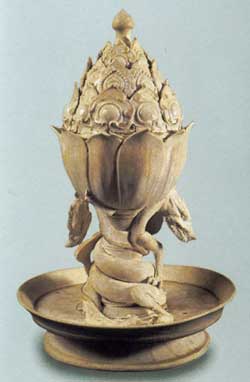
The mention of Penglai is also important. In the older Daoist cosmologies, the central mountain of Penglai was viewed as rising out of the sea. The summit, or "navel," of this mountain is hollow, and extends to the deepest parts of the ocean, where lies the "Cinnabar Field," the source of all living beings. This scene is depicted on the famed Boshanlu censers.

On Penglai, also are the mushrooms of immortality, that grow over deposits of cinnabar and gold. The Chinese recognized that gold often lies above cinnabar deposits in mountains, and believed that gold was naturally transmuted from cinnabar.


Tang dynasty bonshanlu depicting Penglai. The mushroom at the top represented the mushroom of immortality, or the central mountain. Quite easily it might also stand for the "tree of life," the mushroom cloud of an erupting volcano. Source: http://www.21ceramics.com/taoci%20history/baiciimage.htm


Undated bronze boshanlu. Source: http://www.weisbrodltd.com/createpg.cgi?ctlgcode=14&pagenum=13


Boshanlu from Western Han dynasty. Notice depiction of waves lapping on shores of Penglai. Source: http://www.weisbrodltd.com/createpg.cgi?ctlgcode=14&pagenum=13

The divine mushroom was seen as a product of the sublimation of gold and cinnabar that grew over these mineral deposits. The mushroom even glowed in the dark allowing the immortals to find the sought-after lodes of minerals in addition to the fungi. Here also in Penglai were cinnabar caves inhabited by the Phoenix of the South, which the Shanhaijing describes as looking like a cinnabar-red rooster, and probably where would one would also find the auspicious giant bats of Penglai.

Later, possibly under Buddhist influence, these aspects were partly transferred to, or mirrored in, Mount Kun-lun to the west of China.

Volcanic images

Chinese texts describe the hollow summit of Mount Penglai as reaching down into the subterranean or submarine depths matching common imagery of the volcano in many cultures.

Sources of cinnabar, and its separate elements, sulfur and mercury, are nearly always located near volcanoes, hot springs or fumaroles.

Mention of the Cinnabar Field under the hollow mountain of Penglai appears to express this reality. In latter European alchemy, volcanoes were seen as natural laboratories that produced all the base metals from differing combinations of sulfur and mercury, to which they added from Arabian alchemical influence, the neutralizing element of salt.

The "Philosopher's Stone" was described as a red, glassy powder that could transmute base metals to gold, improve health and extend the life of the aged. In the sense that it could convert other metals it stood as a synthetic agent by which the natural processes of the volcano could be reproduced.

Li Shaojun's statement above indicates that in the time of the Qin Emperor certain food and drink vessels existed that were thought capable of extending life.

These vessels may have had some component of cinnabar and/or gold, or possibly the term "gold" here was a symbolic one as often used in the art of alchemy.

If such vessels were made of clay with some degree of cinnabar, it would have impressed the Chinese for at least a few reasons. Firstly, cinnabar as mentioned above, appears to have mostly taken the place of red ochre as a substitute for life-giving blood. They used it in burials, rituals and as a pigment in divination and other sacred writing.

Secondly, cinnabar contains mercury and is considered by many to be toxic, although others feel that it is not so harmful when bound in a stable fashion with other metals. Vessels containing cinnabar which did not have the normal toxic properties but instead had tonic and therapeutic qualities would have deeply impressed the Chinese who had high cultural regard for cinnabar. Also, as cinnabar contained the two base ingredients believed mutable into any other base metal, a vessel containing cinnabar without the normal harmful effects would appear as quite a coup.

Thus, alchemy may have started as an attempt to synthetically produce the material of the life-extending food and drink vessels using cinnabar as a key ingredient.

In Southeast Asia, cinnabar, mercury and sulfur only appear to became important in most areas at a late period. The Dian kingdom of Yunnan probably used an amalgam of gold and mercury in gilding burial good objects dated from 600 BCE to 300 BCE. However, generally Southeast Asians used red clay as a substitute and significator of blood.

Some of the red clays though did contain natural cinnabar. For example, red clay tested at a cave near the Tubuoy River in Pangasinan, Philippines during 1913 contained 1 percent mercury that was believed to be present in cinnabar native to the clay. The cinnabar may contribute to the red color along with iron, and this clay tends to darken with exposure to the Sun and through oxidation.

Theorectically, cinnabar present in vessels made at least partly of volcanic clay would leak little if any mercury present in the sulfide because of the strong binding properties of montmorillonite and similar minerals.

Yin and Yang, Sulfur and Mercury

The Daoists and Tantrics classified sulfur as female and mercury as male. The Arabs and Europeans reversed this classification. Paracelsus and others used the "sulfurous" and "mercurial" categories to classify all things in nature.

A key Tantric text of the Western Transmission likens the Muladhara Cakra, representing the earth and the acting as the seat of the Kundalini as the body's equivalent of the Vadavanala, the latter's description matching that of a submarine volcano.

The uterine blood of the Goddess in Tantric practice is equated to sulfur which resides in the lower parts of the body dominated by that element.

Around the middle of the 7th century CE, Chinese alchemists began moving more toward the idea of liquid elixir rather than the elixir-based vessels mentioned in the Shiji. Using the principle of "like produces like," the alchemists believed that consuming minerals like gold and cinnabar would create in the body properties similar to those in the metals.

Some of these "elixirs" proved deadly as they contained pure mercury, and other toxic minerals like lead and arsenic.

Even centuries later though, an enlightened alchemist like Isaac Newton, would still write of how he regularly consumed such potions that appear to have adversely effected his health, and traces of which have been revealed through modern testing.

In Southeast Asia, the practice of drinking toxic tonics also caught on eventually. Pigafetta states upon encountering the Prince of Luzon in Brunei: "Those Moros go naked as do the other peoples. They drink quick-silver -- the sick man drinks it to cleanse himself, and the well man to preserve his health."

While the use of toxic metals eventually fell out of fashion in most places, spiritual alchemy, which evolved in parallel with the chemical variety, continues in many forms strongly to the present with practices like Kundalini Yoga and Daoist meditation.

Regards,
Paul Kekai Manansala
Sacramento

References

Mahdihassan, S. "History of Cinnabar as Drug, the Natural Substance and the Synthetic Product," Indian Journal of History of Sciences 22(1): 63-70. 1987.

Schipper, Kristofer. The Taoist Body, University of California Press, 1994.

Tuesday, September 05, 2006

Luzon Jars (Glossary)

The Luzon pottery or Rusun-yaki, was renowned for its value in Japan, during the 16th century.

Jars have a long history of sacred and medicinal use in the region of the Philippines and Borneo.

Since Late Neolithic times at least, huge jars or urns were used in this region for primary or secondary burial. The presence of ceramic sherds at many of these burials, apparently from pots smashed during funerary rites, further highlights the spiritual importance of pottery.

Starting in the early to middle medieval period, imported Chinese, Thai and Vietnamese porcelain, sometimes of very high quality, are found along with native earthernwares in excavated burials.

To the present-day, heirloom jars, some massive in size, continue to have spiritual and prestige value among indigenous peoples in the region.

High-priced pots

Just how much they valued the sacred jars can be seen in the amount they were willing to spend on these items, or by their refusal to part with them at any price.

The sacred jar owned by the Datu of Tamparuli in Borneo, was originally sold to a merchant by a Malau chief for two tons of brass cannons, the equivalent in the mid-1800s to 230 pounds sterling. The merchant sold it to the datu for the equivalent in rice of 700 pounds sterling.

When the Sultan of Brunei was offered the equivalent of $100,000 to part with his sacred jar, he said that no offer would be sufficient. Water from the jar was believed to have special magical properties and visiting farmers from as far as the Bisayas in the Philippines were said to have come to obtain a little magic water for their fields.

For the Japanese, the Luzon jar was important because it was the only vessel capable of storing high-quality tea to their liking. From various reports, the jars also appeared to have been viewed as having medicinal and spiritual properties.

The most sensational report of one of these containers comes from Carletti, who reported that the best of the tea-canisters were valued at up to 30,000 pounds sterling, or about US $4 million in 2006 dollars. And these jars were actually used to store tea or tea leaf!

Europeans were astonished at the high amounts paid for these jars, all of which were old, the older the better, and of uncomely appearance. A similar situation was found in Borneo.

Rusun ("Luzon") Sukezaemon's story is well-known in Japan. The Sakai merchant brought back 50 Luzon jars and sold them to agents of the Shogun. He became fabulously rich and built a mansion that put the local castles to shame.

Types of jars

That the Luzon jars were made in Luzon is quite clear from the Tokiko, a work on the Namban, or Southern, ceramics trade.

The Luzon jars are marked as Rusun-tsukuru "made in Luzon" and all the jars from the south are manufactured with "Namban clay." Shogun Hideyoshi had a tsubo or pot purposely manufactured in Luzon during his reign.

Luzon pots, according to the Tokiko, were marked with symbols that relate to the native scripts of the Philippines, and jars with these markings have been found in archaeological works.

Pots (tsubo) were differentiated from the more-valued tea-canisters (cha-ire).

The Japanese were exceptional at distinguishing these pots for quality and in weeding out fakes. A similar situation was noted in Borneo where attempts in China were made, without success, to imitate the ancient wares and sell them on the local market.

The Luzon tea-canisters were of the best quality. However, European witnesses unanimously described the most valued of these vessels as earthenware. The Tokiko says of the Rusun-koroku, or Luzon ware, that it "is soft because it is not thoroughly baked."

Three types of clay were used for glazed wares: white clay which was of the best quality, yellow clay mixed with white clay and sand in the middle, and purplish-black clay was of lowest quality. All Luzon wares were marked with the wheel-mark or rokoru, a clockwise spiral.

The different types of Luzon tea-canisters described in the Tokiko are:

* Stamped with plum-blossoms with thin yellow-green glaze.
* Black-gold glaze.
* Gold glaze.
* Black glaze.
* "Tea-colored glaze and "ears."
* Green-yellow glaze.
* Yellow glaze.
* Rice kettle shape.
* Four knobs.
* Projecting bottom.
* Cleaned of extra clay with a thread (Usu-ito-giri).
* Cord marks? (Hi-tasuki)
* Candy-brown glaze.
* Monrin type.
* With ears.
* Utsumi type.
* "Eggplant" type.
* Divided lids.
* Bizen-shaped.
* Iga-shaped.
* Other types.

According to Antonio de Morga, the most valued jars sought by the Japanese were dark brown in color. Baron Alexander von Siebold confirms this and gives a more detailed description:


The best of them which I have seen were far from beautiful, simply being old, weather -worn, black or dark-brown jars, with pretty broad necks, for storing the tea in...Similar old vessels are preserved amongst the treasures of the Mikado, and the Tycoon, as well as in some of the temples, with all the care due to the most costly jewels, together with documents relating to their history.


Frank Brinkley, in the early 20th century, describes the tea ritual performed by the On-mono-chashi, the Shoguns' tea deputies who wore samurai uniforms, and fetched the "exceedingly homely jars of Luzon pottery to which the Japanese tea-clubs attached extraordinary value."


Every year the Shogun's tea-jars were carried to Uji to be filled. This proceeding was attended with extraordinary ceremonial [sic]. There were nine choice jars in the Shogun's palace, all genuine specimens of Luzon pottery, and three of these were sent each year in turn, two to be filled by the two "deputy families;" the third by the remaining nine families of On-mono-chashi. The jars were carried in solemn procession headed by a master of the tea-cult (cha-no-yu) and a "priest of tea," and accompanied by a large party of guards and attendants. In each fief through which the procession passed it received an ostentatious welcome and was sumptuously feasted. On arrival at Uji the jar, which always left Yedo fifty days before midsummer, stood for a week in a specially prepared store until every vestige of moisture had been expelled, and then, having been filled, were carried to Kyoto and there deposited for a space of one hundred days.


It's quite apparent that these are not celadons as postulated by some. The Japanese were aware of the celadons in Luzon (Rusun no seiji) which they described as shuko seiji "pearl-gray celadon," but these were different than the most valued dark-colored tea-canisters.

Europeans of the 16th century praised and imported both porcelain and celadon from the East. The communion cup of Archbiship Warham, the Lord Chancellor of England from 1504 to 1532, for example, was an imported celadon.

However, European observers of that time and afterward universally disparaged the Luzon tea-canisters. They also refer to these vessels repeatedly as earthenware.

According to the Tokiko, tea leaf kept its quality in these canisters if it touched the bottom or sides of the jar. Thus, it appears that contact with the clay was required to preserve the tea.

In Borneo and the Philippines, the sacred jars are often dated back to the first creation, and the clay is said to come from the gods.

The common division of sacred jars in Borneo mentioned by observers rates the Gusi type, a medium-sized, olive-green-colored jar with "medicinal properties" as having the highest value, followed by the Naga or "dragon jar." The latter is larger than the Gusi and is decorated with Chinese dragon figures. Last comes the Russa jar which is decorated with a representation of a type of deer.

Jars called "Gusi" also appear in the Philippines and Malaysia. They are mostly small to medium-sized but can be of many different colors. Some are stoneware, but most appear as glazed earthenware containers. A type of dark-brown Gusi known as Bergiau was found among the Sea Dayaks and was of higher value than the greenish Gusi.

Although of obvious Chinese influence, geochemical testing and other evidence suggests that dragon jars or Naga were made throughout the Southeast Asian region.

The dragon jars in the Philippines have a unique geochemical signature, but evidence shows that they also imported many dragon jars from elsewhere including the Martabans of Myanmar (Burma).

The sacred origin of the jars is a widespread motif in the region. In Ceram, pottery is one of the divine excretions of the earth goddess Hainuwele.

In Borneo, the sacred jars are made from the clay left over from the creation of the Sun and Moon by Mahatala, or his subject spirits. The Ngaju considered the vessels gifts of the gods, the fruit of the Tree of Life.

Among the Tinguian of the Philippines, the jars are also gifts, from the Sun or Sky-god Kabunian.

Jars similiar to those found in Solheim's "Bau-Malay" culture and to the Geometric Pottery of South China are still manufactured by the Kalinga of northern Luzon, to store water and wine, for fermentation, cooking and other purposes.

Possible explanations

The most prized of the Luzon wares were the locally-made tea canisters made of earthenware and dark brown or black in color marked with a spiral and native script symbols. Contact with the clay from the inside of the jar helped preserve tea. In the Philippines and Borneo, the jars had medicinal and magical properties, and could even speak to the owners and predict the future according to legend.

If we were to speculate on scientific explanations for the medicinal and preservative properties attributed to the Luzon jars, we would first suggest that the finest tea-canisters were unglazed. They belonged to the Rusun-koroku that was "not thoroughly baked" and/or to the Suyakimono or "unglazed wares," both mentioned in the Tokiko.

One of the types of Suyakimono was the Hi-tasuki, possibly marked with a cord or with a corded pattern brought out in relief, that is mentioned above as one of the Luzon tea-canister types.

Fedor Jagor tells of an artifact that he believed matched the descriptions of Luzon tea-canisters given by Antonio de Morga, the governor of the Philippines:


Morga's description suits neither the vessel of Libmanan nor the jar of the British Museum, but rather a vessel brought from Japan a short time ago to our Ethnographical Museum. This is of brown clay, small but of graceful shape, and composed of many pieces cemented together; the joints being gilt and forming a kind of network on the dark ground.


Like most other descriptions of the jars, no mention of any glaze is offered. The earthenware jars were gilded and decorated with brocade making up somewhat for their unsightly appearance.

However, the lack of glaze would explain why contact with the interior of the jar was important in preserving tea leaves. A volcanic clay with minerals like montmorillonite could have possessed the required properties, but the Rusun clay was even more unique than ordinary volcanic types.

Pinatubo volcanic deposits are very high in sulfur, an element with strong preservative properties. Sulfur is also one of the two base elements used by both Eastern and Western alchemists to divide all things into categories similar to Yin and Yang of Chinese cosmology.

Indian alchemy described the kundalini, the volcanic snake-like energy residing near the base of the spine as surrounded by a mass of sulfur.

The other element in this categorization is mercury. Sulfur and mercury are closely associated with volcanoes, fumaroles and hot springs.

Mercury mixed with other metals and then treated with sulfur produces the sulfides, among the most common types of preservatives used today. In ancient times, these sulfides were created by alchemists seeking to reproduce the Philosopher's Stone and similar products.

The Pinatubo eruptive materials are known to be particularly sulfide-rich.

Lastly, we should note that concerning the Suyakimono canisters possibly having "vermillion" cord-like relief or other types of decorations, that the Kalinga potters used carved paddles to create low relief decorations on their local manufacture jars.

Relief decoration on Kalinga pots
Source: Kalinga Ceramics


Bau-Malay-like low relief patterns.


Bau-Malay-like globular shape.


Kalinga storage jar wrapped in twisted rattan. Source: http://curieuxunivers.umontreal.ca/php/fiche.php?No=45MOA&langue=en

Regards,
Paul Kekai Manansala
Sacramento

References

Brinkley, Frank. Japan: Its History, Arts, and Literature, J.B. Millet Company, 1910.

Descantes, Christophe. Hector Neff, and Michael D. Glascock, "Yapese prestige goods: The INAA evidence for an Asian Dragon Jar," pp. 229-256, IN: Geochemical evidence for long-distance exchange, edited by Michael D. Glascock, Westport, Conn. : Bergin and Garvey, 2002.

Jagor, Fedor and William Gifford Palgrave> The Philippines and the Filipinos of Yesterday ..., Oriental commercial company, 1934.

McKibben, Michael A., C. Stewart Eldridge, and Agnes G. Reyes. Sulfur Isotopic Systematics of the June 1991 Mount Pinatubo Eruptions: A SHRIMP Ion Microprobe Study, http://pubs.usgs.gov/pinatubo/mckibben/index.html, 1999.

St. John, Spenser Buckingham. Life in the forests of the Far East, 1862, pp. 27-28, 300-302.

White, David Gordon. The Alchemical Body: Siddha Traditions in Medieval India, University of Chicago Press, 1998, pp. 234-235.