Showing posts with label messianism. Show all posts

Thursday, March 27, 2008

More on Qingtong

Details of Qingtong's realm in Fangzhou described in the Chen Kao (489 CE) coincide with a series of notices about the country of Fusang in other works. The Liangshu, the annals of the Liang Dynasty compiled in the 7th century, tell of a priest or shaman named Huishen who comes to China in 499 CE as an envoy from Fusang. The same source mentions that in 458 CE, missionaries from Ki-pen brought the Buddhist religion to Fusang. The Liang Si Gong Zhi written in 695 tells of envoys from Fusang who bring official gifts in 520 CE.

Given the timing and the fact that one of Qingtong's titles is "Fusang Great Emperor" (Fusang Daidi, 扶桑大帝) , one can say that Qingtong's domain was intended by the Daoists to refer to the contemporary political entity known as Fusang that had sent two missions to China. And again there is the coincidence also of the introduction of Buddhism to Fusang described in the Liangshu and the mention in the Chen Kao of Buddhism in western Lesser Fangzhu.

Huishen's directions to Fusang are rather confused and have led to a great many theories connecting the legendary land to the Americas across the Pacific Ocean. However, as we have noted earlier the older descriptions of Fusang's location are quite different than those given by Huishen. The Fusang priest states that Fusang is tens of thousands of li to the east of Japan. However, at the same time he mentions the Lieu-kieu (Ryukyu) islands as existing to the north of Fusang.

Also, Huishen in attempting to relate the positions of the Kingdom of Dogs and Kingdom of Women, both linked in his story with Fusang, states that these countries had been visited by a ship from a Fujian port that was blown off course. Therefore it seems that even in Huishen's account, we get an idea of the more traditional location of Fusang. The Kingdom of Dogs (Kou kuo) is described in the contemporary (5th century CE) Hou Han Shu as an island located to the southeast of Zhejiang (Kuai-chi county) matching the geographical location for Fangzhu in the Chen Kao. Possibly the journey to the east of Japan mentioned by Huishen is related to some indirect route to Fusang using the Kuroshio Current.

Buddhism appears to have been introduced to Cambodia, known to the Chinese at the time as Chenla, around about 500 CE. Possibly this what is referred to in the Liangshu and the Chen Kao about the existence of the Buddhist religion in the southern regions.

In the Liang Si Gong Zhi, Prince Yukie interrogates the Fusang envoy of 520 CE about his distant kingdom. In the following passages derived from the Marquis d'Hervey de Saint-Denys' translation, the gifts from Fusang are described.

The envoy from Fusang wept, and responded with respectful ardour. The offering which he presented consisted principally of three hundred pounds of yellow silk, spun by the silkworm of the fusang tree, and of an extraordinary strength. The emperor had an incense-burner of massive gold, of a weight of fifty kin. This could be lifted and held suspended by six of these threads without breaking them. There was also among the presents offered to the emperor a sort of semi-transparent precious stone, cut in the form of a mirror, and of the circumference of more than a foot. In observing the sun by reflection by means of this stone, the palace which the sun contains appeared very distinctly.

The silk from the Fusang Tree is probably barkcloth and that would agree with Huishen's account in which the people make writing paper from Fusang Tree bark. The envoy goes on to describe the Kingdom of Women, where he says the female inhabitants marry serpents rather than dogs as in other accounts.

In this kingdom there are no books, and they know nothing of the art of writing. They believe firmly in the efficacy of certain forms of prayers or maledictions. The women who act uprightly prolong their lives, and those who swerve from the right are immediately cut off. The worship of spirits imposes laws that none dare to violate. To the south of Ho-cheu (the Island of Fire) , situated to the south of this country, is the mountain Yen-kuen (Burning Mountain), the inhabitants of which eat locusts, crabs, and hairy serpents, to preserve themselves from the heat. In this land of Ho-cheu, the ho-mu (trees of fire) grow ; their bark furnishes a solid tissue. Upon the summit of the mountain Yen-kuen there live fire rats (ho-shu), the hair of which serves also for the fabrication of an incombustible stuff, which is cleansed by fire instead of by water. To the north of this Kingdom of Women is the Black Valley (He-ko), and north of the Black Valley are mountains so high that they reach to the heavens...The attendants of tbe court were much amused at these stories. They all laughed and clapped their hands, and said that better stories had never been told. A minister of the emperor, named Wang-yun, interrupted Yu-kie with this bantering objection: 'If we believe the official accounts which have been collected regarding the Kingdom of Women, situated to the west of the country of Tsan-yai and to the south of the Kingdom of Dogs (Keu-kwoh), it is merely inhabited by barbarians of the race of the Kiang-jong, who have a woman as their sovereign; but there has never been any question of serpents filling the office of husbands. How do you account for that?' Yu-kie responded with pleasantry with a new explosion of extravagancies, in the midst of which there appeared here and there a true idea, burlesqued for diversion.

These passages indicate that as in almost all ancient and medieval accounts, reliable facts are interspersed into a great deal of legend and hyperbole meant to amuse the listener or reader. The knowledgeable were expected to know how to discern the reliable information from entertainment. Of interest above for the themes of this blog is the mention of the "Island of Fire," and the "Burning Mountain."


Religion in Fangzhu

In the last post, the meditation known as 'ingesting the rays of the Sun and Moon' was mentioned. The name of Fangzhu itself might relate to the reverence of the solar and lunar luminaries.

In Daoism, the fangzhu mirrors were believed to capture the essence of the Sun and the Moon in a manner similar to Cinnabar Gold (danjin), which was used to make dishes and cups.

Further, take one pound of this elixir and place it over a fire. Fan it, and it will transmute itself into a flowing scarlet gold, called Elixir-Gold. If you smear daggers and swords with this Gold, they will keep the other weapons ten thousand miles away. If you cast plates and bowls with the Elixir-Gold and take food and drinks from them, you will live a long life. Just as you can collect a liquid from the [the essences of] the sun and the moon, and obtain their liquor. If you drink it, you will be free from death.

-- Ge Hong (3rd-4th century CE) , Baopu zi, 4.83, (Fabrizio Pregadio, 2006: 117)

In the article on alchemy in this blog, we discuss the story in the Shiji in which the fangshi wizard Lin Shaojun advises the Qin Emperor to use drinking and eating vessels of cinnabar transmuted into gold to prolong life.

Li Shaojun then advised the emperor, "If you sacrifice to the fireplace you can call the spirits to you, and if the spirits come you can transform cinnabar into gold. Using this gold, you may make drinking and eating vessels, which will prolong the years of your life. With prolonged life you may visit the immortals who live on the island of Penglai in the middle of the sea. If you visit them and perform the Feng and Shan sacrifices, you will never die."

The name "Fangzhu" referring to the square mirror basins that absorb the energies of the Sun and Moon, may thus relate to the importance of the Sun and Moon in local spiritual techniques including those practiced by Qingtong.

Qingtong is also specially charged with the duty of distributing to the realized seed people a powerful charm known as the "Bell of Flowing Gold and Fire" (liu-chin huo-ling) . This amulet is apparently modeled on the small globular ornamental bells that appear in the region as early as the Late Ban Chiang and Dongson periods.


Bronze bracelet with small pellet bells from Late Period Ban Chiang.


The Dongson variety of these bells, often worn on the ankles or on the fringes of clothing, is decorated with the signature Dongsonian motif of rows of circles joined by tangents. The well-known "tiger bells" that continue to be made today originate from these more ancient grelots and are still used as charms against danger and demons.

Considered one of the most powerful amulets in Shangqing tradition, this bell is considered to consist of the "elemental essence of the Nine Stars [of the Dipper]," and it allows the adept to magically transport away from danger to a place of safety. Qingtong himself is said to be garbed in a blue-green damask with a small bell as his pendant.


Qingtong and Later Millenarian Traditions

As already noted, the messianic beliefs in Qingtong show obvious links with the Buddhist savior Prince Moonlight. In some of the Prince Moonlight texts, we find the term "Luminous King" or "Mingwang" used for the this messianic figure.

The title Mingwang would appear frequently in the latter development of messianic sects. Two of the most important of these sects were the White Lotus Tradition and the Hong Society.

In both traditions, the concepts of a chosen elect, of a future paradise and of a bridge, as found in the Qingtong and Prince Moonlight texts, survive. A feature that is added to both the White Lotus Tradition and Hong Society is that of a boat that assists in the journey to the refuge of the elect.

In White Lotus lore this vessel is known as the "Dharma Boat" (fachuan) and the Hong Society version is naturally called the "Hong Boat."

Often we see earlier themes pop up in latter messianic movements. Such is probably the case with the "Immortal Lad," who was originally named Liu Xi Gour (Liu Xi "The Dog") born in 1778. His deceased father was said to be either a Maitreya Buddha or an Immortal making him an Immortal Lad (xiantong). Around the same time, born in 1778, was Li Quan'er (Li the Dog) who was said to have the characters of the Sun and Moon on his palms together with the ideograph for the Ming Dynasty. Hong Society members believed that the messiah would be a prince from the Ming Dynasty lineage. In both these accounts, we can see motifs that may be related to that of the Blue-Green Lad, the Dog People of Fusang and the Fangzhu reverence for Sun and Moon.

The divine boat that rescues the elect is said by Hong Society members to transport passengers to the "City of Willows." The exact location of this city is not given but it involves an important journey over a body of water and it was located near the "Mountain of Fire" guarded by a deity known as the Hong Child. In White Lotus lore, Guanyin is often said to captain the boat of salvation. Sometimes this ship is said to take the elect to Putuoshan island, at other times to Mt. Ling, the Vulture Peak where the Buddha preached the Dharma, or to other locations. Guanyin is also often described as one of the divine passengers on the Hong Boat.

There may be an impulse from the regions south of China in the introduction of the boat motif. Guanyin in her form as Guanyin Nanhai or "Guanyin of the South Seas" is often shown riding across the sea standing on a giant fish's head or on the head of a dragon. Alternatively she is shown standing in a boat. The giant fish and dragon could be forms of the whale boat found in Southeast Asia and the Pacific. The whale features throughout the region as a savior of people lost at sea, or as one who brings back people stranded on the Island of Women or some other distant place. Also, some researchers believe the Eternal Venerable Mother (Wusheng Laomu), the White Lotus supreme deity, originates primarily from Guanyin Laomu, who may appear earlier in the literature.

When Chinese migrants, mainly from the South -- Fujian and Canton -- began searching for the "Golden Mountain" and its riches in Southeast Asia and western America, they were accompanied by secret societies. These are often known as triad societies, many of them millenarian, although not all are involved in organized crime. Sun Yat-sen was surprised at the very high percentage of overseas Chinese who were members of these societies. He is believed to have become a member himself, of the Zhigongtang in Honolulu, and enlisted their aid in the fight against the Ching Dynasty.

Probably the reason for the strength of the triads among the Chinese diaspora lies in the fact that so many of the migrants were laborers for whom the attraction of the societies was great. We can not though discount any millenarian motivations among triad members to find the fabled overseas paradise -- once known as the home of Qingtong, the Fusang Great Emperor.

Regards,
Paul Kekai Manansala
Sacramento

References

Pregadio, Fabrizio. Great Clarity: Daoism and Alchemy in Medieval China, Stanford: Stanford University Press, 2006.

Ter Haar, B. J. Ritual and Mythology of the Chinese Triads: Creating an Identity. Sinica Leidensia Series, 43. Boston: Brill Academic Publishers, 2000.

Vining, E. P. An Inglorious Columbus, D. Appleton and Co., 1885.

Yu, Chun-Fang. Kuan Yin The Chinese Transformation of Avalokiteshvara, Columbia University Press, 2001.

Monday, December 04, 2006

Millenarianism (Glossary)

Millenarianism can be defined as the belief in a future period of prosperity, happiness, justice, etc. Such beliefs generally involve the concept of cyclic eras or a linear era of birth, decay and rebirth, the latter following an apocalypse or the 'end of the age.' In some cases, the apocalypse is seen ultimately as the end of the world, or even the end of the physical universe.

Nusantao millenarianism

The cargo cults that erupted throughout the Pacific at the time of European contact were not multiple spontaneous inventions, but derive from reactions based on common inherited cultural concepts of a "return to the source."

We can surmise that Nusantao millenarianism is based on ideas of transmigration, reincarnation and generational cycles.

Heroes foretold to return in the future like Lono in Hawai'i and Lumauig in the Philippines have genealogical significance. Studies of East Indonesian cultures have provided valuable clues to the importance of genealogical history that likely apply to broader Nusantao thought processes.

Genealogies provided not only the timeline for the past but also for the future. Among Formosan and Philippine peoples, five or six successive generations were seen as successive parts of the human body. A body of generational time. These generations could both precede and follow the present one.

Using genealogies, marriages were made aimed at future "return" and "unification." Thus, two lineages might be reunited in the future, carefully avoiding taboos, by planning a series of future "courtships." Ancestral heirlooms could be brought back to their original house using the same strategies.

A lack of documentation and the loss of oral traditions accounts for the lack of specific knowledge of but a few pre-colonial Nusantao millenarian traditions. However, we do know that these thrived throughout the region during colonial times. They could be divided into two types, one Southeast Asian and the other Pacific.

Between these two regions, there were common links like the ideas of "return to the source" and reincarnation. In the Pacific, the emphasis was on "cargo" and the return of the "other" -- the one that had left to cross the "pond" or "river."

Southeast Asian millenarianism was characterized by peasant revolutions and hidden royal and/or priestly lineages. The material counterpart of Pacific cargo was found in magical heirlooms and amulets.

Bergano left a clue to the concept of the apocalypse among ancient Kapampangans in his dictionary entry for sucu: Datang mangga quing sucu "hasta el termino, o duracion de las edades" ('Until the end or duration of the ages'). The author noted though that not much was known anymore about the origin of this concept in his time.

Sucu (Suku), which also means 'time and place,' is the name preserved in Kapampangan folklore tradition for the god of Mount Arayat, with the alternate form of Sinukuan (s-in-uku-an).

Sucu may have been a god of time judging by his name, similar probably to Laon, mentioned by the early Spanish writers as a supreme god of the Bisayans of the central Philippines. The word laon denotes the passage or flow of time.

In Timor, the cycle of rebirth was likened to recurring seasonal patterns. The dead souls first entered the ancestral mountain, and after a time they were taken by ship out to sea. From there they rose into the sky as vapors to form the black rain clouds. When the rain of Heaven mixes with the "milk" of the Earth, new life is born.

The recurring cosmic battles between Sucu and his archrival Mallari of Pinatubo were also likened to the monsoon weather pattern with Mallari bringing the storms from the Sambal mountains. In the end, despite the conflict, the son of Mallari and the daughter of Sucu end up getting married renewing the cycle.

Five Phases

Nusantao in Taiwan, the Philippines and Borneo, viewed a succession of five generations as analogous to the feet, knees, waist, elbows and head of the human body (or some similar scheme). This idea of time in relation to the human body may also be found in reconstructions of Austronesian words for "body," "year" and "season."

Oracle Bone Inscriptions from China indicate that the Shang had a ritual cycle of five rites conducted throughout the year in honor of the ancestors. These rites may have been based on the order of the Sifang, a five-part view of the world. This conception probably gave rise to the Wuxing or Five Phases view of cyclic time that arises in the Warring States Period. The ritual Wuxing halls of the Han Dynasty had the same general sifang or ya cruciform character shape as the ancestral tombs of the Shang.

Wuxing regulated the cycles of birth, change and dissolution, and gave rise to the concept of "dynastic cycles."

Aspects of previous cyclic turnover are found in Chinese cosmology. In the Huainanzi, Nuwa kills the flood demon Gonggong after a cataclysm involving the gods of fire and water. After repairing the sky, her husband Fu Hsi, belonging to the dog man theme relevant to other apocalyptic traditions, teaches various arts leading to a new golden age. Although this story has some cosmological aspects, neither Nuwa or Fu Hsi represent the first human populations. Before them Chinese tradition tells of the clan of Suiren, who taught people to build houses on trees, and Youchao who taught the art of making fire.

In the Shangshu, it is Yao rather than Fu Shi who is the first emperor, and it is he who conquers Gonggong and ushers in a new world order. Here Yao, and also the Shang ancestor Di Ku, appear to be forms of Shang-ti, the god connected with both dogs and rice. At that time, according to Sarah Allan, the ti character used with the names Yao and Ku referred specifically to Shang-ti.

Ideas of cyclic dynastic change and the periodic arising of new sage movements were already developed in early Daoism and Confucianism. By about the 2nd century BCE, the belief that the sage Lao Tzu (Laozi) would return at regular intervals as the savior Li Hung arose.

Later in medieval times, these millenarian ideas eventually led to the development of the mixed Buddhist-Daoist concept of Prince Moonlight and the King of Light, who engage in all-out war with the forces of evil.

In Chinese Buddhist texts, especially of the Pureland school, we also find the concept of five 500 years periods or a total of 2500 years of decline from the time of the Buddha.

An interesting comparison can be made between the concept of five generations comprising a "body" of time, and the five Chinese ages/phases, with ideas that arose much further to the West. In the second chapter of the Book of Daniel, we read how that prophet interprets the dream of Nebuchadnezzar in which he saw a great image of a metallic man.


31. Thou, O king, sawest, and behold a great image. This great image, whose brightness was excellent, stood before thee; and the form thereof was terrible.

32. This image's head was of fine gold, his breast and his arms of silver, his belly and his thighs of brass,

33. His legs of iron, his feet part of iron and part of clay.

-- Daniel 2


Daniel further interprets the image as representing five successive kingdoms. The difference in value in the metals as one goes from the head to the feet corresponds to a period of decline. These kingdoms, with the exception of the gold head represeting Nebuchadnezzar realm, are all projected into future time. This may be recognized as one of the earliest examples of the popular notion of metallic ages or cycles.

The order in time with the head representing the oldest period and the feet the newest is the reverse of that found in the generational scheme further east.

Rgvedic tradition also records the representation of the four castes in what could be considered an "evolutionary" order as parts of the body of the primordial Purusa deity:


11 When they divided Purusa how many portions did they make?
What do they call his mouth, his arms? What do they call his thighs and feet?

12 The Brahman was his mouth, of both his arms was the Rajanya made.
His thighs became the Vaisya, from his feet the Sudra was produced.

-- Rgveda 10, XC


Here the order from a chronological standpoint could be argued to more closely match that of the Austronesian version of body-time, if one considers an evolution from Sudra to Brahmin.

Earlier in the same hymn, we hear of the annual Purusa sacrifice: "When Gods prepared the sacrifice with Purusa as their offering, Its oil was spring, the holy gift was autumn; summer was the wood."

Reference here is to the year-long Purusamedha sacrifice, which corresponds closely to the Asvamedha horse sacrifice. The body of the Purusa, which translates as "person, man," is linked to the time period of the solar year. In the Philippines, words for "year" (taon, taun, etc.) appear derived from the same root as those for "body" (katawan, ka-tau-an) and "person" (tao, tau, etc.)

India also has a four-ages scheme known as caturyuga, which however is not so strongly linked with metals. A declining cycle of five metal ages -- gold, silver, two of bronze and iron -- is mentioned by the Greek writer Hesiod. The Zoroastrian Bahman Yasht, which was written only in Muslim times but contains older eschatological information, appears to glue on a four-age setup to their older system of ten millennia.

Ancient Egypt and Hermetic Thought

Egypt has the earliest extant texts of clearly apocalyptic literature. The "complaint" texts of the Middle Kingdom dating back to 2000 BCE, tell of the decline of the nation and the coming of a savior king.

The New Kingdom Book of the Dead, chapter 175, tells of destruction of the world by Atum in which Osiris and Horus survive:


You will live more than millions of years, an era of millions, but in the end I will destroy everything that I have created, the earth will become again part of the Primeval Ocean, like the Abyss of waters in their original state. Then I will be what will remain, just I and Osiris, when I will have changed myself back into the Old Serpent who knew no man and saw no god. How fair is that which I have done for Osiris, a fate different from that of all the other gods! I have given him the region of the dead while I have put his son Horus as heir upon his throne in the Isle of Fire, I have thus made his place for him in the Boat of Millions of Years, in that Horus remains on his throne to carry on his work.


In this blog, we have discussed how the Isle of Fire may have been a concept that reached Egypt through Nusantao contacts including those after the establishment of the Punt (Rhapta) spice trade.

Indeed, many aspects of the Isle of Fire can be found in the Middle Kingdom Story of the Shipwrecked Sailor who encounters an island and prince of Punt. Christopher J. Eyre states: "There is a direct comparison here with the island in the Story of the Shipwrecked Sailor: a place which stands at the edge of the cosmos; where the god survives after cataclysmic fire from the sky; where food and spirit (k3)are found to perfection; where the sailor burns his offerings, and is threatened with destruction by fire; but where he receives assurance of post-cataclysmic order, and a renewal of his life, restoration to the created world following his passage through this place of danger."

Egyptian apocalyptic literature down into Ptolemaic times has themes of both a savior king arising from Egypt and another king who comes "from the East" or "from the Sun." An example of the first king is given in the prophecy of Neferti:


A king will come from the South,
Ameny, by name,
Son of a woman of Ta-Seti (Nubia), a child of Khenkhen (Upper Egypt).
He will take the White Crown,
He will wear the Red Crown;
He will join the Double Crown,
He will please the Two Lords with what they desire,
The land in his fist, oar in his grasp.
Rejoice, O people of his time,
The son of man will make his name for all eternity!


I believe the "King from the East", on the other hand, relates to the imagery of Horus waiting to accomplish his works in the Isle of Fire, at the ends of the earth to the East where the Sun was born. The idea of the primordial location as a waiting area figures also in other millenarian traditions.

Here Horus standing for royalty also symbolizes the establishment of a new order, and enmity with the older regime, represented by Seth. In the Nusantao field of action, Tala represents the new order against the older trading clans, and it is from the fiery sacred mountains that he returns.

The term "King from the Sun" sometimes translated "King from the East" is found both in the Potter's Oracle that has been dated anywhere between the 4th century BCE to the 2nd century CE, and the Sybilline Oracles, a work considered roughly contemporaneous with the Potter's Oracle. In the latter work, following a period of serious decline, "Egypt will increase when the king from the sun, who is benevolent for fifty-five years, becomes present, appointed by the greatest goddess Isis."

In the Sybilline Oracles we read: "And then God will send a king from the sun, who will stop the entire earth from evil war, killing some, imposing oaths of fidelity on others. He will not do all these things by his own plans, but in obedience to the noble teachings of the great God."

In Hebrew tradition, the idea of a people coming from the East in latter times is found in II Esdras 1:


1:36 They have seen no prophets, yet will recall their former state.

1:37 I call to witness the gratitude of the people that is to come, whose children rejoice with gladness; though they do not see me with bodily eyes, yet with the spirit they will believe the things I have said.

1:38 "And now, father, look with pride and see the people coming from the east."


Isaiah 41 also speaks of one who is "stirred up" from the East and a savior who comes from the "rising sun." Although often interpreted differently, the "Kings of the East" in Revelation may refer to the same theme. According to some commentators, Apollyon, the king in Revelation who is usually now interpreted as the Devil, leads the armies of God from the East in Revelation.

Dog and horse imagery

Apollyon's army has been widely compared to the apocalyptic hordes mentioned in the second chapter of Joel and characterized as the camp of heaven.


The Lord raises his voice at the head of his army; For immense indeed is his camp, yes, mighty, and it does his bidding. For great is the day of the Lord, and exceedingly terrible; who can bear it?


In the same chapter, we read of this mighty host: " Their appearance is that of horses; like steeds they run." Revelation 9 also describes the army of Apollyon has having a horse-like look. Imagery of the dog, the horse and also the water buffalo/bull pervade many millenarian traditions. We have already mentioned the dog-related qualities of Fu Hsi and Yao (as Shang-ti).

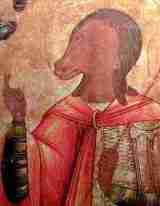
Hermetic apocalyptic literature makes Hermes Tat (Hermes Thoth) a form of the god Hermanubis (Hermes-Anubis). The latter god has the human body and dog/jackal head of Anubis and the wand and clothing of Hermes. Hermanubis plays also the role of Horus as the opponent of Typhon (Seth). The prophetic literature tell of the dark period brought by the Typhonians before a final cataclysmic battle. Some aspects of Hermanubis including his identity as "Son of God" and "Logos" anticipate Christian beliefs.


Hermanubis


St. Christopher of Egypt, the dog-headed saint.


Horse-headed Kalki

In a strange transformation though, latter Christian illumination of Revelation frequently portrays all the satanic hordes including the seven-headed dragon known as the "Beast" with canine heads. This may be due to the dog's relationship with the Underworld. In Norse myth, the wolf Fenrir is turned loose at the advent of the apocalypse.

Horse imagery seems to step in for the earlier canine theme. In Christian, Hindu and Tibetan Buddhist belief, for example, we find the messianic savior arriving on horseback, and sometimes even depicted as a horse or horse-headed man.

However, canine aspects persist in the Hindu and Tibetan Buddhist saviors although submerged below the surface. Kalki, for example, although an incarnation of Visnu is said to take on the destroying powers of Siva. This destructive aspect of Siva is represented by both Bhairava, a god shown accompanied by dogs and also sometimes depicted as a dog himself, and by Rudra.

Rudra is known in the Yajurveda as Svapati "Lord of the Dogs," and the Arthavaveda says that he is followed by howling dogs, so he seems like an early model for Bhairava. The destructive powers of Kalki are known as Ekadesha Rudra (Eleven Rudras). Similarly, Raudracakrin, the Shambhala savior-king, is known as Rudra with the Discus/Wheel. In Kalacakra texts, he is often said to be aided by Rudra in his battles, and apparently he is sometimes also referred to simply as "Rudra." Such destructive aspects also might be present in Apollyon, the Jewish Greek form of the name Apollo, which translates as "Destroyer." The god was closely associated with the wolf.

An eastern explanation might be found for this dog and horse imagery where both animals are often conflated with the primordial pantheistic god. We have seen this latter being can also be identified with the concept of cyclic time represented by the human body divided into five parts. Therefore we can suggest that the pantheistic God with the accompanying dog/horse aspects is identifiable with cyclic and deified time, thus explaining the animal imagery of the apocalyptic battlefield.

'Paradise Terrestrial'

Many traditions exist of end-times actors waiting patiently in the terrestrial paradise or the 'intermediate heaven' for the coming apocalypse. These persons are often said to have escaped death.

In China, Prince Moonlight and the King of Light reigned on the paradise island of Penglai. The Zoroastrians believed that immortal heroes awaited the final battle in Kangdez, where Bahram Varjavand would organize armies from Hind and Chin to fight the forces of evil.

A popular Christian tradition interpreted verses in Revelation concerning the "two witnesses" as applying to the biblical figures Enoch and Elijah, who never died according to tradition. The two witnesses are described as revealing prophecy and battling with the Antichrist before they are killed by the beast. Enoch and Elijah were said to live in the Garden of Eden until those fateful days.

It can be shown that, starting in the early medieval period and clearly established by the middle of that period, a sacred waiting-place of millennial warriors, both good and evil, was located at the eastern edge of insular and tropical Asia. The same place suggested here that the germ of these beliefs arose.

These locations include Kangdez, the fortress of heroes, and the Vourukasha Sea (Sea of Chin) where the great dragon awaited the last days; the Garden of Eden around which one could find Enoch, Elijah and Prester John; Bratayil, the island of al-Dajjal, the Muslim Antichrist, found somewhere in the East Indies; and Penglai the kingdom of Prince Moonlight and the King of Light.

Regards,
Paul Kekai Manansala
Sacramento

References

Eyma, Aayko and C. J. Bennett. A Delta-man in Yebu: Occasional Volume of the Egyptologists' Electronic Forum No. 1, Universal Publishers, 2003, pp. 240-4.

Eyre, Christopher J. Cannibal Hymn: a cultural and literary study, Liverpool University Press, 2002, pp. 82-3.

Muller, Kal. East of Bali: From Lombok to Timor, Tuttle Publishing, 2001, pp. 36-39.