Showing posts with label ayala museum. Show all posts
Showing posts with label ayala museum. Show all posts
Tuesday, August 11, 2009
Video: Gold of the Ancestors, the Surigao Treasure
This video shows part of a broadcast program featuring the story behind the Surigao Treasure discovered in northern part of the island of Mindanao in the Philippines. The Surigao Treasure is the most impressive collection of gold artifacts found in the country and dates back to the 10th - 13th century. The collection includes extraordinary gold belts and one items known as the "Sacred Thread" that may be the single most impressive solid gold personal ornament in the world. The Surigao Treasure is located at the Ayala Museum in Makati, a business district in Metro Manila, and also at the Central Bank of the Philippines.


Tuesday, June 24, 2008
Gold of Ophir
One of the most spectacular museum exhibits in the Philippines is display at the Ayala Museum in Makati (Metro Manila).
"Gold of Ancestors: Pre-Colonial Treasures in the Philippines," is found in the Special Collection Room of the Ayala, the country's finest museum. The display consists of mostly 10th to 13th century gold artifacts, particularly those belonging to the private collection of Leandro and Cecilia Locsin.
Many of the gold items show Indic or Tantric influence.

Garuda ornaments based on the mythical bird from Hindu-Buddhist mythology.

Object described as "anthropomorphic plaque" of a Lady or "Binibini"
One item, considered one of the most stunning artifacts, is called an upavita referring to the sacred thread worn by brahmins in India. However, from my knowledge the upavita or sutra is actually a thread, while the gold object is a large tubular sash-like object that could not go around the groin like an upavita.

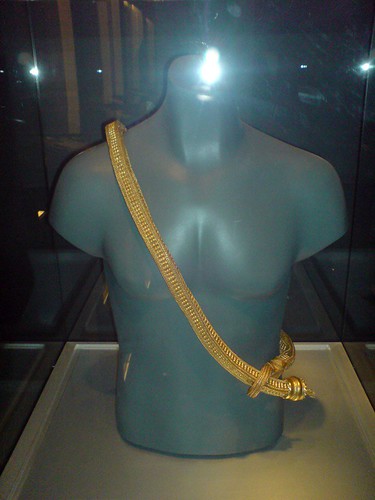
The "upavita" from the Ayala Museum (photo from Manuel Quezon III's album on Flickr).
Some other objects in the Ayala exhibit from Manuel Quezon III's album and from the Ayala Museum site:
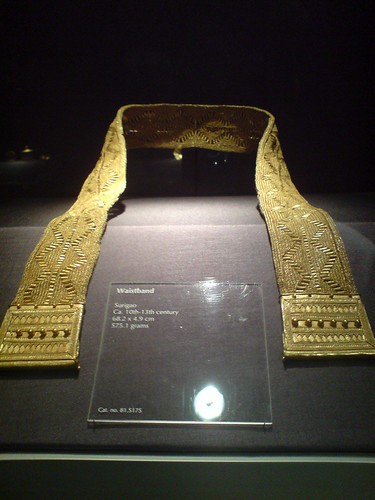
Gold belt

Described as a "kinnari," a half-woman, half-bird creature.
"Gold of Ancestors: Pre-Colonial Treasures in the Philippines," is found in the Special Collection Room of the Ayala, the country's finest museum. The display consists of mostly 10th to 13th century gold artifacts, particularly those belonging to the private collection of Leandro and Cecilia Locsin.
"Many of the precious objects were recovered in association with tenth to thirteenth century Chinese export ceramics."
Many of the gold items show Indic or Tantric influence.
Garuda ornaments based on the mythical bird from Hindu-Buddhist mythology.
Object described as "anthropomorphic plaque" of a Lady or "Binibini"
One item, considered one of the most stunning artifacts, is called an upavita referring to the sacred thread worn by brahmins in India. However, from my knowledge the upavita or sutra is actually a thread, while the gold object is a large tubular sash-like object that could not go around the groin like an upavita.
The "upavita" from the Ayala Museum (photo from Manuel Quezon III's album on Flickr).
Some other objects in the Ayala exhibit from Manuel Quezon III's album and from the Ayala Museum site:
Gold belt
Described as a "kinnari," a half-woman, half-bird creature.
Subscribe to:
Posts (Atom)


