Showing posts with label Suvarnadvipa. Show all posts

Sunday, September 12, 2010

More on migration of Tantric concepts

In 1977, the anthroposophist Pio Filippani-Ronconi suggested that elements of Ismaili Shi'ism appeared to have originated from the Vajrayana Tantric Buddhist doctrine in Tibet.  Specifically he compared the Vajrayana system of the five Dhyani Buddhas, also called Jinas and Tathagatas, to the Holy Family of Islamic mysticism -- the Five of the Mantle.  Indeed, one could favorably compare many elements, particularly in the areas of cosmology and numerology, within the Tibetan and Islamic mystical traditions, and furthermore extend these westward to the Kabbalistic traditions.

The five Dhyani Buddhas are transcendental enlightened beings (Buddhas) as compared to their earthly, human counterparts known as Manusa Buddhas.  Each of the Dhyani Buddhas is linked with a specific cosmic time cycle, and also with a "family" of beings and attributes.  The five-fold division of the cosmos in line with the Dhyani Buddhas recalls the Wuxing classification in China, but we will not pursue that lead in this article.

Dhyani Buddhas are particularly associated with the five primary colors -- white, blue, red, gold/yellow, and green.  

In Islamic mystic tradition, the Five of the Mantle (or Cloak) -- Muhammad; his daughter Fatima, her husband 'Ali; and the couple's sons al-Hasan and al-Husayn -- become primordial, transcendental beings in Twelver Shi'ism.  They are said to have existed before Creation and are linked with successive cosmic cycles in a manner remarkably similar to that of the Dhyani Buddhas.  Additionally, the five are associated with the "Five Lights" or "Five Colors" a reference to the human incarnations of these transcendental beings.

In Tibetan Buddhism, the five Dhyani Buddhas are combined with a sixth being -- the Adibuddha -- representing the pantheistic totality of the group.  Similarly in Islamic mystical tradition, the angel Gabriel becomes the "sixth of you five," which Henry Corbin describes as the "uni-totality" of the pentad.  In both the Tibetan and Islamic systems, this sixth member is associated with the element of the mind, as Vajrasattva (manas "mind") in the case of the Adibuddha, and as the Ruh Natiqa or "Thinking Spirit" in the Ismaili tradition.


Body of Light

The association of the Dhyani Buddhas and the Five of the Mantle with the five colors links conceptually with the belief found in both schools that spiritual adepts can attain a "body of light."

In the Dzogchen and Bonpo traditions of Tibet, this is known as the Rainbow Body or the Rainbow Light Body.   Upon the attainment of the highest yogic plane before death, the yogi dissolves into the "Five Pure Lights," i.e., the five primary colors of the rainbow achieving union with the Dharmakaya, the pantheistic godstuff.

The Sufi "body of light" or "resurrection body" is attained by the adept who completes a sacred itinerary that is generally thought of as imaginal in nature.  Actually the final part of the journey is that in which the devotee travels to union with the Divine in this subtle body of light.


The Inner and Outer Journey

Both the Tibetan and Islamic mystical traditions include concepts of a pilgrimage that the adept undertakes to attain spiritual transformation.

In the Tibetan case, there are clearly both real world along with imaginal sides to this tradition. The pilgrimage sites are real places that have been traditionally used as such including Kamarupa in Assam, the Gondavari River in South India, and the Himalayan range in Nepal and Tibet.  The only really exotic destination is Suvarnadvipa, which also happens to be a key location in this blog's research.

The Tibetan pilgrimage sites are divided into five major groups -- the pitthas, ksetras, chandohas, melapakas and smasanas -- and these are further subdivided by adding the prefix upa- to each major group.  Thus there are five groups of pilgrimage sites, ten in all including subgroups, that are said to correspond also to ten parts of the human body:

Suvarnadvipa is included in the group known as the upamelapakas, which are associated with the feet and the calves.  According to Jamgon Kongtrul, the inner journey of transformation begins interestingly enough from the head and then moves downward toward the feet.  Suvarnadvipa is found at the eighth stage of awakening and is associated with the sacred ground known as the "Higher Gathering Place."  The sacred grounds of the ninth and tenth stages are known respectively as "Cemetery" and "Higher Cemetery" suggesting that the adept is already passed on beyond this life.

The Sufi and Shi'a sacred journey is represented by the journey of the birds to the East toward Mt. Qaf, the eighth mountain in a system that consists of either nine or ten stages.  The birds never proceed beyond Qaf, which is known as the Footstool of God, for the next stages take the adept to the very Throne of God.

For the Sufi mystics also, the inner itinerary begins from the top, starting in the eyes according to al-Kubra then moving down into the face, the chest, and then the rest of the body.  Like Suvarnadvipa, the eighth stage of the Tantric pilgrimage, Mt. Qaf, the eighth sphere, was located in the furthest East.  Abassid tradition places it "behind," i.e. on the other side of the China Sea.


Kabbalah echoes

The Zohar, the central text of Kabbalah that dates back to 13th century Spain, also emphasizes a journey, mainly spiritual in nature, that the practitioner undertakes to reach Gan Eden -- the Garden of Eden, also known as Pardes.  There are actually two Garden of Edens -- a heavenly one that one attains to after death, and an earthly garden where the Shekinah is exiled.

The Shekinah is the female aspect of the Divine that remained in the Terrestrial Paradise after the banishment of humanity.  The Kabbalah adepts seek to rejoin the Shekinah via a sacred pilgrimage to the primordial garden through mystical paths known as Sephirot.  The Sephirot were likened to the organs of the human body, specifically that of Adam Kadmon, the Primordial Man.
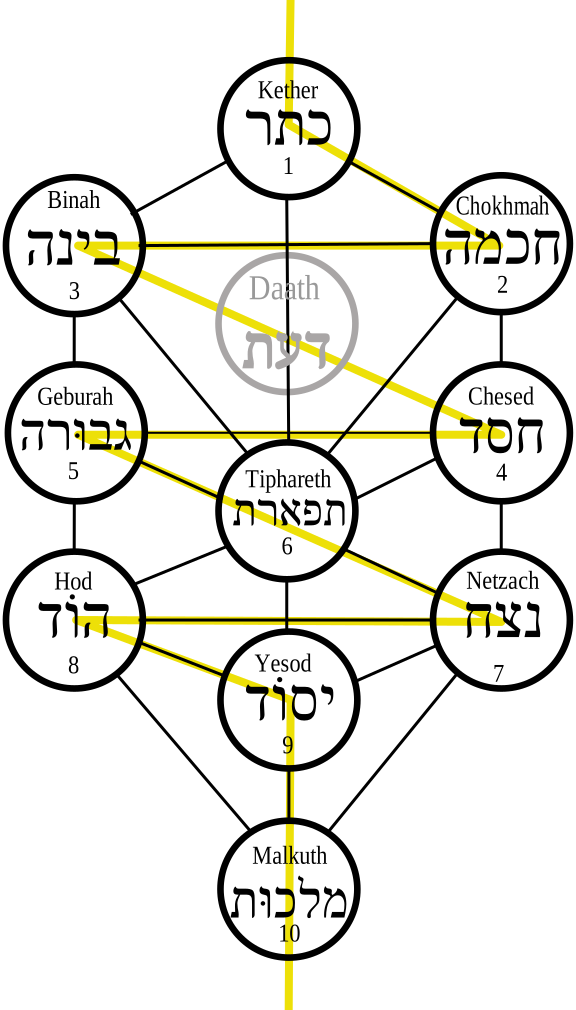
File:Tree of life hebrew.svg
The Sephirot shown in a traditional diagram. (Source:  http://en.wikipedia.org/wiki/File:Tree_of_life_hebrew.svg)


From Wikipedia:  "Metaphorical representation of the Five Worlds, with the 10 Sephirot radiating in each, as successively smaller Iggulim-concentric circles."


At the top of the body is the first Sephira, Keter, the crown of the head, while the tenth and last Sephira corresponding to Gan Eden is Malkuth, which also represents the feet of Adam Kadmon.  The Hebrew term malkuth is related to the malakut of Islamic mysticism with both words referring to the "realm of kings," an area on the border of the earthly and heavenly regions.


Although the sacred journey of Kabbalah was an inner one, the belief in a real world Gan Eden did exist.  According to medieval documents like the Hebrew letters of Prester John, the location of Gan Eden was 'India ha-gedolah or "Further India," the same area where one finds the Sambatyon River and the Lost Ten Tribes of Israel.

Evidence exists that at least some medieval Kabbalists undertook real journeys to these far-off locations.  For example, Abraham Abulafia attempted to find the Sambatyon River with the idea that he could help the world along toward the end times, but also to help undo the "knots" that hindered his own spiritual development. 


Echoes in the East

Suvarnadvipa (Island of Gold) in the Tibetan version of the spiritual itinerary would equate with the locations of Qaf and Gan Eden in the respective Islamic and Kabbalah traditions. As I have argued often here, the Ming Dynasty kingdom known as Lusung (Luzon) was the political and cultural heir to Suvarnadvipa and located in the same geographical political center.

Here we can still find the concept of cyclic and generational time represented in the image of a human body divided into five parts.  The body thus divided could represent five generations of a clan, and also the cycles of regeneration and reincarnation that existed in the previous belief systems.

I have also suggested previously that the sacred lands of Lusung were apparently divided in a quadripartite fashion based on the imagery of the human body.  Thus, we have place names like Olongapo or Ulo ng Apo "Head of the Lord." 

Another example of the human form representing the cosmos or at least the Earth can be seen in the Tausug house architecture that interlinks Earth, tree, house and human body.


http://i18.photobucket.com/albums/b121/kharl_prado/tausug.jpg

A diagram of a traditional pentagonal Tausug house made with nine posts that create an outline of a human body in the well-known squatting figure motif.  The tree acts as the umbilical cord of the Mother Earth extended by a rope tied to a central post.  After nine months, the period of human gestation, the rope is cut.  (Sources  http://media.photobucket.com/image/tausug%20nine%20square%20house%20numbers/kharl_prado/tausug.jpg)


The house with it's symbolic human figure represents the "child" of the Earth and thus is a copy of the world in microcosm. While the oldest form of the Austronesian house had four corner posts, a central post is often added symbolically to represent the center of the world.  Thus, the five posts create an imagery of the cosmos. In the Austronesian scheme of the base, trunk and tip, the base of the house is the bottom and thus one travels back to the "source" by going from top to bottom.  

In another sense, the mythical family of Pinatubo and Arayat can be compared to the Holy Family of the Mantle in Islamic tradition.  In the local folk legends, this family is often represented with five members, for example, Sinukuan and his spouse and their three daughters. However, an extensive review of the traditions would allow us to logically reconstruct the family as consisting of the two deities of Pinatubo and Arayat, standing for the Moon and Sun respectively;  a single child for each of these deities, more connected with the Earth, who are involved in a battle-courtship; and the offspring of the latter who again has an astronomical relationship representing Venus, the Morning Star.

Islamic mystical tradition normally equates Muhammad with the Sun; 'Ali with the Moon; Fatima with Venus; while the al-Hasan and al-Husayn are sometimes equated with the pole stars.  The emphasis on the luminaries and Venus to the exclusion of the other planets is quite telling. The astronomical links here are clearly associated with the association of these "families" with cyclic time.

We also hear of widespread beliefs surrounding the rainbow in the Philippine region .  In some cases, the rainbow was equated with the Supreme Deity, while elsewhere it is seen as the abode of God or the gods.  Sometimes it is viewed as a bridge or boat by which one reaches the Divine after death.  There was a belief that people who died a noble death by the sword, or who were devoured by crocodiles, or struck by lightning, became anitos (deified spirits) and were united with the pantheistic Deity in the rainbow, or through the vehicle of the rainbow.

In Pampanga, the pantheistic nature of the rainbow can be seen in its name pinanari "loincloth of the King" with the "king" here probably referring to the creative force Mangetchay.

Concepts of transformation are also included in the practice of obtaining a mutya, although in this case the transformation involves those still living on earth.  Mutya refers to a pearl or gem that shines and radiates light.  Grace Odal-Devora states: "...the inherent powers and virtues of the various mutya objects can be the basis for conceptualizing on the nature of the self – that starts from discovering the innate powers and inherent virtues within and using them to transform oneself and one’s society – like the transformation of the pearl from slime, mud, sand or dirt into a gem of light, beauty, healing and purity."


Regards,
Paul Kekai Manansala
Sacramento

References

Cooper, David A. The Ecstatic Kabbalah. Boulder, Colo: Sounds True, 2005.

Corbin, Henry. Cyclical time and Ismaili Gnosis, http://www.amiscorbin.com/textes/anglais/Corbin%20Cyclical%20Time.pdf.


Idel, Moshe. Studies in Ecstatic Kabbalah. SUNY series in Judaica. Albany: State University of New York Press, 1988.

Karma-gliṅ-pa, and W. Y. Evans-Wentz. The Tibetan Book of the Dead: Or, The After-Death Experiences on the Bardo Plane, According to Lāma Kazi Dawa-Samdup's English Rendering. Oxford: Oxford University Press, 2000.

Katz, Nathan. Indo-Judaic Studies in the Twenty-First Century: A View from the Margin. New York: Palgrave Mac Millan, 2007, 64-5.

Merkur, Daniel. Gnosis: an esoteric tradition of mystical visions and unions. SUNY series in Western esoteric traditions. Albany, NY: State Univ. of New York Press, 1993, 217-245.

Odal-Devora, Grace. 2006. Some problems in determining the origin of the Philippine word "mutya" or "mutia."  Paper presented at Tenth International Conference on Austronesian Linguistics. 1720 January 2006. Puerto Princesa City, Palawan, Philippines. http://www.sil.org/asia/philippines/ical/papers.html.

Reyes y Florentino, Isabelo de los.  Notes in order to familiarize myself with Philippine theodicy : the religion of the Katipunan which is the religion of the ancient Filipinos, National Historical Institute, 1980, 4, 6.

Sakili, Abraham P. Space and Identity: Expressions in the Culture, Arts and Society of the Muslims in the Philippines. Diliman, Quezon City: Asian Center, University of the Philippines, 2003.

Silliman, Robert Benton. Religious Beliefs and Life at the Beginning of the Spanish Regime in the Philippines: Readings. Dumaguete City, Philippines: Reproduced by College of Theology, Silliman University, 1964.

Wallace, Vesna A. The Inner Kālacakratantra A Buddhist Tantric View of the Individual. New York: Oxford University Press, 2001.

Zangpo, Ngawang, and Blo-gros-mtha'-yas . Sacred Ground: Jamgon Kongtrul on "Pilgrimage and Sacred Geography". Ithaca, N.Y.: Snow Lion Publ, 2001.


Thursday, March 26, 2009

Serlingpa: King of Suvarnadvipa

I have written previously about the introduction of the Kalacakra, the highest Tantric practice in Tibetan, Mongolian and Nepali Buddhism, into India from Shambhala.

Shambhala is equated with the kingdom known in Indian texts as Suvarnadvipa, and the agent who introduced the Kalacakra was none other than the Shamhbala king known as Kalki Sripala.

The mysterious kingdom of Shambhala gave rise to the fabled land known as Shangri-la from the 1933 novel Lost Horizon by British author James Hilton, and Shambhala has become focal point in many modern Western esoteric traditions. Madame Blavatsky and Nicholas Roerich, for example, emphasized the importance of Shambhala.

Shambhala became an important part of the "Great Game," the political intrigues particularly of the 19th and 20th centuries. The Russian imperial family including the Tsar had befriended the Lama Agvan Dorzhiev, who claimed that the Romanovs were the kings of Shambhala. Dorzhiev raised the suspicions of Lord Curzon, Viceroy of India, who thought that Russia might be conspiring with Central Asian nations to undermine British interests in India.

Baron von Ungern-Sternberg an anti-Bolshevik rallied Mongolians to fight the Soviet armies with the promise that they would be reborn in Shambhala. And during World War II, the Japanese after taking Inner Mongolia in 1937 attempted to gain Mongolian allegiance by claiming that Japan was Shambhala.


Serlingpa and the Kalacakra

Geshe Sopa, John Newman and others have suggested that Sripala is the same person known in Tibetan texts variously as Pindo (Pito), Dharmakirti, Dharmapala and Suvarnadvipi ("one from Suvarnadvipa.) The latter name is rendered in Tibetan as Serlingpa or Gserlingpa.

Serlingpa is described as a prince of Suvarnadvipa, while Sripala is listed in Kalacakra texts as the 17th king of the Kalki or Kulika (Tib: Rigden) lineage. Of all the kings of the ancient kingdom of Suvarnadvipa and its predecessors and successors, he is the best documented, and by a number of different traditions.

That Shambhala should be identified with Suvarnadvipa can be posited on a single argument as Tibetan texts describe the existence of the Kalacakra as only in Shambhala before it was introduced into India. The same tradition in some cases clearly suggests the existence of the Kalacakra in Suvarnadvipa without any explanation as to how it got there. And there is more than enough evidence to suggest that the Kalacakra was introduced to India from Suvarnadvipa, which would suggest that the latter is simply another name for Shambhala. Note these points:

  • In his history of Buddhism, Taranatha says that the Kalacakra was introduced into India by Pindo. Different sources claim that Pindo is one of the names of Serlingpa, the prince of Suvarnadvipa.

  • Atisha, the teacher who helped establish Buddhism in Tibet, says that he learned of the Paramadibuddha, the basic Kalacakra text, from the oral teachings of Serlingpa, who he also refers to as Pindo.

  • One of the oldest documents of the Tanjur, the second part of the Tibetan canon that consists of translations of older texts, is known as the Sri Kalacakra-garbhalankara. In the notes to a Peking manuscript of this text, authorship is ascribed to Pindo, "who was born in the land of the Southern Ocean." This ocean is generally associated with the world of Southeast Asia including Suvarnadvipa.

  • A prayer, from one of the two major lineages that have transmitted Tibetan Buddhism, and recorded by Bu ston calls on the blessings of "Kalki Sripala from the end of the Southern Ocean." According to this same lineage, it was Kalki Sripala who brought the Kalacakra to India.

  • According to both major transmission lineages, the Kalacakra came to India together with three major tantric commentaries. All three of these works cite the Paramadibuddha, the work taught to Atisha by Pindo , and two of them are called by names that Newman thinks can be translated as "a commentary according to the thought of Pindo."

  • From this evidence we can clearly see that: Serlingpa, who is also called Pindo and Kalki Sripala, is responsible for introducing the Kalacakra to India, and that he hails from Suvarnadvipa.

    Some aspects of the Kalacakra philosophy may have begun filtering in during 966 or 967 CE, but the main texts and traditions, which did not exist in India previously, were likely brought to that country by Serlingpa in 1012, the date on which the main Kalacakra astronomical calculations used in Tibet are based. It may be that this two-stage transmission accounts for some differences that exist between the two major transmission lineages.

    However, both lineages converge upon a person called Kalacakrapada the Elder, who according to the Rwa lineage inherits the Kalacakra doctrine from Pindo, while the 'Bro lineage has him receiving the knowledge from Kalki Sripala.


    Archaeological evidence

    Two sets of inscriptions from the Chola empire of South India may offer direct evidence of the existence of Serlingpa himself.

    Known as the Larger and Smaller Leiden Grants, these inscriptions tell of a king of Suvarnadvipa who builds a Buddhist shrine at Nagapattana in South India in the name of his father Culamanivarman. The Chola king Rajaraja grants a village for the upkeep of this shrine in the 21st year of his reign, or about 1005 CE. Centuries earlier, a Suvarnadvipa king had erected a Buddhist sanctuary at Nalanda in eastern India in the time of the Pala king Devapala.

    Now a work in the Tangur ascribed to Serlingpa states that it was written "on the request of king Sri Cudamanivarman, during the tenth year of the reign of Cudamanivarman, in Vijayanagara of Suvarnadvipa."

    The Sanskrit name Cudamanivarman is written in Tamil, as in the Leiden Grant, as Culamanivarman. Now given that Serlingpa was alive in 1005, these two references must be referring to the same king of Suvarnadvipa. And as Serlingpa is a prince of Suvarnadvipa who later becomes king, Culamanivarman should have been his paternal ancestor.

    Another manuscript of the Tangur found in Cordier's Catalogue calls the king Cudamanimandapa, while the Leiden Grant refers to the son who builds the Chola shrine as Sri Mara-Vivayottungavarman. So here again we see a variety of names as in the case of Serlingpa. The large number of names though is not unusual for royal personages who often have personal, throne, dynastic and other names usually as titles.

    Now the names Cudamanivarman and Cudamanimandapa might both be titles derived from the old kingdom known as Cudamani probably referring to Coda or Chola territory. Varman means "protector" and is often appended to the names of rulers, while "mandapa" would probably mean a temple or similar structure. It may be that these names or titles refer to the political relations between Suvarnadvipa and the Cholas that are mentioned in Sung Dynasty annals and in the work of Chinese geographer Ma Tuan-lin and referring to this period. In those works, Suvarnadvipa is known as Sanfotsi (Sanfoqi).

    The Sung annals state that the Sanfotsi king in 1003 sent envoys to China telling of a Buddhist temple that was built and said to be in honor of the Chinese emperor. This was very close to the time of the shrine built in South India, and the king at the time would have been Culamanivarman.

    Previously we have mentioned that the king of Suvarnadvipa-Sanfotsi was during this period using a policy of attraction to help in protecting his kingdom's age-old control of the Clove Route. We also hear from a temple inscription in Canton dated 1079 that the "Lord of Sanfotsi" had contributed funds toward the upkeep of not only Buddhist, but also Taoist temples in South China.

    According to Chinese records the throne would have passed from Culamanivarman to his son sometime befween 1003 and 1005 CE. Now when the teacher Atisha went to study under Serlingpa in 1012 or 1013, some sources call the latter "Lord of Suvarnadvipa," which could mean that he was the sovereign at the time. Thus, Serlingpa would have been the son of Mara-Vivayottungavarman, who was the son of Culamanivarman and the person who built the Buddhist shrine in Chola country.

    Taranatha mentions that Pindo brought the Kalacakra to India during the second half of Mahipala's lifetime. Newman thinks this Mahipala must be the Pala king with that name who reigned between 988-1038, but it's not impossible that Taranatha is referring to Kalki Mahipala, the father of Kalki Sripala (Serlingpa) according to Kalacakra tradition.


    Suvarnadvipa as learning center

    As early as the T'ang Dynasty, Chinese texts tell of a renowned Buddhist learning center somewhere in Insular Southeast Asia.

    The traveler I-Tsing (Yijing) describes this center in a place called Fo-hsi. The location of Fo-shi is important and he says that one travels there from Canton sailing toward the asterisms Yi and Tchen, which in the Chinese sidereal compass represent the directions between south-southeast and southeast. The explorer Kie Tan gives a detailed itinerary for the journey to Fo-hsi, which also locates it southeast of Canton. I-Tsing also calls Fo-Shi by the name Chin-chou "Gold Country," which is probably a translation of Sanskrit Suvarnadvipa.

    Al-Biruni tells us that Suvarnadvipa was known among the Muslims as Zabag -- a location widely seen by geographers as referring to what the Sung Chinese called Sanfotsi. We can verifym using the works closest to the date of Serlingpa, that these locations agree with the directions given for sailing to Fo-hsi during the T'ang Dynasty.

    For example, Mas'udi writing in 947 tells us that Zabag was located in the Sea of Champa, i.e. in the ocean adjacent to what is now known as Central Vietnam, and that beyond Zabag was a great ocean of unknown limits i.e., the Pacific Ocean. The same author tells us that Zabag was oriented toward the land of the Khmer, i.e., what is now Cambodia and southern Vietnam, in the same way that Sri Lanka is oriented toward Madurai in South India. That is to say that Zabag was to the east of the land of the Khmers across the sea.

    Sung Dynasty works like those of Zhao Rugua and Zhou Qufei clearly place Sanfotsi along the Eastern Ship Route. Because of the dangers posed by the coral islands and outcroppings now known as the Spratly and Paracel islands, Chinese mariners avoided crossing the middle of the South China Sea. Instead they either hugged the coast from Quanzhou in Fujian to Vietnam to the markets of Zhangcheng (Tonkin) and Zhenla (Cambodia) -- a course known as the Western Ship Route. Or they sailed due south from Quanzhou stopping at Taiwan and the Philippines before going further south toward Maluku.

    When Atisha came to study with Serlingpa, Suvarnadvipa was the center of a great trade empire. Earlier, near the end of the 7th century, Dharmapala, abbot of Nalanda university, is said to have ventured to Suvarnadvipa to study alchemy near the end of his life. In the 8th century, the South Indian monk Vajrabodhi studied for five months in Fo-hsi before traveling to China where he is said to have introduced Tantric Buddhism.

    However, we should note that despite its popularity with Buddhists there is evidence of a great deal of religious plurality in Suvarnadvipa. Already mentioned was the contribution made by the Suvarnadvipa king toward maintenance of both Taoist and Buddhist temples in 1079. In 983, we hear from Chinese records that "the priest Fa-yu, returning from lndia where he had been seeking sacred texts, arrived at Sanfotsi where he met the Hindu priest Mi-mo-lo-shih-li, who after a short conversation gave him a petition expressing his desire to visit the Middle Kingdom and translate sacred books there."

    Islamic writers, who elsewhere show much interest in religious practices, make no mention of the religion practiced in Zabag to this author's knowledge. Islamic terms for Buddhism like samani, budd, buddah, budhah, bahar, etc. are not used in describing Zabag, nor is any other specific term giving of the local religion with the exception that the inhabitants are sometimes called majus, which could be interpreted as "fire-worshipper."

    Again I would assign this to the king's policy of attraction and the general pluralistic society that existed at the time. We know, for example, that while Atisha studied in Suvarnadvipa, there were prophecies of his eventual journey to Tibet. And when his studies were completed, Serlingpa himself is said to have advised Atisha to "go to the north. In the north is the Land of Snows [Tibet]."

    Those who have followed this blog will know that I have suggested that the Suvarnadvipa king was interested in rallying Tibet and India behind his cause in stopping the Muslim juggernaut. Not because of any anti-Muslim viewpoint, indeed texts like the Arabian Nights and Buzurg ibn Shahriyar's Wonders of India indicate that Muslims found Zabag as a very friendly place. Also, I have suggested that the Suvarnadvipa king, under the identity of "Prester John," had actually conspired with Shi'ite Muslims to undermine the threat posed by Sunni expansion along the maritime trade routes.


    Works of Serlingpa and impact

    Besides his part in transmitting the Kalacakra doctrine, Serlingpa is credited with six original works that appear in the Tangur. The most impressive both in length of its title and content, and the scope of its exposition on Mahayana Buddhist philosopy is the Abhisamaya-alamkara-nama-prajnaparamita-upadesa-sastra-vritti-durbodha-aloka-nama-tika.

    Some of Serlingpa's sayings that have been preserved might give us some insight on this thinking and teachings. On suffering, Serlingpa taught:

    Adverse conditions are one's spiritual teacher,
    Ghosts and possessor spirits, the Buddha's emanations.
    Sickness is a broom clearing away negativity and obstructions,
    The sufferings are ornamentation of ultimate reality's expanse.
    These are the four thoroughly unenlightened factors,
    They are essential to tame places that are far from dharma [law],
    They are essential too in times of degeneration
    To help bear negative samsara [repetition] and its misguided ways.

    On the self and self-interest, Serlingpa teaches that one should instead focus on the other:

    Self is the root of [all] negative actions;
    It is the one thing to be discarded with decisiveness.
    The other is a source of enlightenment;
    It is the one thing to be embraced with enthusiasm.
    These two teachings condense those to be relinquished and their antidotes,
    They are vital in places afar from dharma
    They are essential too in times of degeneration,
    To help bear negative samsara and its misguided ways.

    Serlingpa's pupil Kamala was the author of nine works in the Tangur, but Atisha must be considered Serlingpa's most important student. Not only does it appear that Serlingpa had the greatest impact on the training of Atisha, but it was in his kingdom and under his advice that Atisha brought the Sarma lineages to Tibet when Buddhism was under repression by King Langdarma. In his biography, it is said that Atisa upon hearing the name of Serlingpa immediately clasped his palms together at his crown and tears would fall in remembering his teacher's kindness. He credited Serlingpa with leading him to bodhicitta, the desire for enlightenment to help other beings.

    Through his influence on Atisha and by introducing the Kalacakra philosophy, Serlingpa had a great impact on the development of the culture of modern Tibet, Mongolia, Bhutan, Nepal and parts of India; and indirectly on modern Western esoteric traditions.

    Regards,
    Paul Kekai Manansala
    Sacramento

    References

    Chattopadhyaya, Alaka, Atīśa, and Chimpa. Atīśa and Tibet; Life and Works of Dīpaṃkara Śrījñāna in Relation to the History and Religion of Tibet, [Calcutta]: distributors: Indian Studies: Past & Present, 1967.

    Newman, John. "A Brief History of the Kalachakra," in: Geshe Lhundup Sopa, et al.
    The Wheel of Time: The Kalachakra in Context, Deer Park Books, 1985, 51-90.

    Rost, Reinhold. Miscellaneous Papers Relating to Indo-China. London: Trübner & Co, 1886, 189-90.

    Tan Yeok Seong, "The Srivijaya inscription of Canton (A.D. 1079)", Journal of Southeast Asian History 5,2 (1964): 21.

    Saturday, April 12, 2008

    Setsuko Matoba: Zipangu and the Philippines

    Setsuko Matoba has written a book Zipangu and Japan, after doing extensive primary research of sources in Europe, that suggests that Marco Polo's Zipangu (Cipangu) was actually the Philippines rather than Japan. I had missed the announcement of this book when first released about seven months ago.

    Independently, I had come to the conclusion that Zipangu was a confused European conception of a continent that spanned the area from Japan, or at least southern Japan, southward through the Ryukyus, Taiwan, the Philippines all the way to the nutmeg and mace producing lands of the Moluccas.

    The "Golden Land" or Suvarnadvipa region of Zipangu would refer to the region now known as the Philippines.

    Here is the review of Zipangu and Japan that was published in the International Herald Tribune (Herald Asahi) last September.


    29 September 2007
    The International Herald Tribune (Herald Asahi)


    Although he never visited it, the Venetian voyager wrote about a land that was laden with gold

    It turns out he may have been wrong about the location

    Setsuko Matoba, a Madrid-based author, raises the intriguing theory that Zipangu could be a reference to the Philippines in her book "Zipangu and Japan" published last month by Yoshikawa Kobunkan Inc. Matoba arrived at the new interpretation after analyzing archives and maps from the Age of Geographical Discovery (the 15th century through the first half of the 17th century) that she came across during visits to libraries and convents in Spain, Portugal and Italy over the past 10 years. Most of the documents dated back to the 16th century. "I published the book because I hoped to bring to attention documents that were not familiar in Japan," she said. "Giving my own opinion was not what I intended to do." "The Travels of Marco Polo" was based on Polo's experiences and observations during his journeys across Central Asia and China

    Polo (1254-1324) was thought to have handed down the stories orally in Genoa, Italy, in 1298. They were then compiled into a manuscript, which was later translated into many European languages in and after the 14th century

    About 150 original manuscripts of Polo's renditions survive. But there is no mention of "Zipangu" in the earlier versions, according to Matoba

    Instead, the island that captured the imagination of medieval Europe was spelled in several ways, including Cipangu, Cipango, Zipangu, Siampagu and Cyampagu

    "The Travels of Marco Polo," published in Japanese by Heibonsha Ltd. in its Toyo Bunko (the Eastern Library) series, employs the term based on the spelling of Cipangu. "Zipangu" apparently appears in documents for the first time in the early 17th century. In "Chronicle of Churches in Japan," written in the 17th century, Jesuit missionary Joao Rodrigues of Portugal said there was no question that the Zipangu mentioned in "The Travels of Marco Polo" referred to Japan. He noted that Zipangu derived from "Jepuencoe" or "Jiponcoe," the Chinese way of pronouncing Japan. Rodrigues spent many years in Japan from the late 16th century

    Subsequent Jesuit missionaries accepted Rodrigues' view at face value. In turn, it became a mainstream theory in Europe, according to Matoba. Japanese scholars later subscribed to it

    To back up his claim, Rodrigues cited the fact that a huge armada of Mongolian ships under Kublai Khan had come to grief in waters off Japan during a terrible typhoon. The incident, one of two attempted Mongolian invasions of Japan, was mentioned by Polo in his book But details do not match historical facts

    Matoba offers this viewpoint: "Mongolia dispatched its fleet elsewhere as well." She said Polo could easily have been referring to an incident in Southeast Asia

    So where was Zipangu? The documents Matoba gathered suggest the island known by the name of Zipangu is in the tropics

    She noted frequent references to the Philippines, which Spain colonized in the 16th century with the lure of gold being a major factor. In contrast, there was no mention of gold in Japan. Moreover, ancient maps put Japan much further north. It was believed to be a peninsula, part of the Asian land mass, not an island nation, according to Matoba

    Her findings spurred her to postulate that "Zipangu" actually referred to the Philippines and its far-flung archipelago

    Takashi Gonoi, professor emeritus of the history of Christianity in Japan at the University of Tokyo, said he accepted her theory in principle. "It makes more sense if we think that (the island with gold) was a reference to a place other than Japan," Gonoi said. Charlotte von Verschuer, professor of Japanese history and philology at Ecole Pratique des Hautes Etudes in Paris, said Matoba's theory could answer longstanding questions among European scholars as to the location of gold-laden island if it was not Japan. But Masaaki Sugiyama, professor of the Mongolian history at Kyoto University, disagrees

    "The compilation of 'The Travels of Marco Polo' was completed in the latter half of the 14th century, not in the end of the 13th century," he said. "Under the name of Marco Polo, experiences of other people and stories they had heard were incorporated into it." "That is why there are contradictions in it," Sugiyama said, referring to incidents that are at odds with historical facts

    "It is possible that reports on Mongolia's expedition to the island of Java got mixed in with it. Still the outline matches that of the Mongolian expedition against Japan of 1281. There is no doubt that the island with gold was a reference to Japan." Sugiyama said that maps and documents pointing to the Philippines as the site of Zipangu referred to another location with a huge reserve of gold since Japan no longer produced the metal during the Age of Geographical Discovery. Matoba's theory has sparked a debate that may not die down easily. Even so, historians appear to agree on one thing: It raises questions about the veracity of the established theory.

    Wednesday, August 16, 2006

    Chryse (Glossary)

    Chryse, the "Golden One," is the name given by ancient Greek writers to an island rich in gold to the east of India.

    Pomponius Mela, Marinos of Tyre and the Periplus of the Erythraean Sea mention Chryse in the first century CE. It is basically the equivalent of the Indian Suvarnadvipa the "Island of Gold." Josephus calls it in Latin Aurea, and equates the island with biblical Ophir, from where the ships of Tyre and Solomon brought back gold and other trade items.

    Chryse is often coupled with another island Argyre the "Island of Silver" and placed beyond the Ganges. Ptolemy locates both islands east of the Khruses Kersonenson the "Golden Peninsula" i.e. the Malaya Peninsula. North of Chryse in the Periplus was Thin, which some consider the first European reference to China.

    In addition to gold, Chryse was also famed for having the finest tortoise shell in the world according to the Periplus. Large ships brought trade goods back and forth between Chryse and the markets at the mouth of the Ganges.

    Chin-lin

    In ancient Chinese literature, a mysterious region beyond their southern border in Annam was known as Chin-lin "Golden Neighbor" and the Southeast Asian border was also called the "Golden Frontier."

    When China invaded Annam (northern Vietnam) in the first century BCE, the kingdom of Champa fortified villages along the old caravan trail. This path became Route Colonial 9 during the French colonial period, and it was used by the Americans to build the McNamara Line of fortified bases during the Vietnam War.

    With this fortified line, the rugged Central Highlands and a policy of constant piracy, the Champa kingdom held the Chinese at bay for a thousand years. After the fall of the Chin dynasty in the 5th century, Cham raids on Tongking became so frequent that the governor appealed to the emperor for assistance. A war of attrition between China and Champa began that lasted until the rise of the T'ang dynasty.

    During this time though, China was well aware of the golden lands far to the south. The Buddhist pilgrim I-Tsing mentions Chin-Chou "Isle of Gold" in the archipelago south of China on his way back from India.

    Zabag and Wakwak

    In this blog, I have suggested that the kingdoms of Zabag and Wakwak, famed among the medieval Muslims as rich in gold, referred to the eastern islands of the Malay archipelago i.e. the Philippines and Eastern Indonesia.

    Zabag was based in what would later become the kingdom of Lusung.

    In this sense, the Philippines fits the bill as a gold-rich realm.

    The country has consistently ranked second in the world behind only South Africa in gold deposits per land area. The Philippines has historically been the largest producer of gold in Asia despite its relatively small size and the fact that until 1980 most gold was obtained only through small alluvial deposits.

    Although some ancient gold artifacts have been found in this region, they don't match the age suggested by linguistic reconstruction. Gold may have been mostly handed down from generation to generation rather than being used as a burial good item.

    In about the second century CE, there arose a practice of using gold eye covers, and then, gold facial orifice covers to adorn the dead resulting in an increase of ancient gold finds. More than a millennium later, the popularity of dental gold to decorate the teeth significantly increased the amount of gold found at archaeological sites.

    When the Spanish came they discovered an abundance of gold used among the people of the Philippine islands. Here are some relevant quotes:


    Pieces of gold, the size of walnuts and eggs are found by sifting the earth in the island of that king who came to our ships. All the dishes of that king are of gold and also some portion of his house as we were told by that king himself...He had a covering of silk on his head, and wore two large golden earrings fastened in his ears...At his side hung a dagger, the haft of which was somewhat long and all of gold, and its scabbard of carved wood. He had three spots of gold on every tooth, and his teeth appeared as if bound with gold.

    --- Pigafetta on Raja Siaui of Butuan during Magellan's voyage

    For brass, iron and other weighty articles, they gave us gold in exchange...For 14 pounds of iron we received 10 pieces of gold, of the value of a ducat and a half. The Captain General forbade too great an anxiety for receiving gold, without which order every sailor would have parted with all he had to obtain this metal, which would have ruined our commerce forever.

    --- Pigafetta on gold trade in Cebu


    Sailing in this manner, for some time, in 16° of north latitude, they were obliged by continual contrary winds, to bear up again for the Philippine islands, and in their way back, had sight of six or seven additional islands, but did not anchor at any of them. They found also an archipelago, or numerous cluster of islands, in 15 or 16 degrees of north latitude, well inhabited by a white people, with beautiful well-proportioned women, and much better clothed than in any other of the islands of these parts; and they had many golden ornaments, which was a sure sign that there was some of that metal in their country.

    --- Antonio Galvão in 1555 describing the journey of Bartholomew de la Torre in 1548


    "...the ore is so rich that I will not write any more about it, as I might possibly come under a suspicion of exaggerating; but I swear by Christ that there is more gold on this island than there is iron in all Biscay."

    --- Hernando Riquel et al., 1574

    In this island, there are many gold mines, some of which have been inspected by the Spaniards, who say that the natives work them as is done in Nueva Espana with the mines of silver; and, as in these mines, the vein of ore here is continouus. Assays have been made, yielding so great wealth that I shall not endeavor to describe them, lest I be suspected of lying. Time will prove the truth.

    --- Hernando Riquel et al. on island of Luzon, 1574


    There are some chiefs in this island who have on their persons ten or twelve thousand ducats' worth of gold in jewels--to say nothing of the lands, slaves, and mines that they own. There are so many of these chiefs that they are innumerable. Likewise the individual subjects of these chiefs have a great quantity of the said jewels of gold, which they wear on their persons--bracelets, chains, and earrings of solid gold, daggers of gold, and other very rich trinkets. These are generally seen among them, and not only the chiefs and freemen have plenty of these jewels, but even slaves possess and wear golden trinkets upon their persons, openly and freely.

    --- Guido de Lavezaris at al., 1574


    About their necks they wear gold necklaces, wrought like spun wax, and with links in our fashion, some larger than others. On their arms they wear armlets of wrought gold, which they call calombigas, and which are very large and made in different patterns. Some wear strings of precious stones--cornelians and agates; and other blue and white stones, which they esteem highly. They wear around the legs some strings of these stones, and certain cords, covered with black pitch in many foldings, as garters.

    -- Antonio de Morga, 1609

    "... the natives proceed more slowly in this ,and content themselves with what they already possess in jewels and gold ingots handed down from antiquity and inherited from their ancestors. This is considerable, for he must be poor and wrethced who has no gold chains, calombigas, and earrings."

    -- Antonio de Morga, 1609


    The Portugese explorer Pedro Fidalgo in 1545 found gold so abundant on Luzon the inhabitants were willing to trade two pezoes of gold for one pezo of silver.

    When the Portuguese first arrived, most of the gold traded into Brunei came from Luzon. That island was known as Lusung Dao or "Golden Luzon" to the Chinese who also traded for gold in this region.


    A golden Garuda dagger handle from Surigao, Philippines.

    Regards,
    Paul Kekai Manansala
    Sacramento

    References

    Legeza, Laszlo. "Tantric Elements in pre-Hispanic Philippines Gold Art," Arts of Asia, July-Aug. 1988, pp.129-136. (Mentions gold jewelry of Philippine origin in first century CE Egypt)

    Peralta, J.T. "Prehistoric gold ornaments from the Central Bank of the Philippines," Arts of Asia 1981, no.4, p.54.

    Villegas, Ramon N. Ginto: History Wrought in Gold, Manila: Bangko Central ng Pilipinas, 2004.